Tutorials
Nine studies to follow from start to end. The first eight are written in Python snippets that follow each other in one session and run in seconds to a minute each, at sizes chosen for that; the tests of morphoGen run them at each change, so that they stay correct. The ninth is a tour of the graphical interface, which runs the same functions from forms. Each page shows the figures of its own snippets.
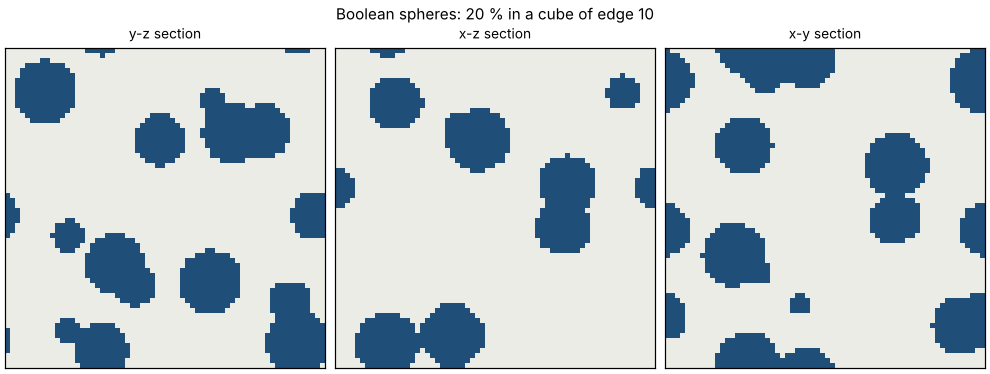
A whole study — SiC particles in an aluminium alloy, from the installation to a behaviour learned from its responses: generation (command line, Python, interface), measures against theory, percolation, apparent moduli and the size of the representative volume, a plastic loading path, exports for MFront, Abaqus and AMITEX_FFTP.
Start here. About a minute in all.
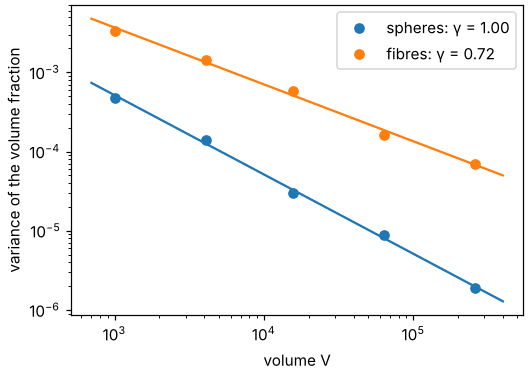
How large is a representative volume? — the statistics of Kanit et al.: the variance of a property against the volume for spheres, whose correlations are short, and for fibres on Poisson lines, whose correlations never stop; the volumes that a precision asks for; the windows of one large image; the conductivity and the bulk modulus of a composite from a configuration, with its report.
About half a minute.
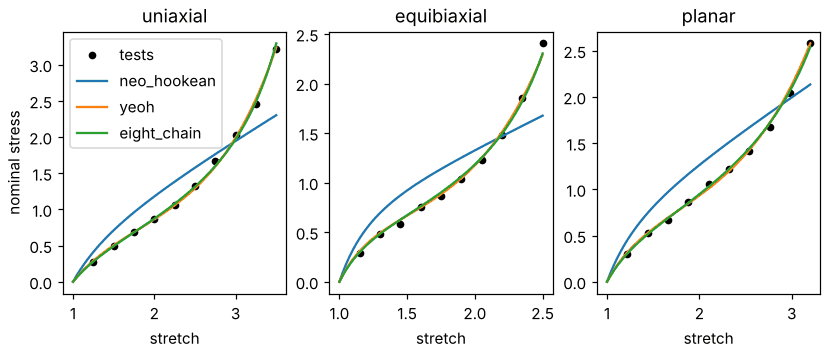
A rubber, from its tests to its tearing — the finite strains: a hyperelastic law fitted to three tests, the softening of Mullins at a material point, a filled rubber stretched by half its length, and a cracked strip that tears at the stretch of Rivlin and Thomas (the phase field in finite strains).
About two minutes.
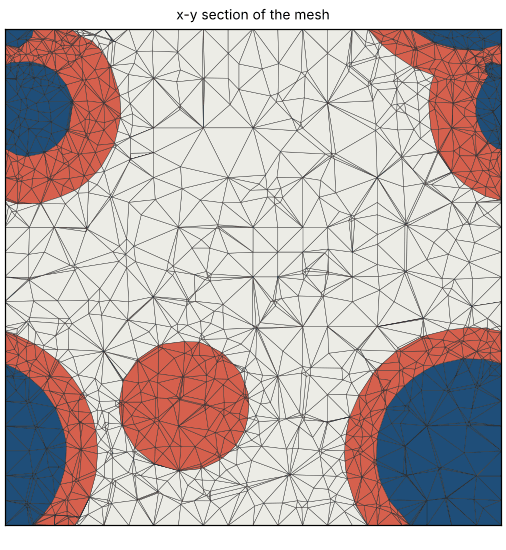
Exact geometry, from implicit functions to meshes — a composite of three phases from the implicit function of each phase to its sections, its surfaces (STL), its conforming mesh, and three solvers on the same geometry: voxels, finite elements, extended finite elements.
About forty seconds; needs the mesher MMG (extra mesh).
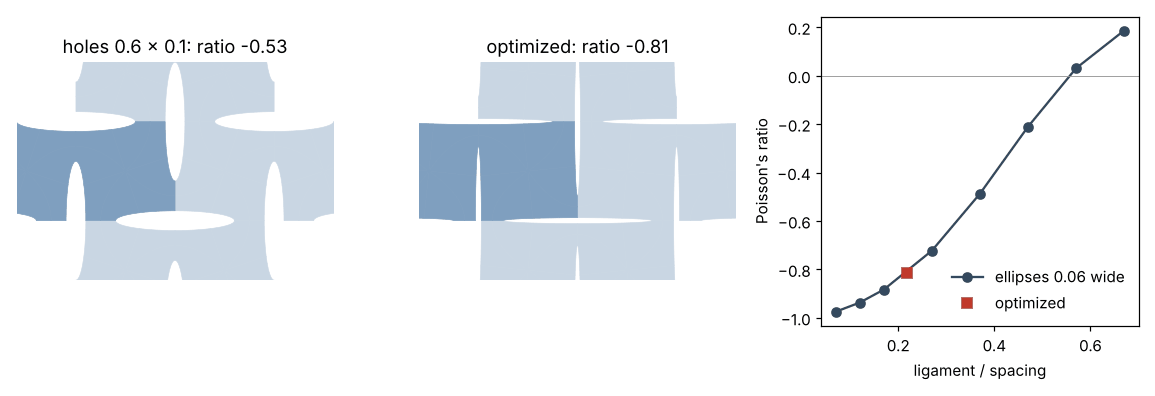
Isogeometric analysis, from a patch to an auxetic sheet — the geometry exact on NURBS patches: Lamé’s cylinder at the third order, periodic cells (square, hexagonal, cut along no straight line), the hole of largest bulk modulus on the bound of Hashin and Shtrikman, and a perforated sheet whose Poisson’s ratio the shape optimization brings to -0.8 at a given stiffness.
About twenty seconds.
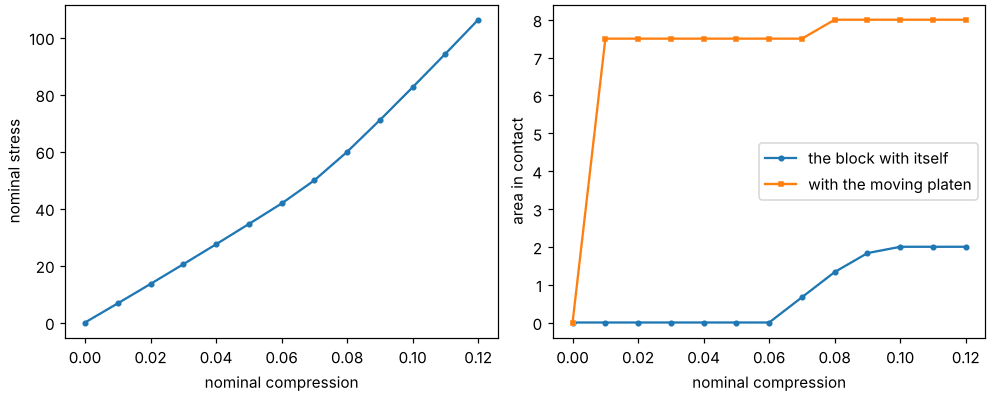
Contact and damage — a block with a flat pore crushed between two platens until the pore closes on itself, an indenter that reads its modulus, the walls of a periodic cell that touch along a loading path; then the damage laws at a material point (Lemaitre, Kachanov and Rabotnov, Mazars) against their closed forms, and a composite whose matrix fails.
About twenty seconds.
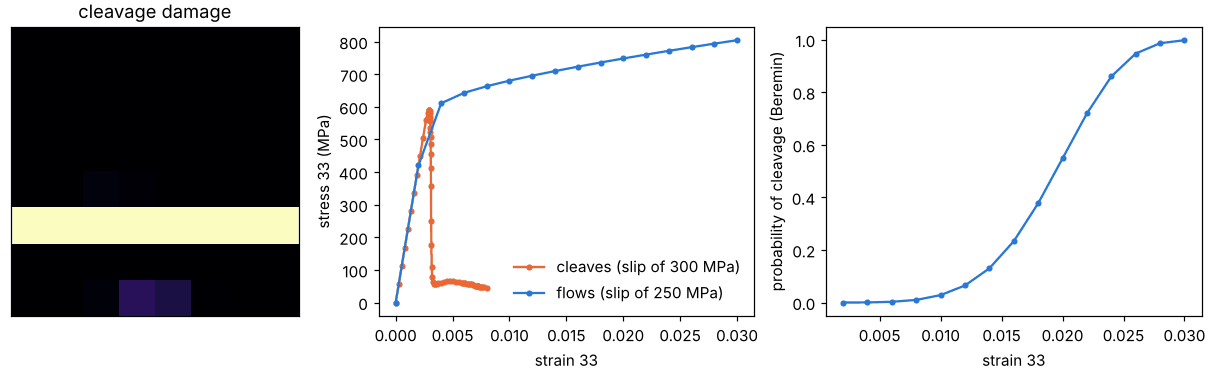
How a microstructure breaks — interfaces that debond at their strength and with their fracture energy, a pore that doubles the utilization of a cyclic load, a crystal of magnesium that twins one way and not the other and a textured polycrystal that keeps the asymmetry, a crystal and a polycrystal of iron that cleave, and the probability of cleavage by the local approach of Beremin.
About half a minute.
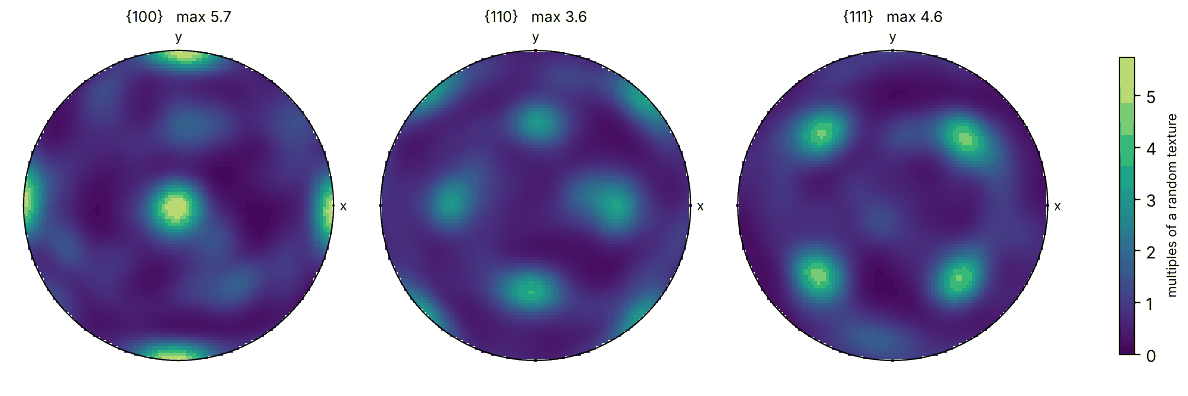
From an orientation map to a textured polycrystal — an EBSD map read with its axes, its grains and its texture (pole figures, the disorientations of the boundaries), the stiffness of its polycrystal, a tension in which its lattices turn, the fibres that a large extension forms, and a polycrystal of space with the texture of the map.
About twenty seconds.
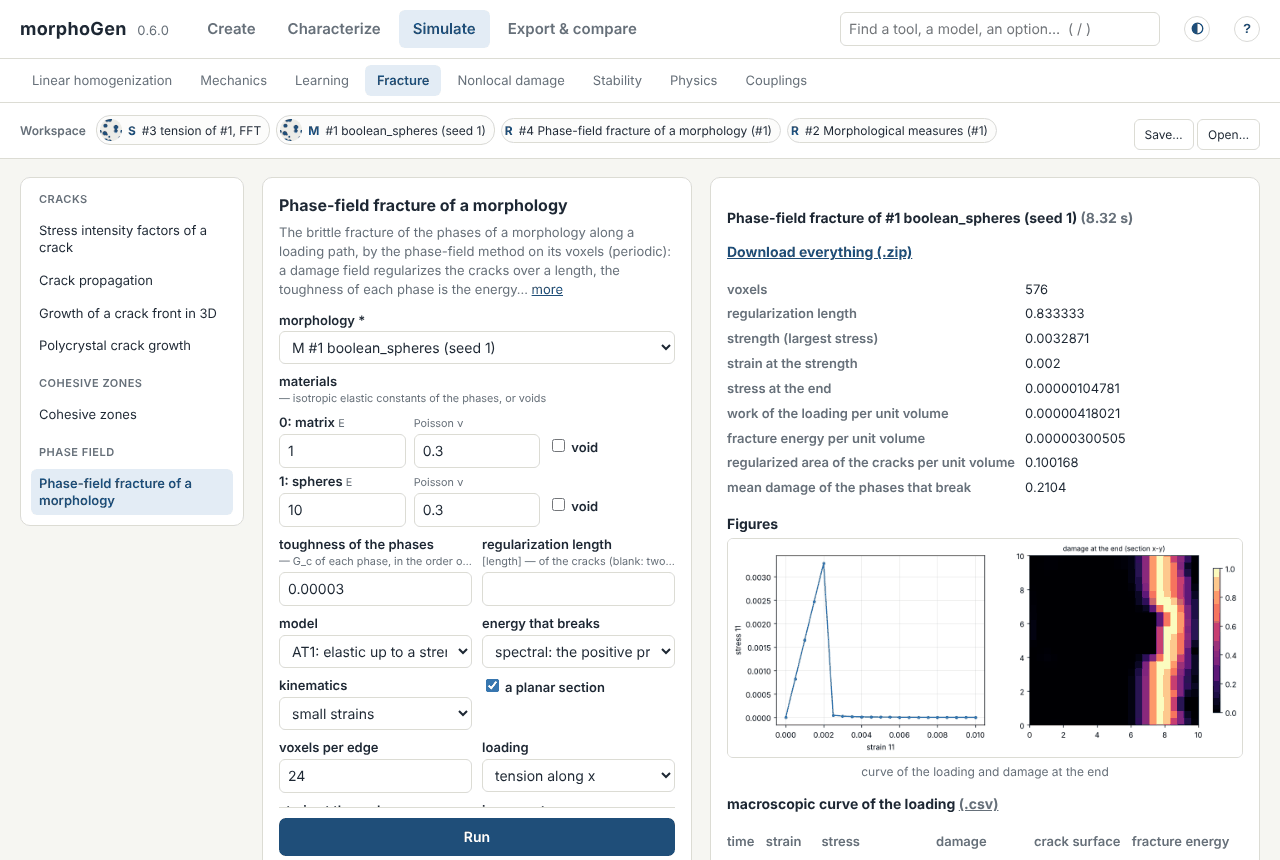
A study in the graphical interface — the menus, the workspace and the search of the page along a small study: a morphology, its measures, a loading path, a crack, its files.
No code. A few seconds per step.
What the tutorials do not cover is in the guide to the physics (every problem of the homogenization module, in snippets that the tests run too), the recipes (short answers to “how do I…”) and the gallery (a configuration to start from for each model and solver).