Gallery of examples¶
Each card below is one of the example configurations of morphoGen, its templates: the
image of its first realization, a line of description, the commands that reproduce it and
the configuration itself, to change at will. morphogen template lists them, morphogen template NAME -o NAME.yaml writes one, morphogen run NAME.yaml runs it (morphogen optimize for the topology optimizations, morphogen laser for the laser-architectured
sheets), and the graphical interface (morphogen gui)
opens the form of each model filled with its template. The tutorial walks
through a whole study; the configuration reference describes the configurations.
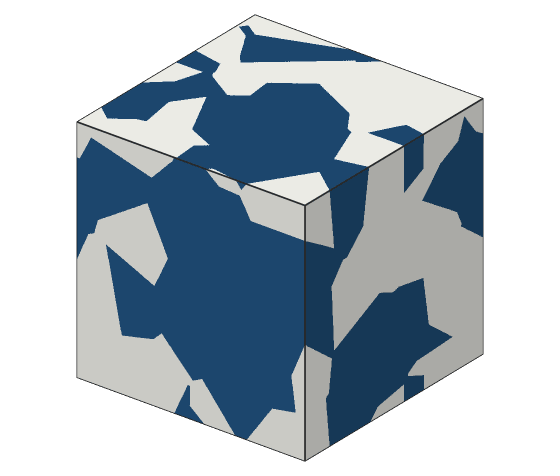
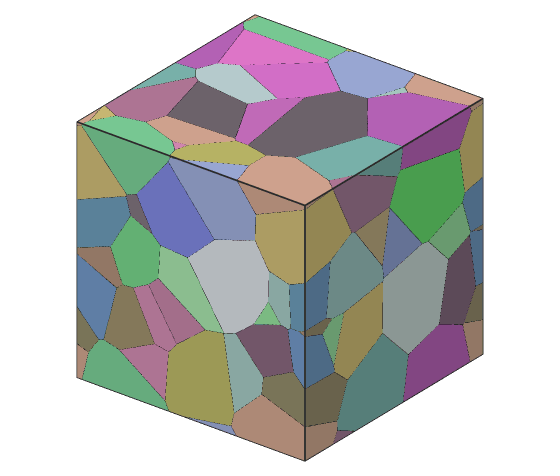
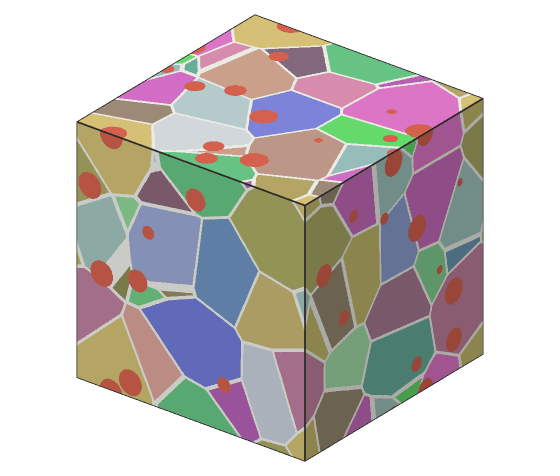
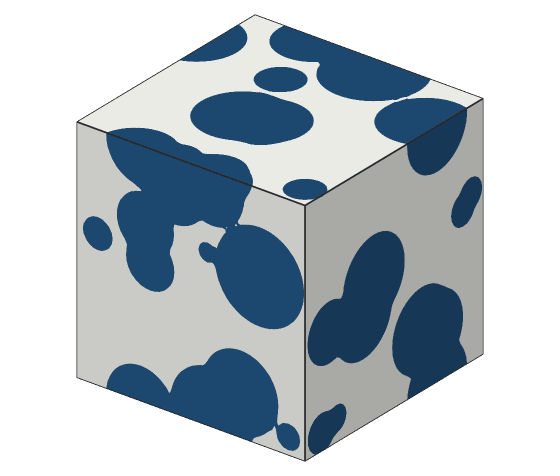
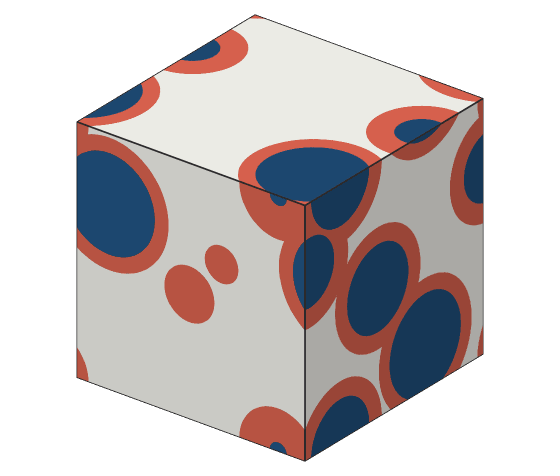
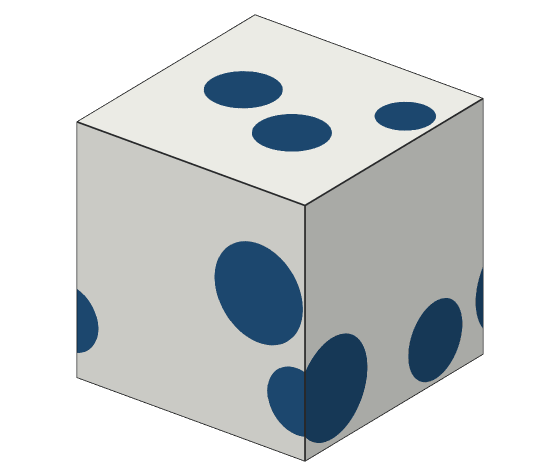
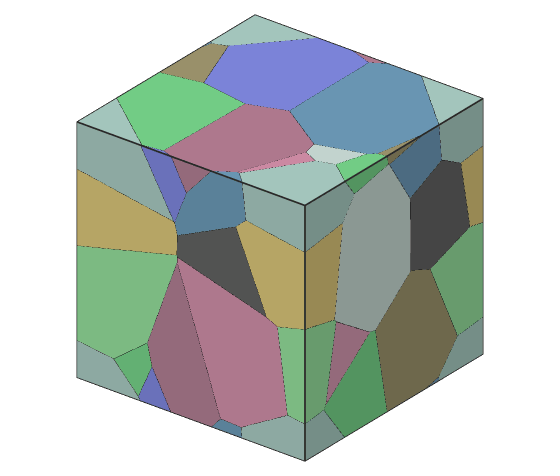
The images show the realization that morphogen run makes first (the realization 0 of the
seed of the template), in its domain: three faces of its box, each the section of the
microstructure computed in its plane, as the interface draws them (anti-aliased
interfaces, the colours of the phases, a colour per grain of a polycrystal). A planar
structure shows its x-y section, a template that studies a planar section of its volume
(voxels.section) that section, an optimization its design, and the thin structures that
the faces barely cut (the vascular tree, the aggregates, the networks of struts or fibres
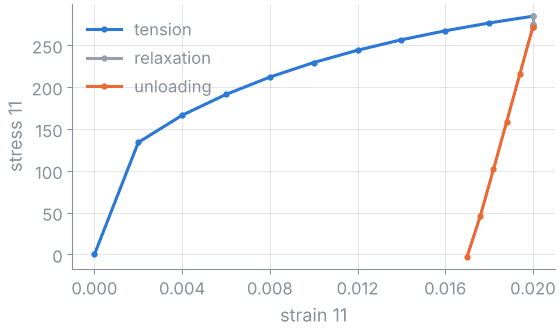
and the open foams) the surface of their phase 1 in 3D. Some cards show a second
figure, what the run of the template computes: the curve of its loading path, or the
damage of a cell that broke, drawn from the files of the run. They are written by
python docs/gallery/make_gallery.py, which writes this page too.
Point processes and Boolean models¶
Grains placed at random points: overlapping, penetrable or hard, clustered in aggregates, coated.
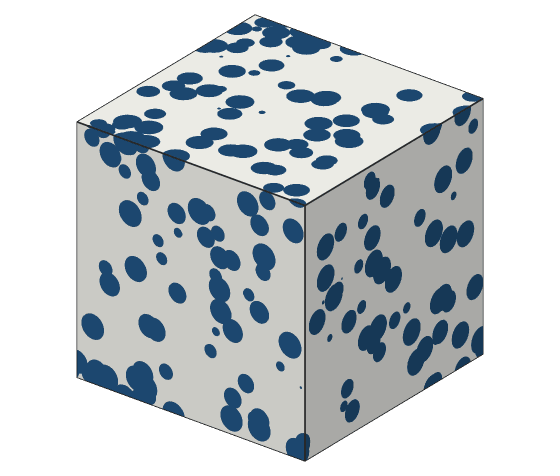
boolean_spheres — Boolean model of spheres: overlapping grains of a porous or granular medium, with its exact covariance and integral range.
morphogen template boolean_spheres -o boolean_spheres.yaml
morphogen run boolean_spheres.yaml
Configuration
# Boolean model of spheres: porous or granular medium with overlapping grains.
model:
  type: boolean_spheres
  radius: 1.0                  # or {type: lognormal, mean: 1.0, std: 0.2}
  volume_fraction: 0.3         # of the union of spheres (or give `intensity`)
domain:
  size: 20.0                   # cube edge (or [Lx, Ly, Lz])
  periodic: true
  unit: um
seed: 1
realizations: 2
voxels:
  voxel_size: 0.2
outputs:
  directory: out/boolean_spheres
  name: spheres
  geometry: [json, csv]        # json | csv | geo
  image: [vti]                 # vti | vtk | mhd | npz | npy | tif
  mesh:
    formats: [inp]             # inp | msh | vtu (others through meshio)
    phases: [0, 1]
analysis: [volume_fraction, specific_surface, connectivity]
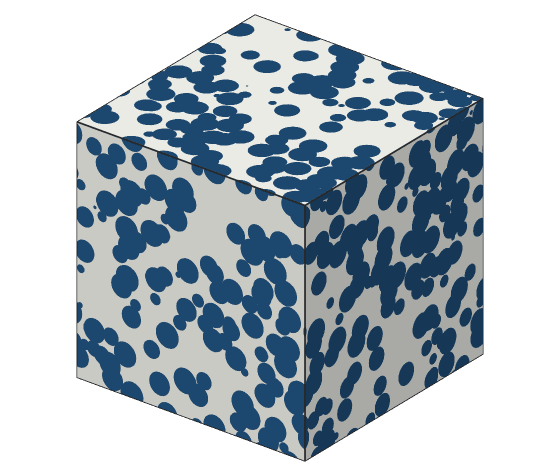
penetrable_spheres — Penetrable spheres with impenetrable cores (Torquato’s cherry-pit model), between the Boolean model and hard spheres.
morphogen template penetrable_spheres -o penetrable_spheres.yaml
morphogen run penetrable_spheres.yaml
Configuration
# Penetrable spheres with impenetrable cores, the cherry-pit model of Torquato (1984):
# spheres of radius R whose cores of radius 0.5 R do not overlap, between the Boolean
# model (impenetrability 0: fraction 1 - exp(-eta)) and hard spheres (1: fraction eta),
# eta being the number of spheres per unit volume times their volume.
model:
  type: penetrable_spheres
  radius: 0.5
  impenetrability: 0.5
  reduced_density: 0.6
domain:
  size: 10.0
  periodic: true
seed: 1984
realizations: 3
voxels:
  voxel_size: 0.05
outputs:
  directory: out/penetrable_spheres
  name: cherry_pit
  image: [vti]
analysis: [volume_fraction, specific_surface, connectivity]
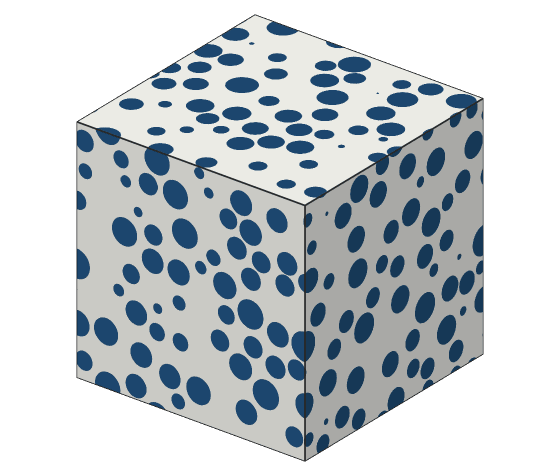
hardcore_spheres — Non-overlapping spheres by random sequential addition (jamming near 0.38).
morphogen template hardcore_spheres -o hardcore_spheres.yaml
morphogen run hardcore_spheres.yaml
Configuration
# Non-overlapping spheres by random sequential addition (jamming near 0.38).
model:
  type: hardcore_spheres
  radius: {type: uniform, low: 0.8, high: 1.2}
  volume_fraction: 0.3
  min_gap: 0.05
domain:
  size: 20.0
  periodic: true
seed: 3
voxels:
  voxel_size: 0.2
  supersampling: 2             # exported image holds partial volume fractions
outputs:
  directory: out/hardcore_spheres
  name: particles
  geometry: [csv]
  image: [vti]
  mesh:
    formats: [inp]
  periodic_pairs: true         # facing nodes on opposite faces, for periodic BCs
analysis: [volume_fraction, specific_surface]
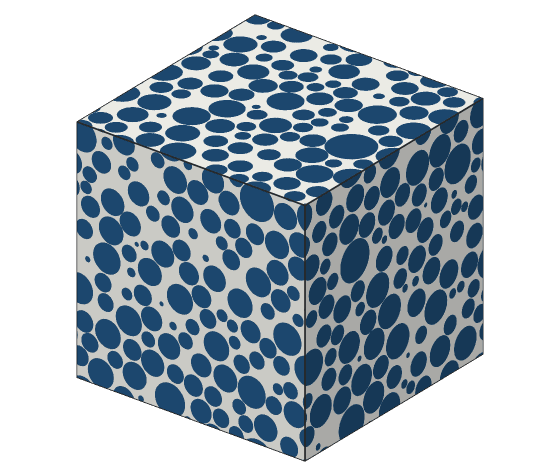
dense_packing — A dense random packing of hard spheres grown to 0.6 by the Lubachevsky–Stillinger algorithm.
morphogen template dense_packing -o dense_packing.yaml
morphogen run dense_packing.yaml
Configuration
# A dense random packing of hard spheres (Lubachevsky & Stillinger 1990): the spheres of
# a hard-sphere fluid grow until they reach their radii, here to 0.6, well beyond the
# random sequential addition (0.38); equal spheres jam near 0.64 (the maximally random
# jammed state of Torquato), polydisperse ones a little beyond.
model:
  type: hardcore_spheres
  method: lubachevsky_stillinger
  radius: {type: lognormal, mean: 0.5, std: 0.1}
  volume_fraction: 0.6
  growth_rate: 0.01            # slower: denser, and ordered for equal spheres
domain:
  size: 10.0
  periodic: true
seed: 1990
voxels:
  voxel_size: 0.05
outputs:
  directory: out/dense_packing
  name: packing
  geometry: [csv]
  image: [vti]
analysis: [volume_fraction, specific_surface, connectivity]
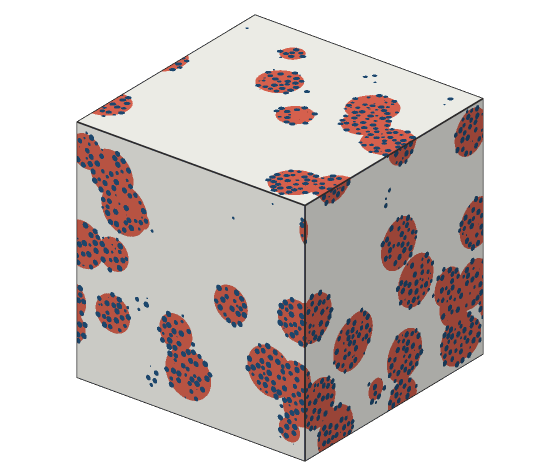
cox_nanocomposite — Particles clustered in the aggregates of a Boolean model (a Cox model), with a bound-rubber phase: carbon black in an elastomer.
morphogen template cox_nanocomposite -o cox_nanocomposite.yaml
morphogen run cox_nanocomposite.yaml
Configuration
# Nanocomposite: small particles clustered in aggregates, a Cox Boolean model of
# spheres whose germs fall in the phase 1 of a Boolean model of large spheres (carbon
# black or silica in elastomers: Jean, Jeulin et al. 2011). Non-overlapping particles
# (hardcore); the aggregates around them may form a phase of their own (bound rubber).
model:
  type: cox_spheres
  aggregates: {type: boolean_spheres, radius: 0.1, volume_fraction: 0.25}
  radius: 0.012
  local_fraction: 0.35         # fraction of the aggregates taken by the particles
  hardcore: true
  aggregate_phase: 2           # omit for two phases (particles in a matrix)
domain:
  size: 1.0
  periodic: true
seed: 11
voxels:
  shape: 192
outputs:
  directory: out/cox_nanocomposite
  name: nanocomposite
  geometry: [json, csv]        # csv: centres and radii of the particles
analysis: [phase_fractions, specific_surface]
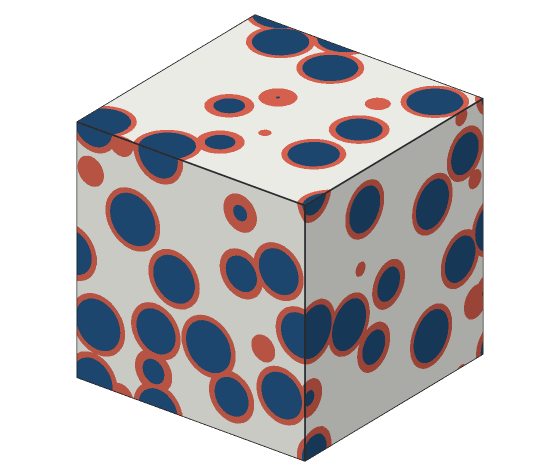
coated_spheres — Hard spheres with a coating of constant thickness: three phases, homogenized by FFT.
morphogen template coated_spheres -o coated_spheres.yaml
morphogen run coated_spheres.yaml
Configuration
# Spheres with an interphase: a coating of constant thickness around non-overlapping
# spheres (exact for unions of spheres and segments), three phases whose effective
# stiffness is computed by FFT. With side: inside, the spheres become hollow shells
# (core_phase 0), or core-shell particles (core_phase 3).
model:
  type: coating
  model: {type: hardcore_spheres, radius: 0.1, volume_fraction: 0.25}
  thickness: 0.02
  side: outside                # outside: a coating; inside: a shell
domain:
  size: 1.0
  periodic: true
seed: 5
voxels:
  shape: 96
homogenization:
  method: fft
  materials:
    0: {young: 3.0, poisson: 0.35}       # matrix
    1: {young: 70.0, poisson: 0.22}      # spheres
    2: {young: 10.0, poisson: 0.3}       # interphase
  properties: [stiffness]
outputs:
  directory: out/coated_spheres
  name: coated
analysis: [phase_fractions]
Dead leaves, Gaussian fields and reconstructions¶
Random sets defined through random functions, and a random set rebuilt from its correlation functions.
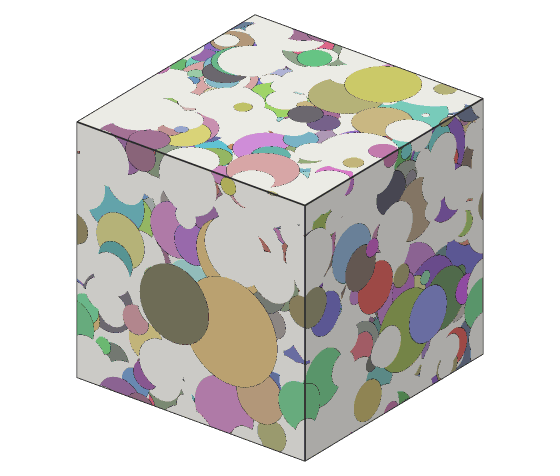
dead_leaves — Dead leaves of spheres: a two-phase mosaic of non-convex grains with random crystal orientations (Jeulin 1997).
morphogen template dead_leaves -o dead_leaves.yaml
morphogen run dead_leaves.yaml
Configuration
# Dead leaves of spheres (Jeulin 1997): each point belongs to the last sphere that fell
# on it. The visible parts of the leaves form a tessellation of non-convex grains, here
# two-phase and with random crystal orientations; the theory gives the probability
# that two points see the same leaf, the covariance and the integral range.
model:
  type: dead_leaves
  radius: {type: lognormal, mean: 0.08, std: 0.03}
  phase_fractions: [0.5, 0.5]
  crystal_orientations: true
domain:
  size: 1.0
  periodic: true
seed: 1997
realizations: 2
voxels:
  shape: 96
outputs:
  directory: out/dead_leaves
  name: leaves
  image: [vti]
  labels: [vti]                # visible leaves (grain ids)
analysis: [volume_fraction, specific_surface, cells]
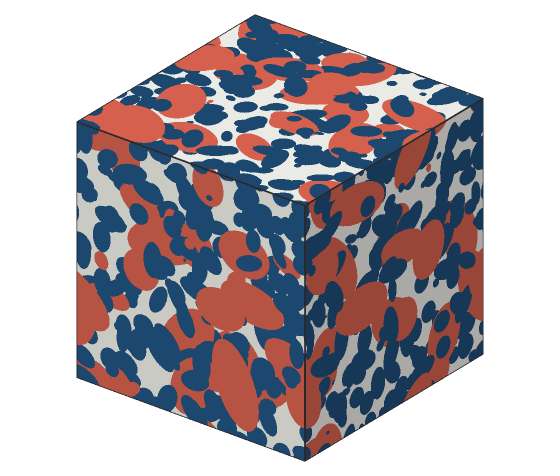
sequential_dead_leaves — Two families of spheroidal leaves, prolate and flat, falling on a background until it is covered 1.5 times.
morphogen template sequential_dead_leaves -o sequential_dead_leaves.yaml
morphogen run sequential_dead_leaves.yaml
Configuration
# Sequential dead leaves (Jeulin 1997): two families of spheroidal leaves, small and
# prolate (phase 1) or large and flat (phase 2), fall on a background (phase 0) until
# each point is covered 1.5 times on average: exp(-1.5) = 22 % of it stays uncovered.
# phase_fractions are the fractions of space of the leaves of each phase; the theory
# gives the fractions with the background, the covariances and the integral range.
model:
  type: dead_leaves
  shape: spheroid
  aspect_ratio: 2.0
  phase_fractions: [0.0, 0.6, 0.4]
  phase_radius: [0.05, 0.04, 0.09]
  coverage: 1.5
  background: 0
domain:
  size: 1.0
  periodic: true
seed: 1968
voxels:
  shape: 96
outputs:
  directory: out/sequential_dead_leaves
  name: leaves
  image: [vti]
  labels: [vti]                # visible leaves; the background is the last label
analysis: [phase_fractions, specific_surface, cells]
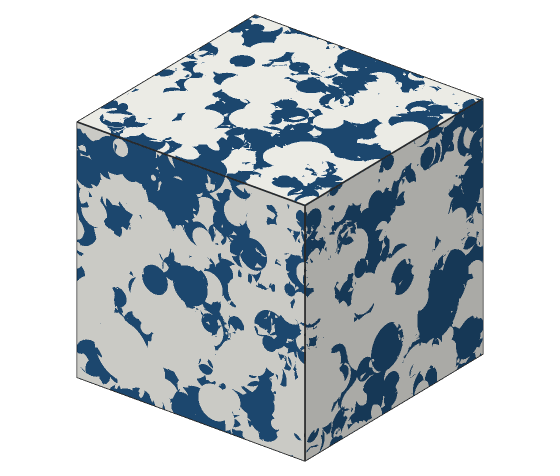
transparent_dead_leaves — The random function of transparent leaves of random grey levels, thresholded to a volume fraction of 0.35.
morphogen template transparent_dead_leaves -o transparent_dead_leaves.yaml
morphogen run transparent_dead_leaves.yaml
Configuration
# Transparent dead leaves (Jeulin 1997): spherical leaves of random grey levels fall on
# each other, each letting 1 - alpha = 60 % of what it covers show through; the random
# function they make is thresholded to a volume fraction of 0.35 (the threshold from the
# law of its series). Its mean, variance and covariance are exact; alpha = 1 gives the
# dead leaves.
model:
  type: transparent_dead_leaves
  radius: {type: lognormal, mean: 0.06, std: 0.02}
  transparency: 0.4
  values: uniform
  volume_fraction: 0.35
domain:
  size: 1.0
  periodic: true
seed: 1997
realizations: 2
voxels:
  shape: 96
outputs:
  directory: out/transparent_dead_leaves
  name: transparent
  image: [vti]
analysis: [volume_fraction, specific_surface, connectivity]
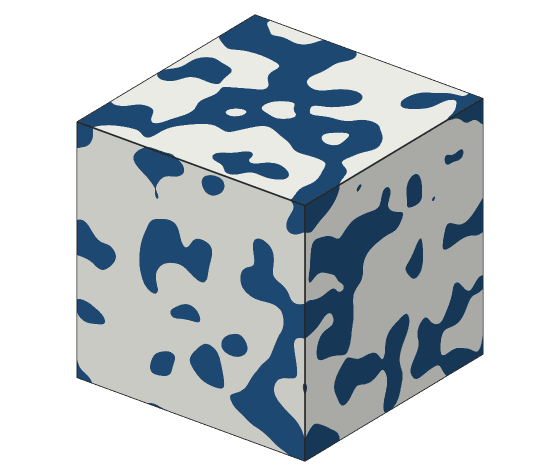
gaussian_excursion — Excursion set of a Gaussian random field: a bicontinuous porous medium.
Needs scikit-image (extra surface).
morphogen template gaussian_excursion -o gaussian_excursion.yaml
morphogen run gaussian_excursion.yaml
Configuration
# Excursion set of a Gaussian random field (bicontinuous porous medium).
model:
  type: gaussian_excursion
  correlation_length: 1.0
  volume_fraction: 0.4
domain:
  size: 16.0
  periodic: true
seed: 5
voxels:
  shape: 128
outputs:
  directory: out/gaussian_excursion
  name: field
  image: [vti]
  surface: [stl]               # needs scikit-image
analysis: [volume_fraction, specific_surface, connectivity]
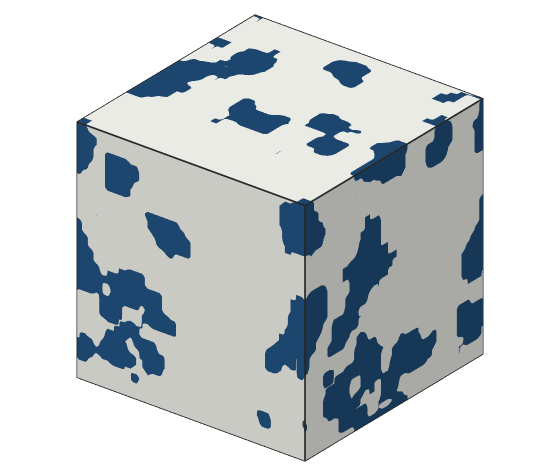
reconstruction — A Boolean model of spheres rebuilt from its two-point and lineal-path functions by simulated annealing (Yeong & Torquato 1998).
morphogen template reconstruction -o reconstruction.yaml
morphogen run reconstruction.yaml
Configuration
# Stochastic reconstruction (Yeong & Torquato 1998): a two-phase lattice annealed to the
# two-point probability S2 and the lineal-path function L of a realization of a Boolean
# model of spheres. S2 alone keeps the fraction and the correlations but not the
# connectedness along lines that L carries; compare the chords and the connectivity of
# the reconstruction with those of the reference (or set lineal_path: 0).
model:
  type: reconstruction
  reference: {type: boolean_spheres, radius: 0.08, volume_fraction: 0.3}
  lineal_path: 1.0             # weight of L in the energy, 0: S2 alone
  cell_size: 0.025
  sweeps: 60
domain:
  size: 1.0
  periodic: true
seed: 1998
voxels:
  shape: 40
outputs:
  directory: out/reconstruction
  name: reconstruction
  image: [vti]
analysis: [volume_fraction, specific_surface, chords, connectivity]
Fibres and layers¶
Straight, curved and bending fibres, with or without overlap, networks of fibres, and laminates.
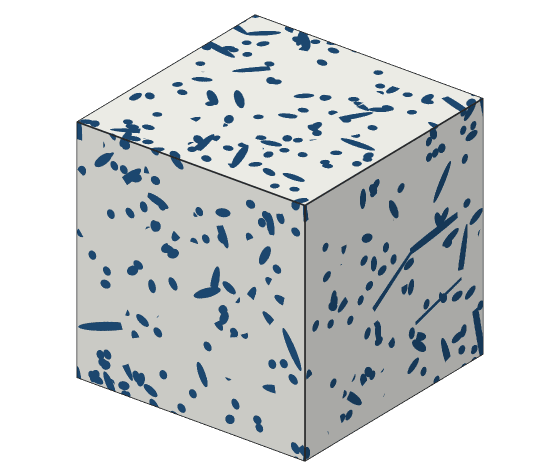
boolean_cylinders — Boolean model of finite fibres (cylinders or spherocylinders) of any law of orientations.
morphogen template boolean_cylinders -o boolean_cylinders.yaml
morphogen run boolean_cylinders.yaml
Configuration
# Boolean model of finite fibres (cylinders or spherocylinders).
model:
  type: boolean_cylinders
  radius: 0.5
  length: 8.0
  orientation: isotropic       # or {type: aligned, direction: [0, 0, 1]} / {type: planar, normal: [0, 0, 1]}
  caps: flat                   # flat | round
  volume_fraction: 0.15
domain:
  size: 30.0
  periodic: true
seed: 1
voxels:
  voxel_size: 0.15
outputs:
  directory: out/boolean_cylinders
  name: fibres
  geometry: [json]
  image: [vti]
analysis: [volume_fraction, specific_surface, connectivity]
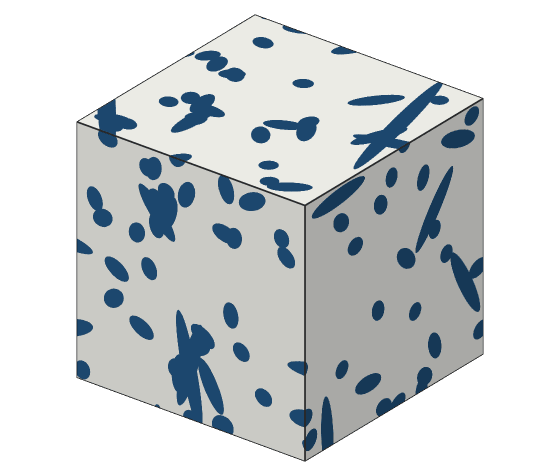
poisson_fibers — Infinite fibres on isotropic Poisson lines (Dirrenberger et al. 2014), in a non-periodic domain.
morphogen template poisson_fibers -o poisson_fibers.yaml
morphogen run poisson_fibers.yaml
Configuration
# Poisson fibres (Dirrenberger et al. 2014): infinite cylinders on isotropic Poisson lines.
# Infinite fibres cannot be periodic: the domain must be non-periodic.
model:
  type: poisson_fibers
  radius: 1.0
  volume_fraction: 0.16
domain:
  size: 30.0
  periodic: false
seed: 2014
voxels:
  voxel_size: 0.25
outputs:
  directory: out/poisson_fibers
  name: fibres
  geometry: [json, geo]        # geo: Gmsh script for conforming tetrahedral meshes
  image: [vtk]                 # legacy VTK (cell data), e.g. for FFT solvers
  mesh:
    formats: [msh]
    phases: [1]                # mesh the fibres only (porous medium)
analysis: [volume_fraction, specific_surface, connectivity]
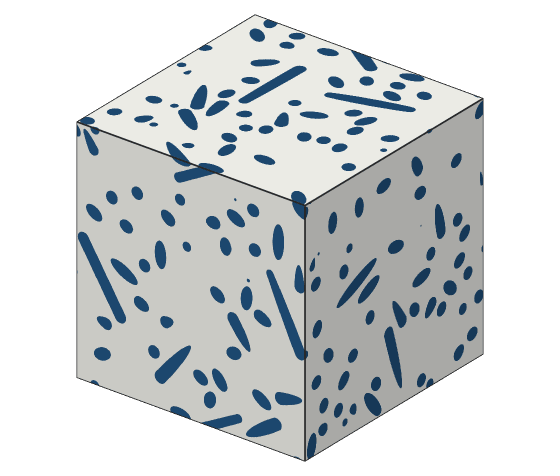
hardcore_fibers — Non-overlapping straight fibres by random sequential addition, at a minimal gap: a fibre-reinforced composite.
morphogen template hardcore_fibers -o hardcore_fibers.yaml
morphogen run hardcore_fibers.yaml
Configuration
# Non-overlapping straight fibres (spherocylinders) by random sequential addition: no two
# fibres closer than min_gap, a fibre-reinforced composite. The process jams at a
# fraction that falls as the fibres lengthen; aligned fibres pack further.
model:
  type: hardcore_fibers
  radius: 0.5
  length: 6.0                  # of the cylindrical part (aspect ratio 7 with the caps)
  orientation: isotropic       # or {type: aligned, direction: [0, 0, 1]} / {type: planar, normal: [0, 0, 1]}
  volume_fraction: 0.15
  min_gap: 0.1
domain:
  size: 20.0
  periodic: true
seed: 1
voxels:
  voxel_size: 0.1
outputs:
  directory: out/hardcore_fibers
  name: fibres
  geometry: [json]
  image: [vti]
analysis: [volume_fraction, specific_surface, connectivity]
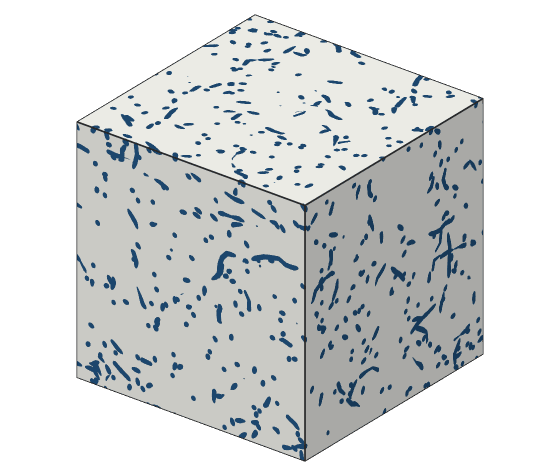
curved_fibers — Boolean model of curved fibres: worm-like chains whose tangents decorrelate along the contour.
morphogen template curved_fibers -o curved_fibers.yaml
morphogen run curved_fibers.yaml
Configuration
# Boolean model of curved fibres: worm-like chains of 12 straight segments whose tangents
# decorrelate as exp(-s / persistence) along the contour (nonwovens, entangled networks).
# A persistence much longer than the fibres gives straight fibres; a shorter one,
# tortuous fibres (theory: mean square end-to-end distance of the chain).
model:
  type: curved_fibers
  radius: 0.3
  length: 12.0                 # contour length
  persistence: 6.0
  segments: 12
  orientation: isotropic       # first direction; or aligned / planar
  volume_fraction: 0.1
domain:
  size: 30.0
  periodic: true
seed: 1
voxels:
  voxel_size: 0.15
outputs:
  directory: out/curved_fibers
  name: fibres
  geometry: [json]
  image: [vti]
analysis: [volume_fraction, specific_surface, connectivity]
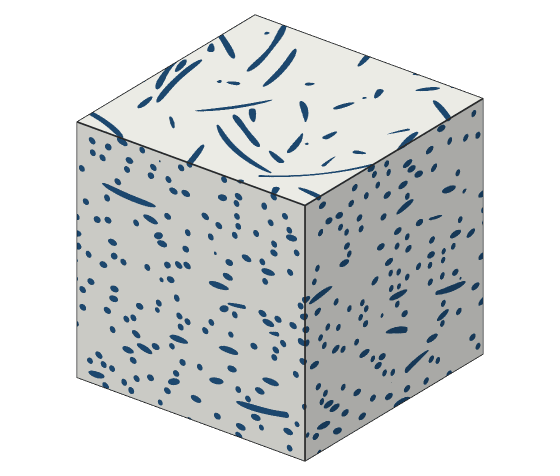
curved_arcs — Circular arcs of uniform radii of curvature without overlap, lying close to a plane, as the fibrous preforms of PuMA.
morphogen template curved_arcs -o curved_arcs.yaml
morphogen run curved_arcs.yaml
Configuration
# Curved fibres as in NASA's PuMA: circular arcs whose radii of curvature are uniform
# between 15 and 30, here without overlap (random sequential addition, no two fibres
# closer than min_gap), lying in planes close to xy as in fibrous preforms. Other shapes:
# shape: worm_like (persistent random walk, persistence) or helix (crimp: helix_radius,
# helix_pitch); overlap: true gives the Boolean model.
model:
  type: curved_fibers
  shape: arc
  radius: 0.5
  length: 16.0                 # contour length
  segments: 12
  curvature_radius: {type: uniform, low: 15.0, high: 30.0}
  orientation: {type: planar, normal: [0, 0, 1]}   # the tangents at the middles of the arcs
  overlap: false
  min_gap: 0.1
  volume_fraction: 0.1
domain:
  size: 40.0
  periodic: true
seed: 7
voxels:
  voxel_size: 0.25
outputs:
  directory: out/curved_arcs
  name: fibres
  geometry: [json]
  image: [vti]
analysis: [volume_fraction, specific_surface, connectivity, minkowski]
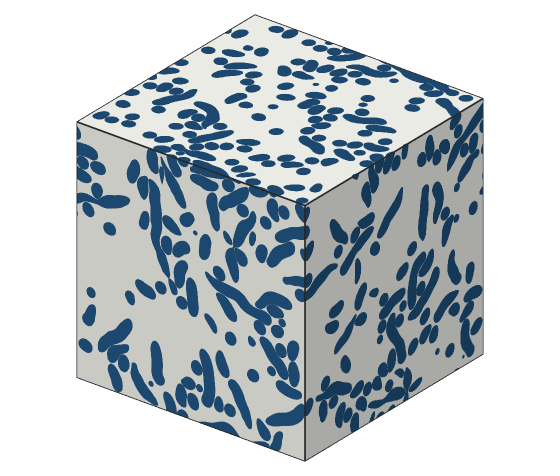
random_walk_fibers — Bending fibres packed without overlap by forces to 0.35 (Altendorf & Jeulin 2011).
morphogen template random_walk_fibers -o random_walk_fibers.yaml
morphogen run random_walk_fibers.yaml
Configuration
# Bending fibres without overlap at a high volume fraction (Altendorf & Jeulin 2011): random
# walks whose steps follow a von Mises-Fisher law between the main direction of their fibre
# (reliability kappa1) and the previous step (kappa2, the smoothness of the bending), packed
# by forces, repulsions of the overlapping segments against springs that keep their
# lengths and the angles of the joints, until no two fibres overlap. Up to about 0.5 for
# isotropic fibres of aspect ratio 11, more when aligned (beta -> 0).
model:
  type: random_walk_fibers
  radius: 0.5
  length: 10.0                 # contour length: aspect ratio (L + 2r) / 2r = 11
  orientation: {type: beta, beta: 0.5}   # Schladitz's beta law about z (1: isotropic)
  kappa1: 10.0
  kappa2: 100.0
  volume_fraction: 0.35
domain:
  size: 20.0
  periodic: true
seed: 1
voxels:
  voxel_size: 0.1
outputs:
  directory: out/random_walk_fibers
  name: fibres
  geometry: [json]
  image: [vti]
analysis: [volume_fraction, specific_surface, connectivity]
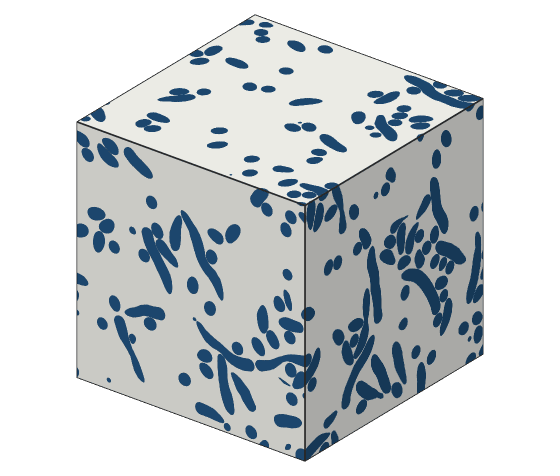
contact_fibers — The same bending fibres drawn into contact by contact forces (Keilmann, Redenbach & Willot 2026).
morphogen template contact_fibers -o contact_fibers.yaml
morphogen run contact_fibers.yaml
Configuration
# Bending fibres drawn into contact (Keilmann, Redenbach & Willot 2026): the random walks
# of Altendorf & Jeulin packed without overlap, then the pairs of fibres closer than the
# interaction distance (here half a radius, the paper's 1 voxel for a radius of 2) drawn
# together by contact forces against the springs of the fibres. The summary gives the
# contacts per fibre before and after the contact packing; the theory, Toll's estimate.
model:
  type: random_walk_fibers
  radius: 0.5
  length: 10.0                 # contour length: aspect ratio L / 2r = 10
  orientation: isotropic
  kappa1: 10.0
  kappa2: 100.0
  step: 1.0                    # segments of a radius (the paper's balls: 0.5)
  volume_fraction: 0.2
  interaction_distance: 0.25
domain:
  size: 20.0
  periodic: true
seed: 2026
voxels:
  voxel_size: 0.1
outputs:
  directory: out/contact_fibers
  name: fibres
  geometry: [json]
  image: [vti]
analysis: [volume_fraction, specific_surface, connectivity]
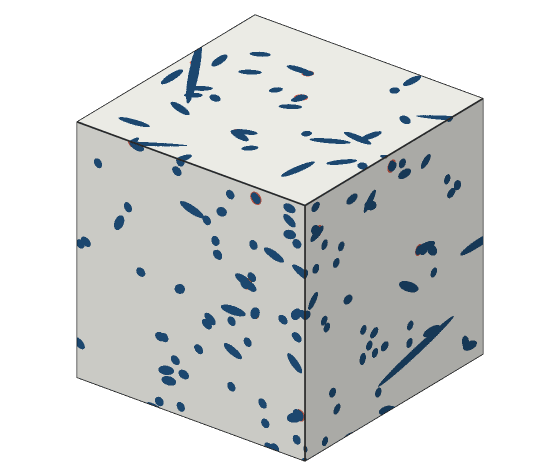
cross_linked_fibers — Entangled carbon fibres moulded about a plane, half their contacts bonded by epoxy cross-links (Chatti et al.).
morphogen template cross_linked_fibers -o cross_linked_fibers.yaml
morphogen run cross_linked_fibers.yaml
Configuration
# Entangled cross-linked fibres (Mezeix et al. 2009; Chatti et al. 2018, 2020): carbon
# fibres of 7 um at 8.5 %, long enough to cross the volume element (infinite fibres on
# Poisson lines: the domain must be non-periodic), gathered about the plane normal to the
# axis of compression by moulding (their Gaussian girdle, sigma = 0.4 rad), half their
# contacts bonded by epoxy cross-links (phase 2). Contacts 42 um apart along the fibres
# on average (39 um if isotropic; d / 2f = 41 um at small fractions), cross-links 84 um.
model:
  type: cross_linked_fibers
  radius: 3.5
  orientation: {type: girdle, sigma: 0.4, axis: [0, 0, 1]}
  volume_fraction: 0.085
  bonded_fraction: 0.5
  link_radius: 5.0
domain:
  size: 200.0
  periodic: false
  unit: um
seed: 2018
voxels:
  voxel_size: 1.0
outputs:
  directory: out/cross_linked_fibers
  name: fibres
  geometry: [json]
  image: [vti]
analysis: [volume_fraction, specific_surface, connectivity]
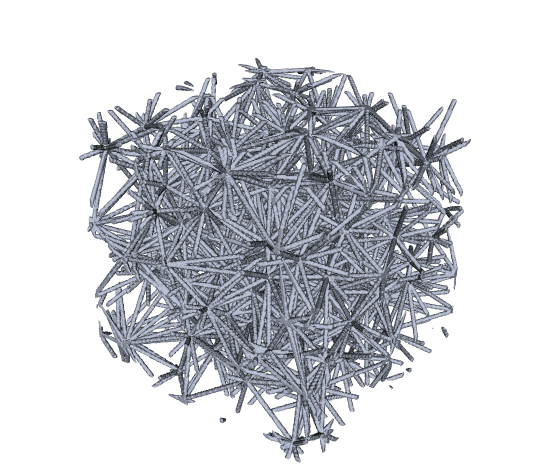
delaunay_network — A fibre network on the edges of the Delaunay triangulation of random points, cross-linked at every node (Ban et al. 2016).
morphogen template delaunay_network -o delaunay_network.yaml
morphogen run delaunay_network.yaml
Configuration
# Fibre network on the edges of the Delaunay triangulation of random points (Ban et al.
# 2016): fibres join the points whose Voronoi cells share a face, cross-linked at every
# node, about 15.5 fibres per node for Poisson points (2 + 48 pi^2 / 35), 6 in a plane
# (dimension: 2). The dual of the open foam (open_foam), far more connected.
model:
  type: delaunay_network
  n_points: 200                # exactly 200 nodes in the periodic box
  radius: 0.04                 # or volume_fraction: 0.1, solved on each realization
  regularity: 0.0              # least distance of the points (hard-core points), in jamming distances
  dimension: 3                 # 2: a planar network in the middle plane z of the domain
domain:
  size: 5.0
  periodic: true
seed: 1
voxels:
  voxel_size: 0.02
outputs:
  directory: out/delaunay_network
  name: network
  geometry: [json]
  image: [vti]
analysis: [volume_fraction, specific_surface, connectivity]
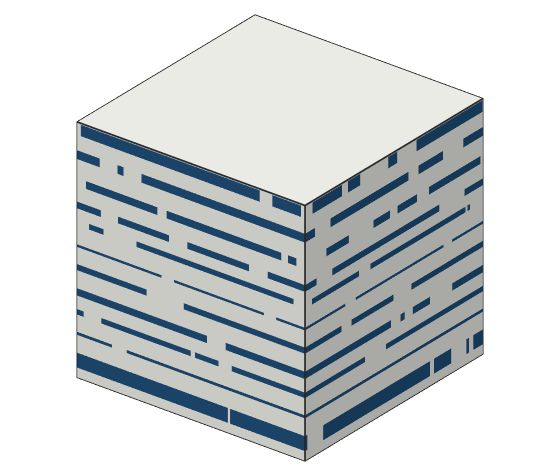
random_laminate — A nanolayered film: layers of lognormal thicknesses, the thinner ones broken up by holes (Bironeau et al. 2016).
morphogen template random_laminate -o random_laminate.yaml
morphogen run random_laminate.yaml
Configuration
# Nanolayered film (Bironeau et al. 2016): layers of two polymers of lognormal
# thicknesses stacked along z, the thinner layers (phase 1) broken up by holes covering
# 20 % of their area. Two scales of heterogeneity: the layers along z, the holes in the
# plane. Without holes, the variance of the volume fraction of a cube of edge L
# decreases as 1/L only (theory: integral_range_1d).
model:
  type: random_laminate
  thickness: {type: lognormal, mean: 0.1, std: 0.05}    # layers of phase 1 (um)
  spacing: {type: lognormal, mean: 0.3, std: 0.1}       # layers of phase 0
  axis: 2
  hole_fraction: 0.2
  hole_radius: {type: uniform, low: 0.1, high: 0.3}
domain:
  size: 5.0
  periodic: true
  unit: um
seed: 2016
realizations: 2
voxels:
  shape: 128
outputs:
  directory: out/random_laminate
  name: film
  geometry: [json]
  image: [vti]
analysis: [volume_fraction, specific_surface, chords, thickness]
Tessellations¶
Mosaics of cells: polycrystals, computed or measured, multiphase mosaics and closed cells.
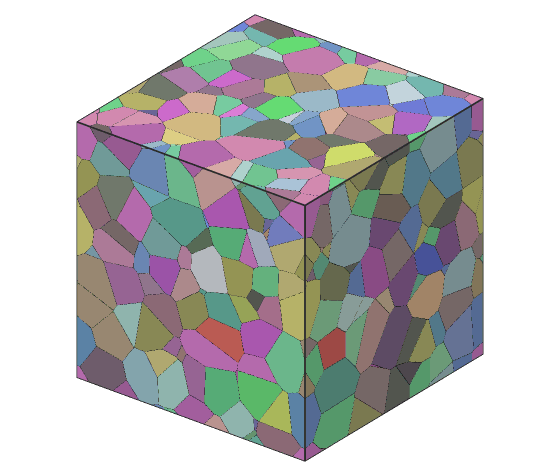
voronoi — A Poisson–Voronoi polycrystal of 343 grains with random crystal orientations.
morphogen template voronoi -o voronoi.yaml
morphogen run voronoi.yaml
Configuration
# Poisson-Voronoi polycrystal with random crystal orientations (Yang et al. 2019).
model:
  type: voronoi
  n_cells: 343
  crystal_orientations: true
domain:
  size: 1.0
  periodic: true
  unit: mm
seed: 7
voxels:
  shape: 64
outputs:
  directory: out/voronoi
  name: grains
  geometry: [json, csv]        # csv: germs, phases and Euler angles per cell
  labels: [vti]                # cell labels (grain ids)
  mesh:
    formats: [inp]
analysis: [cells]
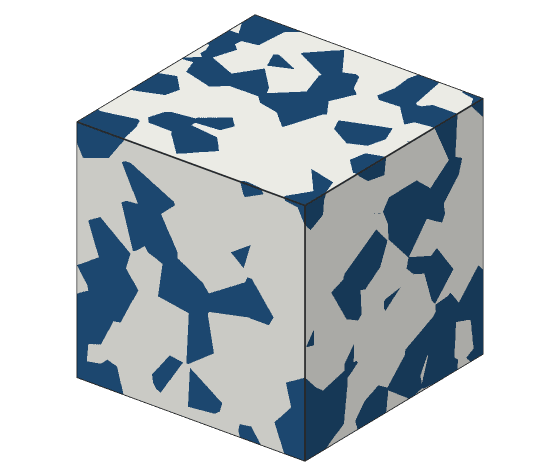
laguerre — A Laguerre (power) tessellation as a two-phase mosaic (Kanit et al. 2003).
morphogen template laguerre -o laguerre.yaml
morphogen run laguerre.yaml
Configuration
# Laguerre (power) tessellation; two-phase mosaic (Kanit et al. 2003 style).
model:
  type: laguerre
  intensity: 300.0
  radius: {type: uniform, low: 0.02, high: 0.08}
  phase_fractions: [0.7, 0.3]  # probabilities of phases 0 and 1 for each cell
domain:
  size: 1.0
  periodic: true
seed: 11
voxels:
  shape: 64
outputs:
  directory: out/laguerre
  name: mosaic
  image: [vti]
  labels: [vti]
analysis: [volume_fraction, cells]
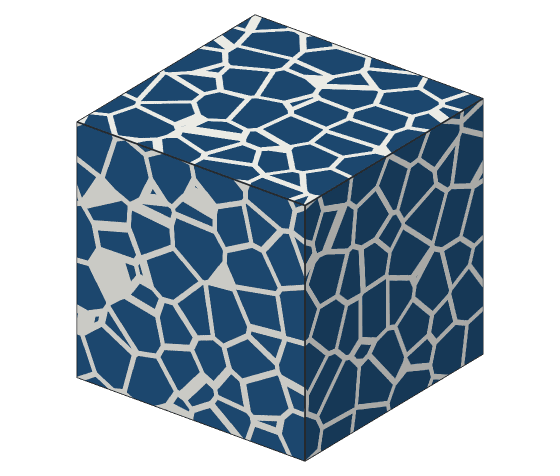
hyperuniform_cells — The walls of the Voronoi cells of stealthy hyperuniform germs: disordered but regular closed cells.
morphogen template hyperuniform_cells -o hyperuniform_cells.yaml
morphogen run hyperuniform_cells.yaml
Configuration
# A disordered hyperuniform closed-cell structure: the walls (a grain-boundary phase) of
# the Voronoi cells of stealthy hyperuniform germs (the collective coordinates of
# Torquato and coworkers: S(k) = 0 for the wave vectors of the box up to the radius that
# constrains 30 % of the degrees of freedom). Its cells are about ten times more regular
# than those of Poisson germs (the coefficient of variation of their volumes 0.04 against
# 0.42), while the structure has no long-range order.
model:
  type: voronoi
  n_cells: 200
  germs: stealthy
  stealthiness: 0.3
  boundary_thickness: 0.02
domain:
  size: 1.0
  periodic: true
seed: 2004
voxels:
  shape: 96
outputs:
  directory: out/hyperuniform_cells
  name: cells
  image: [vti]
  labels: [vti]
analysis: [volume_fraction, specific_surface, cells]
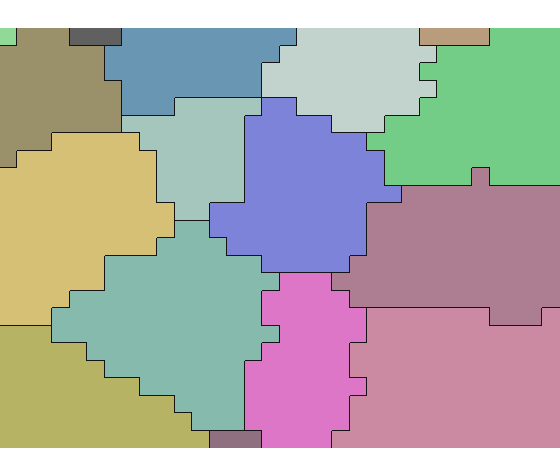
ebsd — A measured polycrystal: windows of an orientation map (EBSD, an .ang or a .ctf file), its grains found from the disorientations of its points, each with its mean orientation; their stiffness by FFT.
morphogen template ebsd -o ebsd.yaml
morphogen run ebsd.yaml
Configuration
# A measured polycrystal: windows of an orientation map (EBSD) as the realizations of a
# study. The grains of the map are its sets of neighbouring points less than 5 degrees
# apart; each has its mean orientation, and the elastic stiffness of the window is that
# of its crystals of nickel, by the FFT solver. The bulk modulus of a polycrystal of
# cubic crystals is (C11 + 2 C12) / 3 = 180.37 GPa for every window; the Young's moduli
# vary from a window to the next with the grains that it holds.
#
# The map is the demonstration map that comes with morphoGen (a section of a polycrystal
# as an acquisition would give it, written by examples/ebsd_map.py): put the path of an
# .ang or a .ctf file in its place, from the folder of this file.
model:
  type: ebsd
  file: ebsd_map.ctf
  threshold: 5.0               # degrees between two neighbouring points of one grain
  min_size: 5                  # points: smaller grains are given to their neighbours
  window: random               # origin: the window at the first corner of the map
domain:
  size: [16.0, 12.0, 0.5]      # um: a window of 32 x 24 points of the map
  periodic: false
seed: 2026
realizations: 4
voxels:
  voxel_size: 0.5              # the step of the map
homogenization:
  method: fft
  materials:
    1: {cubic: [246.5, 147.3, 124.7]}   # nickel, GPa
  properties: [bulk_modulus, shear_modulus, stiffness]
outputs:
  directory: out/ebsd
  name: ebsd
  image: [vti]
  labels: [vti]
analysis: [volume_fraction]
Foams and lattices¶
Architected materials: strut lattices, regular or not, hierarchical lattices, fractal sponges and foams.
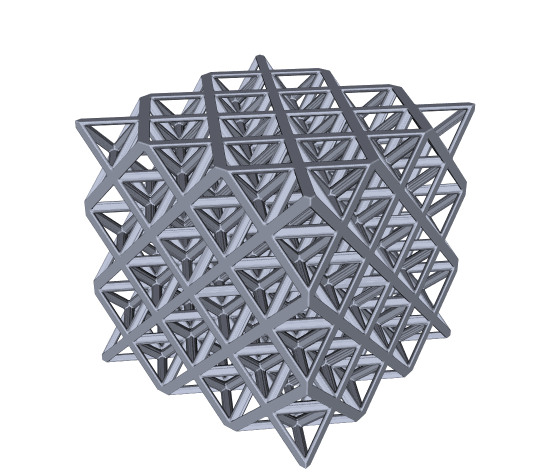
strut_lattice — An octet-truss strut lattice at 15 % relative density.
Needs scikit-image (extra surface).
morphogen template strut_lattice -o strut_lattice.yaml
morphogen run strut_lattice.yaml
Configuration
# Octet-truss strut lattice at 15 % relative density.
model:
  type: strut_lattice
  cell: octet                  # cubic | bcc | fcc | octet
  cell_size: 5.0
  volume_fraction: 0.15        # or strut_radius
domain:
  size: 15.0
  periodic: true
  unit: mm
voxels:
  voxel_size: 0.1
outputs:
  directory: out/strut_lattice
  name: octet
  geometry: [csv]              # struts: end points and radius
  surface: [stl]
  mesh:
    formats: [vtu]
    phases: [1]
analysis: [volume_fraction]
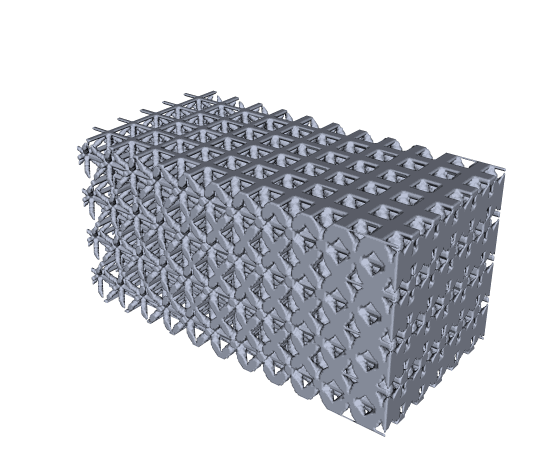
graded_lattice — An octet lattice graded along x and turned by 45° about z, with its STL surface for additive manufacturing.
Needs scikit-image (extra surface).
morphogen template graded_lattice -o graded_lattice.yaml
morphogen run graded_lattice.yaml
Configuration
# A functionally graded octet lattice for additive manufacturing: the strut radius grows
# linearly from 0.05 to 0.15 cell along x (relative density from about 0.11 to 0.68), the
# lattice turned by 45 degrees about z. A non-periodic sample (rotated and graded
# lattices are not periodic), its watertight surface written as STL.
model:
  type: strut_lattice
  cell: octet                  # cubic | bcc | fcc | octet | kelvin
  cell_size: 1.0
  radius_gradient: [0.05, 0.15]  # at the lower and upper faces along gradient_axis
  gradient_axis: 0
  rotation: [45.0, 0.0, 0.0]   # Bunge angles (degrees) of the lattice
domain:
  size: [8.0, 4.0, 4.0]
  periodic: false
seed: 1
voxels:
  voxel_size: 0.04
outputs:
  directory: out/graded_lattice
  name: lattice
  geometry: [json]
  image: [vti]
  surface: [stl]
analysis: [volume_fraction, specific_surface, connectivity]
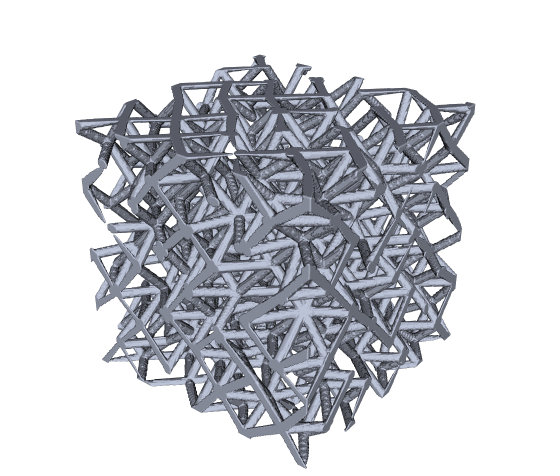
random_lattice — An octet lattice with missing struts and displaced nodes, and the rigidity of its framework (Maxwell–Calladine).
morphogen template random_lattice -o random_lattice.yaml
morphogen run random_lattice.yaml
Configuration
# Strut lattice with defects: octet-truss struts removed at random down to a mean
# coordination of 7 struts per node (at least 3 at every node), and nodes displaced by up
# to 10 % of the cell size. The rigidity of the pin-jointed framework is analysed
# (results.csv: mechanisms, self-stresses, floppy macroscopic strains): below a mean
# coordination of about 6 (Maxwell), macroscopic strains become floppy and the lattice
# turns bending-dominated. Use mesh and homogenization sections (see
# homogenization_gyroid) for its apparent moduli.
model:
  type: random_lattice
  cell: octet                  # cubic, bcc, fcc or octet
  cell_size: 1.0
  strut_radius: 0.07
  coordination: 7.0
  perturbation: 0.1
domain:
  size: 4.0                    # periodic: a whole number of cells
  periodic: true
seed: 2001
realizations: 3
voxels:
  shape: 96
outputs:
  directory: out/random_lattice
  name: lattice
  geometry: [json]             # struts, and the framework (nodes, struts, shifts)
  image: [vti]
analysis: [volume_fraction, connectivity]
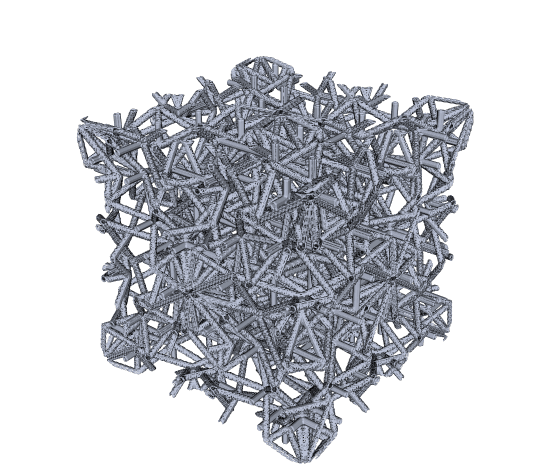
hierarchical_lattice — A hierarchical lattice of hollow tubes: frames of octahedra of generation 1 (Rayneau-Kirkhope, Mao & Farr 2012).
morphogen template hierarchical_lattice -o hierarchical_lattice.yaml
morphogen run hierarchical_lattice.yaml
Configuration
# Hierarchical lattice of hollow tubes (Rayneau-Kirkhope, Mao and Farr, PRL 109, 2012):
# the nodes of an fcc lattice joined by frames of generation 1, columns of regular
# octahedra whose compressed edges are tubes. Each generation lowers the exponent of
# the material needed to carry a load without buckling.
model:
  type: hierarchical_lattice
  cell_size: 1.0
  generations: 1
  cells: 3                     # octahedra per frame
  tube_radius: [0.012, 0.012]  # tubes of the frames of generation 1 and 0
  wall_thickness: 0.004        # hollow tubes (omit for solid ones)
  connections: nn+nnn          # octet truss (nn) and cube edges (nnn)
domain:
  size: 1.0
  periodic: true
voxels:
  shape: 256
outputs:
  directory: out/hierarchical_lattice
  name: frames
  geometry: [json]             # the tubes and their bores, regenerated exactly
analysis: [volume_fraction]
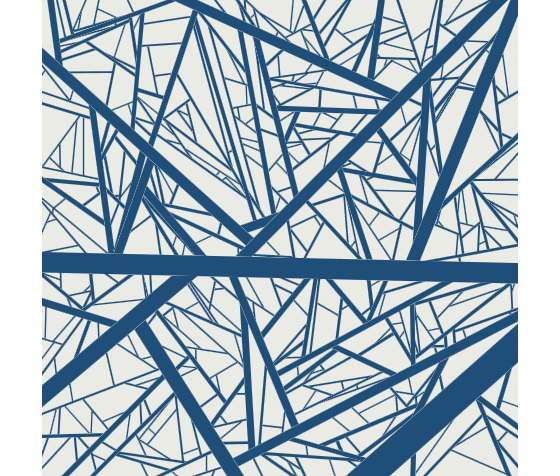
scale_rich_network — A scale-rich network: 500 ligaments of power-law thicknesses grown until they meet, at 40 % relative density (Both et al. 2026).
morphogen template scale_rich_network -o scale_rich_network.yaml
morphogen run scale_rich_network.yaml
Configuration
# Scale-rich network (Both, Chen, ..., Portela & Barabási, Nature 659, 345, 2026):
# ligaments lambda_0 t^-alpha thick grown one after another from points of the voids until
# they meet, so that their thicknesses, lengths and connectivities span orders of
# magnitude in one sample (power-law tails of exponents 1 + 1/alpha, 3 and 3). The network
# lies in the x-y plane and is extruded along z: a planar image one voxel thick, as the
# prismatic specimens of the paper (plane strain).
model:
  type: scale_rich_network
  n_ligaments: 500             # T, as the printed specimens of the paper
  decay: 0.5                   # alpha: 0 uniform thicknesses, 0.9 a few thick ligaments
  volume_fraction: 0.4         # solved on each realization (or initial_thickness: 0.06)
  # angles: [0, 90]            # aligned ligaments (default: uniform orientations)
  # pole: [0.5, 0.5]           # polarized: along the direction of the pole...
  # pole_angle: 90             # ...turned by 90 degrees: tangential, for...
  # polarized_fraction: 0.2    # ...the first 20 % of the ligaments
  # nucleation_gradient: [1, 4]  # nucleation four times denser at the upper face along x
  # frame: 0.005               # a frame of material: the sample as a periodic cell
domain:
  size: [1.0, 1.0, 0.001]
  periodic: false              # the ligaments end on the boundary of the box
seed: 1
voxels:
  voxel_size: 0.001            # the thinnest ligament, 0.06 / sqrt(500) = 0.0027 here
outputs:
  directory: out/scale_rich_network
  name: network
  geometry: [json]
  image: [vti]
analysis: [volume_fraction, specific_surface, connectivity]
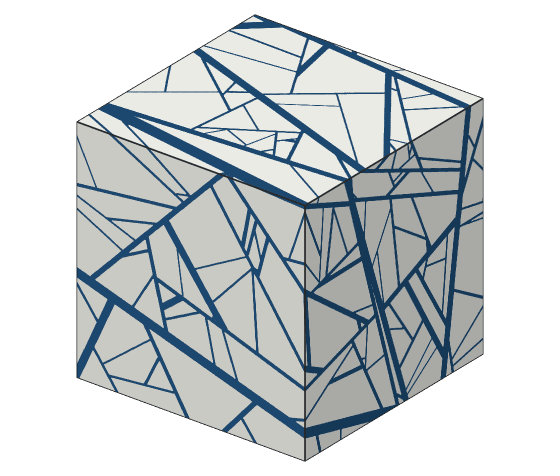
scale_rich_plates — A scale-rich network in space: 400 plates of power-law thicknesses, each splitting a closed cell in two, at 30 % relative density.
morphogen template scale_rich_plates -o scale_rich_plates.yaml
morphogen run scale_rich_plates.yaml
Configuration
# Scale-rich network of plates in three dimensions (Both, Chen, ..., Portela & Barabási,
# Nature 659, 345, 2026, Fig. 6a): plates lambda_0 t^-alpha thick grown one after another
# from points of the voids until they meet, each splitting a convex void into two closed
# cells, so that the areas and degrees of the plates have power-law tails of exponent 5/2.
# element: beams grows struts until they touch instead (open cells).
model:
  type: scale_rich_network
  dimension: 3
  element: plates              # or beams: struts, open cells
  n_ligaments: 400             # T plates
  decay: 0.3                   # alpha: 0 uniform thicknesses, 0.9 a few thick plates
  volume_fraction: 0.3         # solved on each realization (or initial_thickness: 0.04)
  # orientation: {type: aligned, direction: [0, 0, 1]}  # layers (default: isotropic)
  # pole: [0.5, 0.5, 0.5]      # polarized normals: at pole_angle to the direction...
  # pole_angle: 90             # ...of the pole, here shells about it
  # nucleation_gradient: [1, 4]  # nucleation four times denser at the top...
  # gradient_axis: 2           # ...along z
  # frame: 0.02                # a closed box: the sample as the cell of a periodic medium
domain:
  size: [1.0, 1.0, 1.0]
  periodic: false              # the plates end on the boundary of the box
seed: 1
voxels:
  voxel_size: 0.00625          # 160^3: the thinnest plate, 0.039 / 400^0.3 = 0.0065 here
outputs:
  directory: out/scale_rich_plates
  name: plates
  geometry: [json]
  image: [vti]
analysis: [volume_fraction, specific_surface, connectivity]
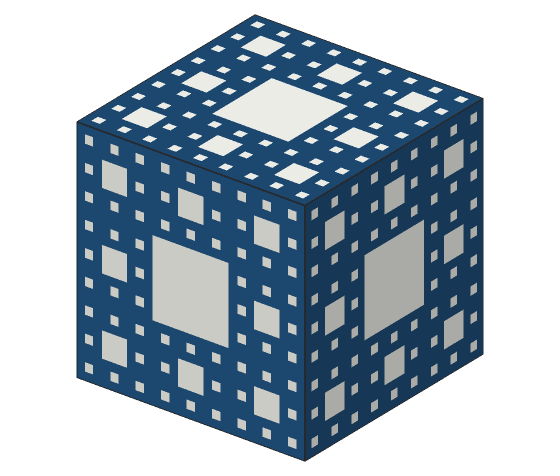
menger_sponge — The Menger sponge of level 3, of fractal dimension ln 20 / ln 3.
morphogen template menger_sponge -o menger_sponge.yaml
morphogen run menger_sponge.yaml
Configuration
# Menger sponge of level 3: 20 of the 27 sub-cubes kept at each level, fractal
# dimension ln 20 / ln 3 = 2.727 (box counting on the voxels gives it back). Other
# patterns: vicsek, cantor_dust, or any list of kept sub-cubes.
model:
  type: fractal_sponge
  pattern: menger
  level: 3
  cell_size: 1.0
domain:
  size: 1.0
  periodic: true
voxels:
  shape: 81                    # 3^4: the smallest holes three voxels wide
outputs:
  directory: out/menger_sponge
  name: menger
analysis: [volume_fraction, fractal_dimension]
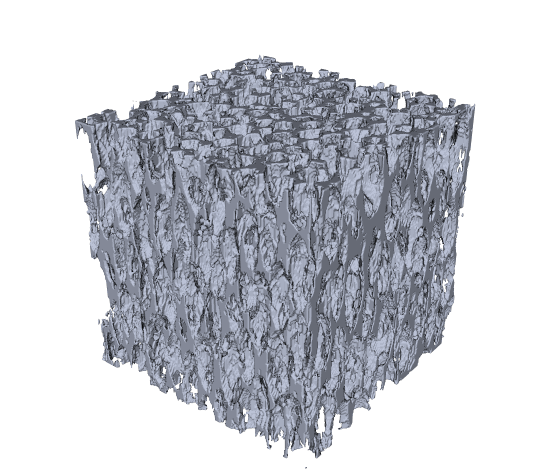
level_set_foam — An open-cell copper foam as a level set of distance fields of packed ellipsoids (Degdeg & Dirrenberger 2026).
morphogen template level_set_foam -o level_set_foam.yaml
morphogen run level_set_foam.yaml
Configuration
# The open-cell copper foam of Degdeg & Dirrenberger (2026), a level set of distance
# fields (Sonon et al. 2012; Kilingar et al. 2019): seeds are aligned ellipsoids of short
# semi-axes 87 to 145 um (b = 1.22 a, c = 3.22 a), densely packed; the struts follow the
# edges of their tessellation with convex cross-sections (curvature -0.7) thickening
# towards the nodes (c1 = 50, c2 = 1: 2.1 times wider there), their thickness solved
# for the solid fraction 0.261 of the tomography. Lengths in mm. The mean ligament
# thickness comes out at about 74 um (72.8 um in their model, 71.1 um measured).
# cells: closed adds walls (wall_thickness); thickness: t instead of volume_fraction.
model:
  type: level_set_foam
  seed_radius: {type: uniform, low: 0.0871, high: 0.1452}
  aspect: [1.22, 3.22]
  packing: dense
  packing_fraction: 0.6
  volume_fraction: 0.261
  curvature: -0.7
  c1: 50.0
  c2: 1.0
domain:
  size: 3.0
  periodic: true
seed: 3
voxels:
  voxel_size: 0.025
outputs:
  directory: out/level_set_foam
  name: foam
  image: [vti]
analysis: [volume_fraction, specific_surface, thickness, minkowski]
TPMS¶
Triply periodic minimal surfaces, as sheets or networks (the stiffness of the gyroid is under Linear homogenization).
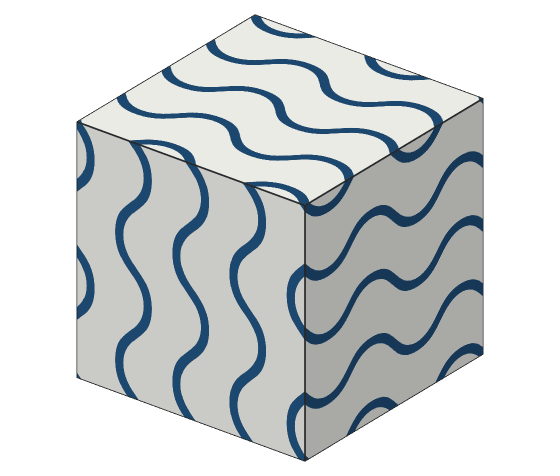
tpms — A sheet gyroid at 20 % relative density, with its watertight STL surface.
Needs scikit-image (extra surface).
morphogen template tpms -o tpms.yaml
morphogen run tpms.yaml
Configuration
# Sheet gyroid at 20 % relative density (architected material for additive manufacturing).
model:
  type: tpms
  surface: gyroid              # gyroid | schwarz_p | schwarz_d | neovius
  variant: sheet               # sheet | network
  cell_size: 5.0
  volume_fraction: 0.2
domain:
  size: 10.0                   # a whole number of cells when periodic
  periodic: true
  unit: mm
voxels:
  voxel_size: 0.1
outputs:
  directory: out/tpms
  name: gyroid
  image: [vti]
  surface: [stl]               # watertight STL, closed on the box faces
analysis: [volume_fraction, specific_surface]
Automata and tilings¶
Structures grown on lattices by local rules, and assemblies of building blocks.
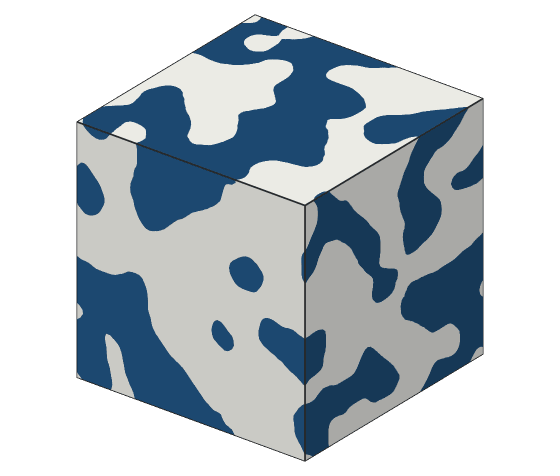
cellular_automaton — A bicontinuous structure coarsened from noise by Vichniac’s annealing rule.
morphogen template cellular_automaton -o cellular_automaton.yaml
morphogen run cellular_automaton.yaml
Configuration
# Bicontinuous two-phase structure coarsened by a cellular automaton: Vichniac's twisted
# majority rule ("anneal") moves the interfaces of random noise by their mean curvature,
# like the annealing of a binary alloy. Other rules: majority, conserved (coarsening at
# constant volume fraction), clouds (cave-like structures) or any B.../S... rule.
model:
  type: cellular_automaton
  rule: anneal
  neighbourhood: moore         # von_neumann, moore, edges or euclidean
  steps: 40
  initial_fraction: 0.5
  cell_size: 0.25              # a lattice of 64^3 cells
  smoothing: 0.75              # rounded interfaces at other resolutions and in meshes
domain:
  size: 16.0
  periodic: true
seed: 1984
voxels:
  shape: 64                    # one voxel per cell: the lattice itself
outputs:
  directory: out/cellular_automaton
  name: anneal
  geometry: [json]             # exact lattice: re-voxelize or mesh it later
  image: [vti]
  level_set: [vti]
analysis: [volume_fraction, specific_surface, connectivity]
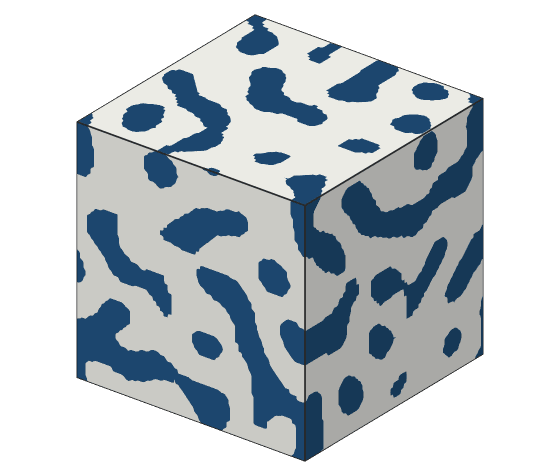
activator_inhibitor — Turing patterns of Young’s activator–inhibitor automaton.
morphogen template activator_inhibitor -o activator_inhibitor.yaml
morphogen run activator_inhibitor.yaml
Configuration
# Turing-like patterns of Young's (1984) activator-inhibitor cellular automaton: each cell
# weighs the active cells of a near ball against those of a surrounding shell. The
# inhibition radius sets the wavelength (about 1.5 to 2 times its value); a volume
# fraction turns the threshold into a rank rule (the most activated cells win).
model:
  type: activator_inhibitor
  activation_radius: 0.5
  inhibition_radius: 1.25
  volume_fraction: 0.35
  steps: 20
  cell_size: 0.125             # a lattice of 64^3 cells
domain:
  size: 8.0
  periodic: true
seed: 1984
voxels:
  shape: 64
outputs:
  directory: out/activator_inhibitor
  name: turing
  image: [vti]
analysis: [volume_fraction, specific_surface, connectivity]
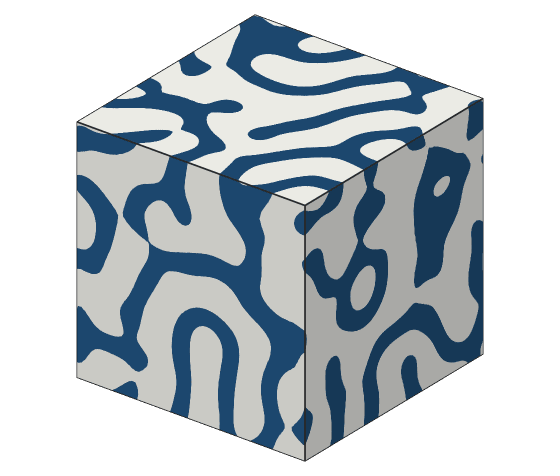
reaction_diffusion — Turing patterns of the Gray–Scott reaction–diffusion system (Pearson 1993).
Needs scikit-image (extra surface).
morphogen template reaction_diffusion -o reaction_diffusion.yaml
morphogen run reaction_diffusion.yaml
Configuration
# Turing patterns of the Gray-Scott reaction-diffusion system (Pearson 1993): spots,
# worms, labyrinth or holes, or any feed and kill rates. The activator concentration is
# thresholded at the requested volume fraction; its smooth field gives smooth interfaces
# at any resolution and for conforming meshes. Patterns have a period of about 12 cells.
model:
  type: reaction_diffusion
  pattern: labyrinth
  steps: 4000
  volume_fraction: 0.4
  cell_size: 0.0625            # a lattice of 64^3 cells, a period of about 0.75
domain:
  size: 4.0
  periodic: true
seed: 1993
voxels:
  shape: 128                   # twice the lattice resolution (interpolated field)
outputs:
  directory: out/reaction_diffusion
  name: labyrinth
  image: [vti]
  surface: [stl]               # needs scikit-image
analysis: [volume_fraction, specific_surface, connectivity]
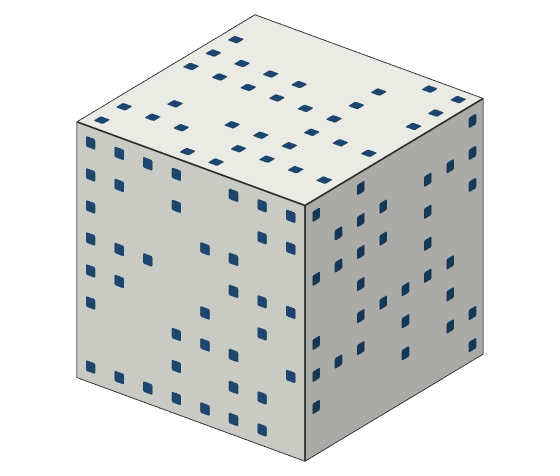
tile_assembly — A compatible assembly of pipe tiles drawn by wave function collapse: a network without dead ends.
morphogen template tile_assembly -o tile_assembly.yaml
morphogen run tile_assembly.yaml
Configuration
# Combinatorial design: a random compatible assembly of building blocks. Pipe tiles join
# a node to some of their faces; an open face must meet an open face, so the network has
# no dead end at the tile boundaries, and 'degrees' sets the allowed node degrees (here:
# no dead ends at all). The assembly is drawn by wave function collapse (constraint
# propagation with backtracking). With tiles: polarized (blocks of combinatorial
# metamaterials, after Coulais et al. 2016), periodic boxes need an even number of tiles
# along each axis; method: uniform draws uniformly among all compatible assemblies of
# narrow boxes (exact transfer matrices), method: random ignores compatibility.
model:
  type: tile_assembly
  tiles: pipes
  degrees: [0, 2, 3, 4]
  open_probability: 0.6
  pipe_radius: 0.18
  tile_length: 1.0
  tile_cells: 12               # lattice cells per tile edge
domain:
  size: 8.0
  periodic: true
seed: 2016
voxels:
  shape: 96                    # one voxel per lattice cell
outputs:
  directory: out/tile_assembly
  name: pipes
  geometry: [json]             # lattice and tile indices of the assembly
  image: [vti]
analysis: [volume_fraction, specific_surface, connectivity]
Growth¶
Structures grown by a process in time: grains, aggregates and trees.
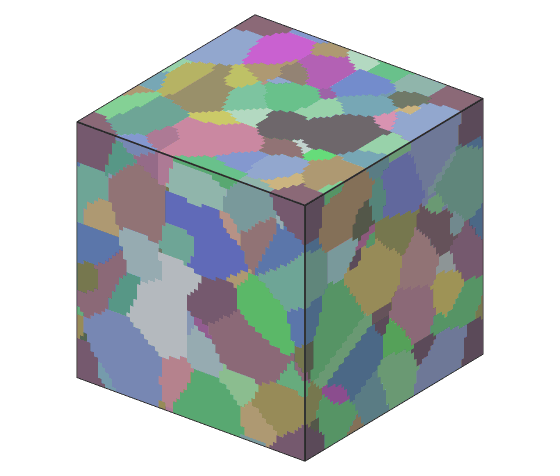
nucleation_growth — A Johnson–Mehl polycrystal: grains nucleated at a constant rate grow until they impinge (JMAK kinetics).
morphogen template nucleation_growth -o nucleation_growth.yaml
morphogen run nucleation_growth.yaml
Configuration
# Johnson-Mehl polycrystal: grains nucleate at a constant rate in the untransformed volume
# and grow at constant velocity until impingement (Johnson-Mehl-Avrami-Kolmogorov). The
# run manifest (run.json) gives the theory: Avrami exponent 4, grain density and mean
# grain volume. Set 'time' for a partial transformation (grains in a matrix),
# growth_shape: cube for faceted grains, coarsening_steps for normal grain growth.
model:
  type: nucleation_growth
  nucleation: continuous       # or site_saturation (nucleus_density: Voronoi grains)
  nucleation_rate: 0.0001      # nuclei per unit volume and unit time
  growth_rate: 1.0
  crystal_orientations: true
domain:
  size: 64.0
  periodic: true
  unit: um
seed: 1939
voxels:
  shape: 64                    # cell_size 1: one voxel per cell
outputs:
  directory: out/nucleation_growth
  name: grains
  geometry: [json]             # lattice, labels, orientations, nucleation times, kinetics
  labels: [vti]                # grain ids
  image: [vti]
analysis: [cells]
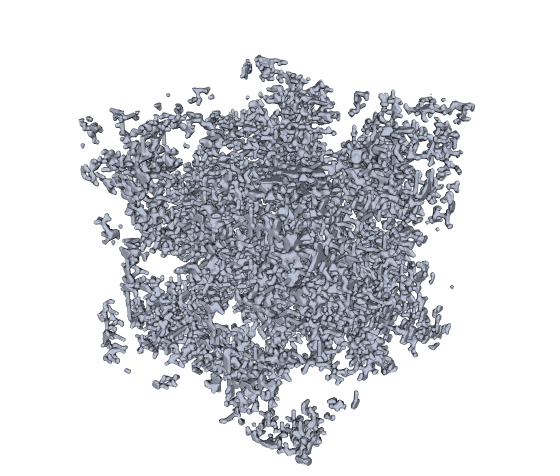
aggregation — Diffusion-limited aggregation: fractal clusters grown by random walkers (Witten & Sander 1981).
morphogen template aggregation -o aggregation.yaml
morphogen run aggregation.yaml
Configuration
# Diffusion-limited aggregation (Witten and Sander 1981): random walkers stick to clusters
# grown from seeds, which become fractal (dimension about 2.5 in 3D). Eden growth gives
# compact clusters and ballistic aggregation dense porous ones; geometry: deposit grows
# films from the face z = 0 of a non-periodic domain. A sticking probability below 1
# gives denser, reaction-limited aggregates.
model:
  type: aggregation
  process: dla                 # dla, eden or ballistic
  geometry: cluster
  n_seeds: 20
  volume_fraction: 0.08
domain:
  size: 64.0
  periodic: true
seed: 1981
voxels:
  shape: 64
outputs:
  directory: out/aggregation
  name: dla
  image: [vti]
  labels: [vti]                # cluster of each particle
analysis: [volume_fraction, specific_surface, connectivity]
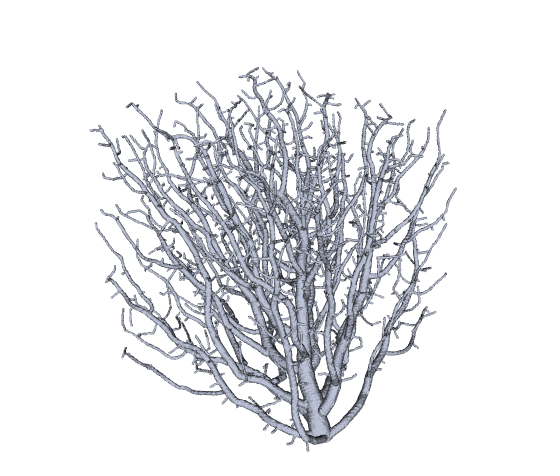
vascular_tree — A vascular tree grown by space colonization, its radii by Murray’s law.
Needs scikit-image (extra surface).
morphogen template vascular_tree -o vascular_tree.yaml
morphogen run vascular_tree.yaml
Configuration
# Vascular tree grown by space colonization toward 3000 random points of the tissue,
# from a root on the lower face; the radii follow Murray's law (r^3 of a vessel = sum of
# r^3 of its branches), from capillaries of radius 0.004.
model:
  type: branching
  n_attractors: 3000
  step: 0.02
  roots: 1
  root_position: face
  tip_radius: 0.004
  murray_exponent: 3.0         # 2: the pipe model of plants (da Vinci's rule)
domain:
  size: 1.0
  periodic: false
seed: 2
voxels:
  shape: 160
outputs:
  directory: out/vascular_tree
  name: tree
  geometry: [csv]              # the segments: end points and radii
  surface: [stl]
analysis: [volume_fraction, connectivity]
Bio-inspired¶
Microstructures drawn from biology.
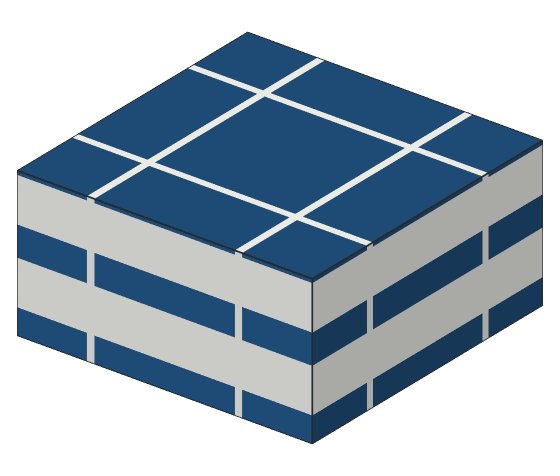
nacre — Nacre: staggered aragonite tablets bonded by a soft organic mortar (brick and mortar).
morphogen template nacre -o nacre.yaml
morphogen run nacre.yaml --seed 1
Configuration
# Nacre: staggered layers of aragonite tablets (brick-and-mortar) bonded by a soft
# organic mortar, about 90 % of mineral. The effective stiffness (FFT) is far above that
# of the mortar: the tablets carry the load, the mortar transfers it by shear.
model:
  type: nacre
  arrangement: brick           # brick (staggered) or voronoi (polygonal tablets)
  tablet_size: 1.0             # square tablets of side 1
  tablet_thickness: 0.2
  mortar_thickness: 0.05       # between the layers, and between tablets (gap)
  overlap: 0.5                 # shift of a layer from the previous one, in tablets
domain:
  size: [2.0, 2.0, 1.0]        # 4 layers of 0.25
  periodic: true
voxels:
  voxel_size: 0.0125           # 4 voxels across the mortar
homogenization:
  method: fft
  materials:
    0: {young: 4.0, poisson: 0.4}        # biopolymer mortar (GPa)
    1: {young: 100.0, poisson: 0.3}      # aragonite tablets (GPa)
  properties: [stiffness]
outputs:
  directory: out/nacre
  name: nacre
analysis: [volume_fraction]
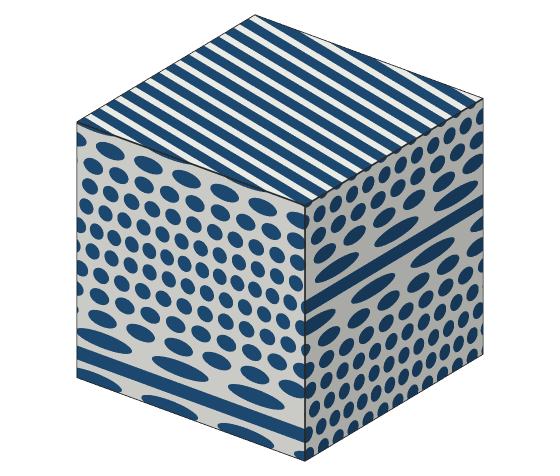
bouligand — A Bouligand twisted plywood: layers of fibres turned by 15° from one to the next (the dactyl club of the mantis shrimp).
morphogen template bouligand -o bouligand.yaml
morphogen run bouligand.yaml --seed 1
Configuration
# Bouligand (twisted plywood) structure of the dactyl club of the mantis shrimp or of
# fish scales: layers of parallel fibres, each turned by 15 degrees from the one below.
# Twelve layers make a half-turn: the periodic box holds one. The moduli along x and y
# are equal; the directions of the fibres, taken among the families periodic in the box
# (here within 1.4 degrees), leave the in-plane shear modulus a few percent off
# isotropy, less in larger boxes.
model:
  type: bouligand
  fiber_radius: 0.03
  fiber_spacing: 0.08
  layer_thickness: 0.08333333  # 12 layers in the box
  pitch_angle: 15.0
  start_angle: 0.0
domain:
  size: 1.0
  periodic: true
voxels:
  shape: 128
homogenization:
  method: fft
  materials:
    0: {young: 2.0, poisson: 0.4}        # protein matrix
    1: {young: 40.0, poisson: 0.3}       # mineralized chitin fibres
  properties: [stiffness]
outputs:
  directory: out/bouligand
  name: plywood
analysis: [volume_fraction]
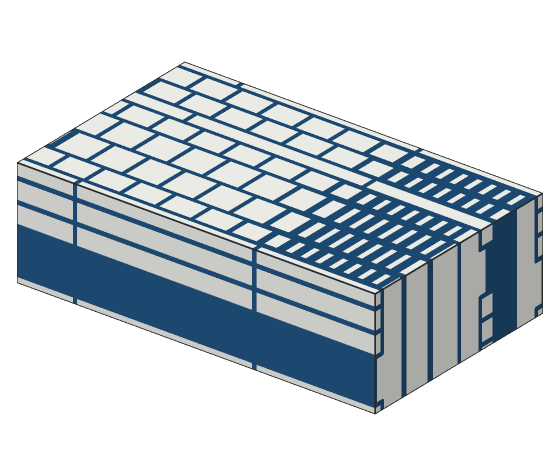
wood — Softwood: radial files of tracheids through a growth ring, with rays.
morphogen template wood -o wood.yaml
morphogen run wood.yaml --seed 1
Configuration
# Softwood: radial files of tracheids through a growth ring, large thin-walled earlywood
# cells then small thick-walled latewood ones, prismatic along the grain (z), and rays:
# ribbons of parenchyma cells that run radially (x) between two files, whose tracheids
# pass beside them. Along the grain the stiffness is close to the wall fraction times that
# of the walls. Across it the walls bend: the straight radial walls and the rays make the
# earlywood about three times stiffer radially than tangentially (y), while the dense
# latewood band, continuous along y, stiffens the tangential direction; here the two
# moduli are close (E_R about 2.2 GPa, E_T 2.4 to 2.5 GPa, E_L 3.9 GPa).
model:
  type: honeycomb
  arrangement: wood            # also: hexagonal, square, voronoi
  cell_size: 0.4               # width of the radial files
  wall_thickness: 0.05         # earlywood walls
  ring_width: 4.0
  latewood_fraction: 0.3
  latewood_size: 0.4           # radial size of the latewood cells / earlywood
  latewood_wall: 2.0           # wall thickness of the latewood cells / earlywood
  ray_fraction: 0.1            # rays, uniseriate (ray_width: 1 cell across)
  ray_height: 0.72             # three ray cells high (ray_cell_height: 0.6 cell size)
domain:
  size: [4.0, 2.4, 1.2]        # one ring, six files; two whole rays
  periodic: true
voxels:
  voxel_size: 0.025
homogenization:
  method: fft
  materials:
    0: void                              # lumens
    1: {young: 10.0, poisson: 0.3}       # cell walls (GPa)
  properties: [stiffness]
outputs:
  directory: out/wood
  name: wood
analysis: [volume_fraction]
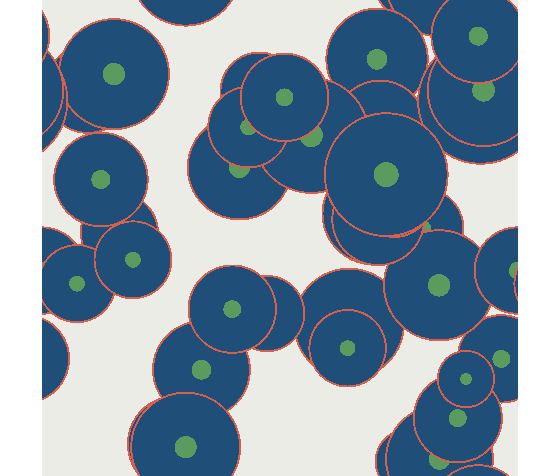
osteons — Cortical bone: osteons with their Haversian canals and cement lines, remodelled one after another.
morphogen template osteons -o osteons.yaml
morphogen run osteons.yaml --seed 1
Configuration
# Cortical (Haversian) bone in micrometres: osteons remodelled one after another (a
# dead-leaves model of cylinders), each with a Haversian canal and a cement line; the
# bone not remodelled is interstitial. Four phases, the canals forming the porosity.
model:
  type: osteons
  radius: {type: normal, mean: 100.0, std: 15.0}
  coverage: 0.65
  canal_ratio: 0.2
  cement_thickness: 4.0
  axis: 2                      # the bone axis
domain:
  size: [1000.0, 1000.0, 8.0]  # prismatic along the axis
  periodic: true
  unit: um
voxels:
  voxel_size: 2.0
homogenization:
  method: fft
  materials:
    0: {young: 22.0, poisson: 0.3}       # interstitial bone (GPa)
    1: {young: 18.0, poisson: 0.3}       # osteonal lamellar bone
    2: {young: 12.0, poisson: 0.3}       # cement lines
    3: void                              # Haversian canals
  properties: [stiffness]
outputs:
  directory: out/osteons
  name: cortical
analysis: [phase_fractions]
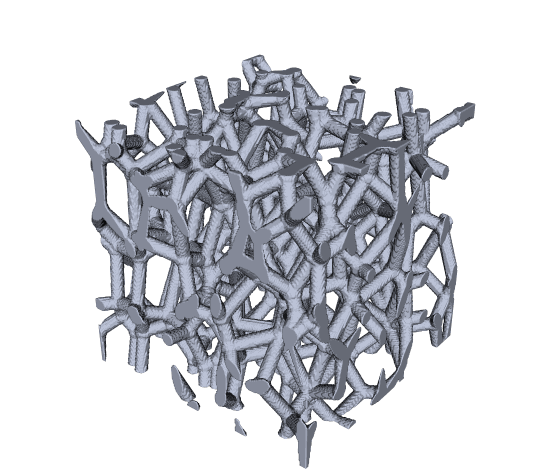
trabecular_bone — Trabecular bone or an open-cell foam: struts on the edges of relaxed, elongated Voronoi cells.
morphogen template trabecular_bone -o trabecular_bone.yaml
morphogen run trabecular_bone.yaml
Configuration
# Trabecular bone, or an open-cell foam: struts along the edges of the periodic Voronoi
# tessellation of relaxed germs (Lloyd iterations: even cells), elongated by 1.6 along
# z (the main load), with thicker nodes, at 15 % relative density (reached on each
# realization). Its stiffness scales as the square of the density (Gibson and Ashby),
# larger along the elongation.
model:
  type: open_foam
  n_cells: 64
  volume_fraction: 0.15        # or strut_radius
  relaxation: 10
  anisotropy: 1.6
  axis: 2
  node_ratio: 1.3
domain:
  size: 1.0
  periodic: true
seed: 3
voxels:
  shape: 96
homogenization:
  method: fft
  materials:
    0: void
    1: {young: 18.0, poisson: 0.3}       # bone tissue (GPa)
  properties: [stiffness]
outputs:
  directory: out/trabecular_bone
  name: trabecular
analysis: [volume_fraction, connectivity]
Linear homogenization¶
Apparent elastic and thermal properties, by finite elements on conforming meshes or by the FFT solver on voxels.
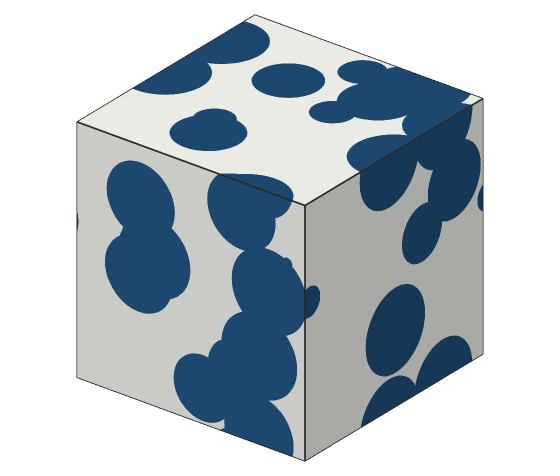
homogenization_spheres — The apparent moduli of stiff spheres in a soft matrix under the four boundary conditions (finite elements: 10-node tetrahedra whose edges follow the spheres).
Needs the mesher MMG (extra mesh).
morphogen template homogenization_spheres -o homogenization_spheres.yaml
morphogen run homogenization_spheres.yaml
Configuration
# Apparent elastic moduli of a Boolean model of stiff spheres in a soft matrix under the
# four boundary conditions, by finite elements on conforming tetrahedral meshes (MMG).
# The apparent bulk moduli satisfy Reuss <= SUBC <= PBC <= KUBC <= Voigt, and MBC lies
# between SUBC and KUBC (Kanit et al. 2003; Dirrenberger et al. 2014). The elements have
# ten nodes, those of the interfaces on the spheres (curved edges), and the mesh follows
# the grooves where two spheres overlap (its sharp edges); the grid of the mesher is
# fine enough for the necks and the gaps between the spheres. About six minutes for the
# two realizations (110,000 nodes each).
model:
  type: boolean_spheres
  radius: 1.0
  volume_fraction: 0.3
domain:
  size: 6.0
  periodic: true
seed: 2003
realizations: 2
mesh:
  size: 1.0                 # largest element size (the interface is refined)
  background: 0.25          # the grid on which the mesher samples the spheres
  order: 2                  # 10-node tetrahedra (the default of an analysis); 1: 4-node
homogenization:
  materials:
    0: {young: 1.0, poisson: 0.3}      # matrix
    1: {young: 20.0, poisson: 0.3}     # spheres
  boundary_conditions: [kubc, periodic, mixed, subc]
  properties: [bulk_modulus, shear_modulus]
outputs:
  directory: out/homogenization_spheres
  name: spheres
  conforming_mesh: [vtu]
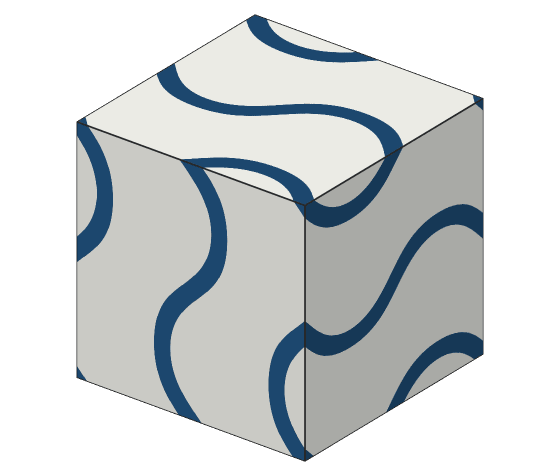
homogenization_gyroid — The cubic stiffness tensor and the conductivity of a sheet gyroid cell (finite elements, quadratic tetrahedra).
Needs the mesher MMG (extra mesh).
morphogen template homogenization_gyroid -o homogenization_gyroid.yaml
morphogen run homogenization_gyroid.yaml
Configuration
# Effective stiffness tensor (cubic symmetry) and conductivity of a sheet gyroid lattice
# of relative density 0.2, by periodic homogenization of one unit cell with finite
# elements on a conforming mesh of the solid (the void is not meshed). Thin sheets need
# 10-node tetrahedra or several elements across the thickness. Local fields (energy
# density, von Mises stress...) are written for ParaView.
model:
  type: tpms
  surface: gyroid
  variant: sheet
  cell_size: 1.0
  volume_fraction: 0.2
domain:
  size: 1.0
  periodic: true
mesh:
  size: 0.08
  order: 2
  background: 0.025           # method: grid only (the default meshes the exact sheet):
                              # level-set sampling, about 3 points across the sheet
homogenization:
  materials:
    0: void
    1: {young: 110000.0, poisson: 0.34, conductivity: 7.0}   # Ti-6Al-4V
  boundary_conditions: [periodic]
  properties: [stiffness, bulk_modulus, shear_modulus, conductivity]
  fields: true
outputs:
  directory: out/homogenization_gyroid
  name: gyroid
  conforming_mesh: [vtu]
homogenization_voronoi — The apparent moduli and stiffness tensor of a two-phase Voronoi mosaic (FFT).
morphogen template homogenization_voronoi -o homogenization_voronoi.yaml
morphogen run homogenization_voronoi.yaml
Configuration
# Apparent elastic moduli and stiffness tensor of a two-phase Voronoi mosaic (Kanit et
# al. 2003) by the FFT solver on voxel images (periodic conditions). Tessellations can
# also be meshed grain by grain and solved by finite elements under any boundary
# condition: add a 'mesh' section and method: fe (see homogenization_polycrystal).
model:
  type: voronoi
  n_cells: 60
  phase_fractions: [0.3, 0.7]
domain:
  size: 10.0
  periodic: true
seed: 2003
realizations: 2
voxels:
  shape: 48
homogenization:
  method: fft
  materials:
    0: {young: 1.0, poisson: 0.3}      # soft phase
    1: {young: 100.0, poisson: 0.3}    # hard phase
  boundary_conditions: [periodic]
  properties: [bulk_modulus, shear_modulus, stiffness]
outputs:
  directory: out/homogenization_voronoi
  name: mosaic
  image: [vti]
homogenization_polycrystal — The apparent moduli of a copper polycrystal meshed grain by grain (finite elements).
Needs the mesher MMG (extra mesh).
morphogen template homogenization_polycrystal -o homogenization_polycrystal.yaml
morphogen run homogenization_polycrystal.yaml
Configuration
# Apparent elastic moduli of a copper polycrystal: a periodic Voronoi tessellation whose
# grains are cubic crystals with uniformly random orientations, meshed grain by grain
# (exact cells, conforming grain boundaries, matching periodic faces) and solved by
# finite elements. The bulk modulus is exactly (C11 + 2 C12) / 3 for every boundary
# condition; the shear moduli satisfy Reuss <= SUBC <= PBC <= KUBC <= Voigt. With 50
# grains, each shear component (C44, C55, C66) depends on the texture of the sample (a
# few GPa); the isotropic projection of the stiffness tensor (column
# stiffness.periodic.shear_modulus) lies close to the Hashin-Shtrikman bounds (45.96 -
# 49.45 GPa).
model:
  type: voronoi
  n_cells: 50
  crystal_orientations: true
domain:
  size: 1.0
  periodic: true
seed: 1962
realizations: 2
mesh:
  size: 0.12                # largest element size (10-node elements, the default)
  min_feature: 0.02         # cell edges and caps smaller than this are removed first
homogenization:
  materials:
    1: {cubic: [168.4, 121.4, 75.4], conductivity: 400.0}   # copper, GPa and W/m/K
  boundary_conditions: [kubc, periodic, subc]
  properties: [bulk_modulus, shear_modulus, stiffness]
outputs:
  directory: out/homogenization_polycrystal
  name: copper
  conforming_mesh: [vtu, inp]   # grains: cell data / element sets and orientations
homogenization_polycrystal_inclusions — A copper polycrystal with an amorphous grain-boundary phase and alumina inclusions (FFT).
morphogen template homogenization_polycrystal_inclusions -o homogenization_polycrystal_inclusions.yaml
morphogen run homogenization_polycrystal_inclusions.yaml
Configuration
# Copper polycrystal with an amorphous grain-boundary phase and alumina inclusions,
# homogenized by FFT: the grains (phase 1) are cubic crystals turned by their random
# orientations, the boundaries (phase 0, 0.01 thick) and the inclusions (phase 2) are
# isotropic. The combination keeps the grains of the polycrystal under the inclusions.
model:
  type: combination
  operation: inclusions
  models:
    - {type: voronoi, n_cells: 50, crystal_orientations: true, boundary_thickness: 0.01}
    - {type: hardcore_spheres, radius: 0.05, volume_fraction: 0.05}
  inclusion_phases: [2]
domain:
  size: 1.0
  periodic: true
seed: 11
voxels:
  shape: 64
homogenization:
  method: fft
  materials:
    0: {young: 60.0, poisson: 0.35}           # grain boundaries (GPa)
    1: {cubic: [168.4, 121.4, 75.4]}          # copper crystals
    2: {young: 380.0, poisson: 0.22}          # alumina
  properties: [bulk_modulus, shear_modulus]
outputs:
  directory: out/homogenization_polycrystal_inclusions
  name: composite
  image: [vti]
  labels: [vti]
analysis: [phase_fractions]
homogenization_mixed_loading — Thermo-elastic loadings mixing strains and stresses on a unidirectional glass-epoxy composite.
morphogen template homogenization_mixed_loading -o homogenization_mixed_loading.yaml
morphogen run homogenization_mixed_loading.yaml --seed 1
Configuration
# Thermo-elastic homogenization of a unidirectional glass-epoxy composite with the
# macroscopic strain and stress of the periodic cell as unknowns, as the periodic
# element of Z-set: named loadings mix prescribed strain and stress components, and a
# temperature change. A Bouligand structure with no twist is a unidirectional
# composite: one fibre of radius 2 (12.6 %) along z per 10 x 10 cell.
model:
  type: bouligand
  fiber_radius: 2.0
  fiber_spacing: 10.0
  layer_thickness: 10.0
  pitch_angle: 0.0
  start_angle: 90.0            # along z in the (y, z) plane of the layers
  axis: 0
domain:
  size: [10.0, 10.0, 0.3125]   # prismatic along the fibre: 4 voxels
  periodic: true
voxels:
  shape: [128, 128, 4]
homogenization:
  method: fft
  materials:
    0: {young: 2800.0, poisson: 0.39, expansion: 9.5e-5}   # epoxy (MPa, 1/K)
    1: {young: 89000.0, poisson: 0.3, expansion: 5.5e-6}   # glass fibre
  properties: [stiffness, thermal_expansion]
  loadings:
    free_heating: {temperature: 100.0}                   # stress-free: the expansion
    blocked_heating: {strain: {"11": 0, "22": 0, "33": 0, "23": 0, "31": 0, "12": 0},
                      temperature: 100.0}                # the thermal stresses
    tension_33: {stress: {"33": 100.0}}                  # uniaxial stress along the fibre
    plane_strain_11: {strain: {"11": 0.001, "33": 0.0}}  # mixed: the rest stress-free
outputs:
  directory: out/homogenization_mixed_loading
  name: unidirectional
homogenization_crystallization — A partially crystallized material: grains of the Avrami law meshed conformingly (finite elements).
Needs the mesher MMG (extra mesh).
morphogen template homogenization_crystallization -o homogenization_crystallization.yaml
morphogen run homogenization_crystallization.yaml
Configuration
# Partially crystallized material: spherical grains nucleated at a constant rate grow in
# an amorphous matrix until the transformation is stopped (36 % crystallized according
# to the Avrami law, see run.json; about 40 grains per sample). The arrival time of the
# growth front gives an exact level set, so that the grains are meshed conformingly
# (MMG) and homogenized by finite elements, like the other implicit morphologies, with
# 10-node elements whose nodes lie on the grains (about a minute per sample).
model:
  type: nucleation_growth
  nucleation: continuous
  nucleation_rate: 0.006
  growth_rate: 0.65
  time: 4.0
  cell_size: 0.25
domain:
  size: 12.0
  periodic: true
seed: 1940
realizations: 2
mesh:
  size: 1.0
homogenization:
  materials:
    0: {young: 2.5, poisson: 0.38, conductivity: 0.2}    # amorphous polymer, GPa
    1: {young: 6.0, poisson: 0.33, conductivity: 0.4}    # crystallites
  boundary_conditions: [periodic]
  properties: [bulk_modulus, shear_modulus, conductivity]
outputs:
  directory: out/homogenization_crystallization
  name: crystallized
  conforming_mesh: [vtu]
homogenization_interphase — Spheres, their interphase and the matrix meshed conformingly from the implicit function of each phase: three phases by finite elements whose nodes lie on the interfaces, with the level sets and the surfaces of the phases.
Needs the mesher MMG (extra mesh), scikit-image (extra surface).
morphogen template homogenization_interphase -o homogenization_interphase.yaml
morphogen run homogenization_interphase.yaml
Configuration
# Three phases meshed conformingly: spheres, their interphase of constant thickness and
# the matrix. Each phase has its implicit function, exact on the interfaces of the model
# (distances to the spheres); the mesher (MMG) cuts the box by them one after the other,
# so that the elements follow the two interfaces of each particle and match on opposite
# faces; the coatings that overlap are cut group by group, and the grooves where two of
# them meet are edges of the mesh. Finite elements under periodic conditions for the
# stiffness and the conductivity; compare with the voxels of the template coated_spheres
# (method: fft).
# The files: the mesh (coated_0000_tet.vtu), the implicit function of each phase on the
# voxels (coated_0000_levelset_phase<k>.vti) and the surface of each phase but the last
# (coated_0000_phase<k>.stl). The elements have ten nodes (the default of an analysis),
# those of the two interfaces of each particle on their spheres: curved edges, which keep
# the volumes of the spheres and of their interphase within a percent with elements twice
# as large as the interphase is thick. About two minutes.
model:
  type: coating
  model: {type: hardcore_spheres, radius: 1.0, volume_fraction: 0.2}
  thickness: 0.3
  side: outside
domain:
  size: 5.0
  periodic: true
seed: 2
mesh:
  size: 0.7                    # largest edge of the elements
voxels:
  shape: 64                    # of the implicit functions and of the surfaces
homogenization:
  method: fe
  materials:
    0: {young: 3.0, poisson: 0.35, conductivity: 0.2}    # matrix
    1: {young: 70.0, poisson: 0.22, conductivity: 1.0}   # spheres
    2: {young: 10.0, poisson: 0.3, conductivity: 0.5}    # interphase
  boundary_conditions: [periodic]
  properties: [stiffness, conductivity]
outputs:
  directory: out/homogenization_interphase
  name: coated
  conforming_mesh: [vtu]
  level_set: [vti]
  surface: [stl]
analysis: [phase_fractions]
Nonlinear behaviours¶
Loading paths of elasto-viscoplastic composites and polycrystals, a rubber in finite strains, a reduced model, a matrix that plasticity damages, and a porous cell whose walls come into contact.
homogenization_viscoplastic — SiC particles in a viscoplastic aluminium alloy: tension, relaxation and unloading (finite elements: 10-node tetrahedra, which do not lock when the matrix flows).
Needs the mesher MMG (extra mesh).
morphogen template homogenization_viscoplastic -o homogenization_viscoplastic.yaml
morphogen run homogenization_viscoplastic.yaml
Configuration
# Elastic SiC particles (20 %) in an elasto-viscoplastic aluminium alloy: tension at the
# strain rate 1e-3 /s to 2 %, relaxation for 100 s, then unloading, the lateral stresses
# free (periodic element: E22, E33 and the shears are degrees of freedom). The matrix
# yields first; the particles carry a growing share of the load, and the residual
# stresses make the matrix yield again in reverse during the unloading (Bauschinger
# effect). Curves: spheres_0000_tension_periodic.csv; plastic strain fields: .vtu.
# The mesh is analysed with 10-node elements (the default; the 4-node ones lock when the
# matrix flows, and overestimate the stress): about three and a half minutes.
model:
  type: hardcore_spheres
  radius: 1.0
  volume_fraction: 0.2
domain:
  size: 5.0
  periodic: true
seed: 7
mesh:
  size: 0.9
homogenization:
  materials:
    0:                                   # aluminium alloy (MPa, s)
      young: 70000
      poisson: 0.33
      plasticity:
        yield: 100                       # R0
        isotropic: [{Q: 80, b: 20}]      # R(p) = Q (1 - exp(-b p))
        kinematic: [{C: 10000, D: 100}]  # Armstrong-Frederick backstress
        norton: {K: 50, n: 5}            # dp/dt = <f / K>^n (omit: rate-independent)
    1: {young: 400000, poisson: 0.2}     # SiC particles, elastic
  boundary_conditions: [periodic]        # also kubc
  properties: [stiffness]                # the elastic stiffness, for comparison
  paths:
    tension:                             # values at the times; free components: zero stress
      times: [0, 20, 120, 130]
      increments: [10, 10, 5]
      strain: {"11": [0, 0.02, 0.02, 0.017]}
  nonlinear:
    tolerance: 1.0e-6                    # relative residual of the Newton iterations
  fields: true                           # stress and plastic strain at the end of each segment
outputs:
  directory: out/homogenization_viscoplastic
  name: spheres
homogenization_crystal_plasticity — A nickel polycrystal pulled to 10 % in finite strains, Méric–Cailletaud crystal plasticity (finite elements).
Needs the mesher MMG (extra mesh).
morphogen template homogenization_crystal_plasticity -o homogenization_crystal_plasticity.yaml
morphogen run homogenization_crystal_plasticity.yaml
Configuration
# Tension of a polycrystal of a nickel alloy to 10 % in finite strains: a periodic Voronoi
# tessellation of 12 grains with random orientations, meshed grain by grain with
# quadratic tetrahedra (linear ones lock under plastic flow), each grain a cubic crystal
# slipping on its 12 octahedral systems (crystal plasticity of Meric and Cailletaud). The
# lateral faces are free of tractions: a uniaxial Cauchy stress. Curves
# (polycrystal_0000_tension_periodic.csv): nominal strains and stresses E, S (components of
# the macroscopic gradient F - I and of the first Piola-Kirchhoff stress), true
# (logarithmic) strains LE and true (Cauchy) stresses TS, mean cumulated plastic strain p.
# Fields (.vtu, at 0.1, 0.5, 2 and 10 %): Cauchy stress, logarithmic strain, plastic
# strain, current orientations of the lattices and displacement of the nodes (warp the
# mesh by it in ParaView).
model:
  type: voronoi
  n_cells: 12
  crystal_orientations: true
domain:
  size: 1.0
  periodic: true
seed: 11
mesh:
  size: 0.2
  min_feature: 0.05
  order: 2                          # quadratic tetrahedra
homogenization:
  materials:
    1:
      cubic: [250000, 160000, 120000]  # MPa
      crystal_plasticity:
        families: [octahedral]          # also cube, bcc110, bcc112
        tau0: 80                        # critical resolved shear stress (MPa)
        Q: 20                           # r = tau0 + Q sum_r h_sr (1 - exp(-b v_r))
        b: 10
        C: 20000                        # x = C alpha, dalpha = dgamma - D alpha |dgamma|
        D: 300
        K: 25                           # dgamma/dt = <(|tau - x| - r) / K>^n
        n: 10
        # self, coplanar, Hirth, collinear, glissile and Lomer interactions
        interaction: [1.0, 1.0, 0.6, 12.3, 1.6, 1.3]
  boundary_conditions: [periodic]
  paths:
    tension:                            # strain rate 1e-3 /s
      times: [0, 1, 5, 20, 100]
      increments: [4, 16, 15, 32]       # steps of 0.025 % through the elastic-plastic
      strain: {"11": [0, 0.001, 0.005, 0.02, 0.1]}  # transition, then 0.1 and 0.25 %
  nonlinear:
    kinematics: finite                  # or small
  fields: true
outputs:
  directory: out/homogenization_crystal_plasticity
  name: polycrystal
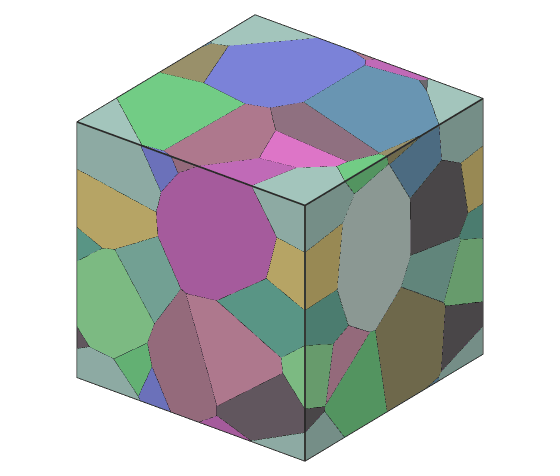
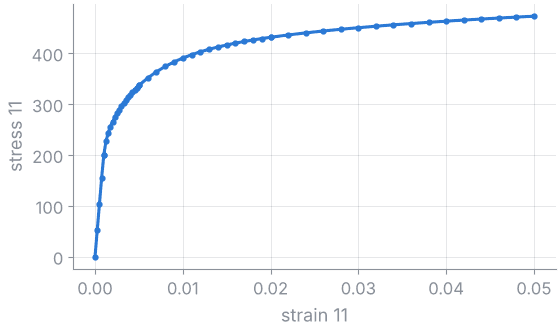
homogenization_crystal_plasticity_fft — The same on 24³ voxels of 20 grains, to 5 % (the nonlinear FFT solver).
morphogen template homogenization_crystal_plasticity_fft -o homogenization_crystal_plasticity_fft.yaml
morphogen run homogenization_crystal_plasticity_fft.yaml
Configuration
# Tension of a polycrystal of a nickel alloy to 5 % in finite strains, on voxels: a
# periodic Voronoi tessellation of 20 grains with random orientations, 24^3 voxels, solved
# by the nonlinear FFT solver (the periodic element on trilinear voxels with F-bar, Newton
# iterations whose corrections are solved by conjugate gradients preconditioned in Fourier
# space). Each grain is a cubic crystal slipping on its 12 octahedral systems (crystal
# plasticity of Meric and Cailletaud), as in homogenization_crystal_plasticity (meshed
# grains). The lateral faces are free of tractions: a uniaxial Cauchy stress. Curves
# (polycrystal_0000_tension_periodic.csv): nominal strains and stresses E, S (components of
# the macroscopic gradient F - I and of the first Piola-Kirchhoff stress), true
# (logarithmic) strains LE and true (Cauchy) stresses TS, mean cumulated plastic strain p.
# Fields (.vti, at 0.1, 0.5, 2 and 5 %): Cauchy stress, logarithmic strain, plastic
# strain, current orientations of the lattices and displacement at the centres of the
# voxels, one array per component (stress_11 ...).
model:
  type: voronoi
  n_cells: 20
  crystal_orientations: true
domain:
  size: 1.0
  periodic: true
seed: 11
voxels:
  shape: 24                           # about 700 voxels per grain
homogenization:
  method: fft                         # voxel image, periodic conditions
  materials:
    1:
      cubic: [250000, 160000, 120000]  # MPa
      crystal_plasticity:
        families: [octahedral]          # also cube, bcc110, bcc112
        tau0: 80                        # critical resolved shear stress (MPa)
        Q: 20                           # r = tau0 + Q sum_r h_sr (1 - exp(-b v_r))
        b: 10
        C: 20000                        # x = C alpha, dalpha = dgamma - D alpha |dgamma|
        D: 300
        K: 25                           # dgamma/dt = <(|tau - x| - r) / K>^n
        n: 10
        # self, coplanar, Hirth, collinear, glissile and Lomer interactions
        interaction: [1.0, 1.0, 0.6, 12.3, 1.6, 1.3]
  boundary_conditions: [periodic]
  paths:
    tension:                            # strain rate 1e-3 /s
      times: [0, 1, 5, 20, 50]
      increments: [4, 16, 15, 15]       # steps of 0.025 % through the elastic-plastic
      strain: {"11": [0, 0.001, 0.005, 0.02, 0.05]}  # transition, then 0.1 and 0.2 %
  nonlinear:
    kinematics: finite                  # or small
    integration: bbar                   # F-bar (B-bar in small strains); full: locking
  fields: true
outputs:
  directory: out/homogenization_crystal_plasticity_fft
  name: polycrystal
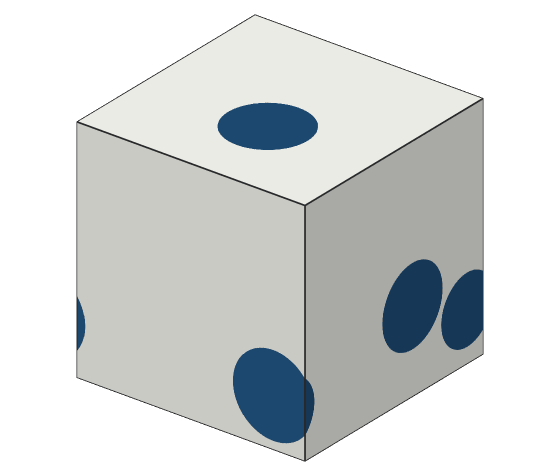
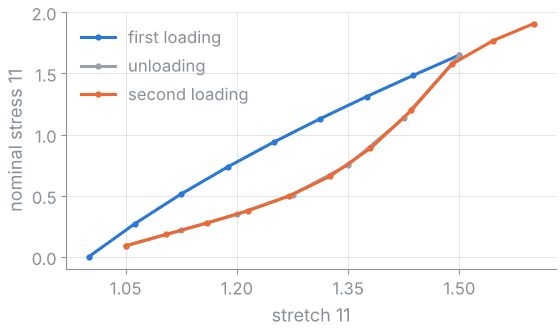
homogenization_rubber — A filled rubber stretched by half its length, unloaded and stretched again: the eight chains of Arruda and Boyce and the softening of Mullins, in finite strains (the nonlinear FFT solver).
morphogen template homogenization_rubber -o homogenization_rubber.yaml
morphogen run homogenization_rubber.yaml
Configuration
# A filled rubber in finite strains: stiff particles (15 %) in a rubber whose chains lock
# (the eight chains of Arruda and Boyce) and which softens along its first loading (the
# effect of Mullins, after Ogden and Roxburgh). Stretched by 50 %, unloaded, then
# stretched by 60 %, the sides free: the second loading follows a softer curve up to the
# stretch already reached, then the first one again. The particles are elastic (the
# energy of Hencky in finite strains). Nominal strains and stresses, with the true ones
# (LE11, TS11) in rubber_0000_cycle_periodic.csv; about two minutes.
model:
  type: hardcore_spheres
  radius: 1.0
  volume_fraction: 0.15
domain:
  size: 5.0
  periodic: true
seed: 3
voxels:
  shape: 16
homogenization:
  method: fft
  materials:
    0:                                   # the rubber (MPa)
      young: 3.0
      poisson: 0.45
      hyperelasticity:
        model: eight_chain               # also neo_hookean, mooney_rivlin, yeoh, gent, ogden...
        lock: 3.0                        # the locking stretch of the chains
        mullins: [1.5, 0.3, 0.1]         # r, m, beta of the softening
    1: {young: 300.0, poisson: 0.3}      # the particles
  properties: []
  paths:
    cycle:                               # free components: zero stress
      times: [0, 1, 2, 3]
      increments: [8, 6, 10]
      strain: {"11": [0, 0.5, 0.05, 0.6]}  # nominal: the stretch minus one
  nonlinear:
    kinematics: finite                   # total Lagrangian, F-bar voxels
  fields: true
outputs:
  directory: out/homogenization_rubber
  name: rubber
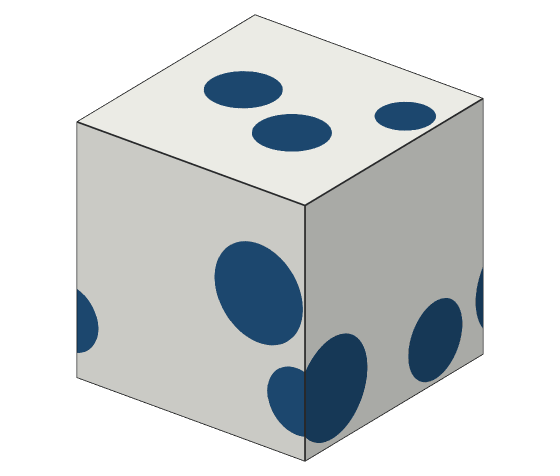
homogenization_ntfa — A reduced model (NTFA) of an elasto-plastic composite trained on full-field paths.
morphogen template homogenization_ntfa -o homogenization_ntfa.yaml
morphogen run homogenization_ntfa.yaml
Configuration
# Reduced model of an elasto-plastic composite by the nonuniform transformation field
# analysis (NTFA, Michel & Suquet 2003): SiC spheres in an aluminium alloy, voxelized.
# The model is trained once on full-field paths (here tension and shear), whose plastic
# strain fields give six modes of the matrix; the paths are then followed by the reduced
# model in milliseconds (results <name>.ntfa), and also by the full field here
# (full_field: true) to compare them (<name>.periodic). The training paths must span
# the loading directions of the paths followed. Isotropic and kinematic (Armstrong-
# Frederick) hardening; norton: {K, n} for viscoplasticity.
model:
  type: hardcore_spheres
  radius: 1.0
  volume_fraction: 0.2
domain:
  size: 5.0
  periodic: true
seed: 7
voxels:
  shape: 24
homogenization:
  method: fft
  materials:
    0:                                   # aluminium alloy (MPa)
      young: 70000
      poisson: 0.33
      plasticity:
        yield: 100                       # R0
        hardening: 1000                  # R(p) = H p + Q (1 - exp(-b p))
        isotropic: [{Q: 30, b: 50}]
        kinematic: [{C: 10000, D: 100}]  # Armstrong-Frederick backstress
    1: {young: 400000, poisson: 0.2}     # SiC particles, elastic
  boundary_conditions: [periodic]
  paths:
    tension:
      times: [0, 1]
      increments: [10]
      strain: {"11": [0, 0.01]}
    cycle:
      times: [0, 1, 2]
      increments: [10, 10]
      strain: {"11": [0, 0.01, -0.006]}
  ntfa:
    training:                            # full-field paths whose snapshots give the modes
      tension:
        times: [0, 1]
        increments: [10]
        strain: {"11": [0, 0.01]}
      shear:
        times: [0, 1]
        increments: [10]
        strain: {"12": [0, 0.02]}
    modes: 6                             # per plastic phase
    save: ntfa_model.npz                 # the reduced model, for later runs
    full_field: true                     # also the full-field paths, to compare
outputs:
  directory: out/homogenization_ntfa
  name: composite
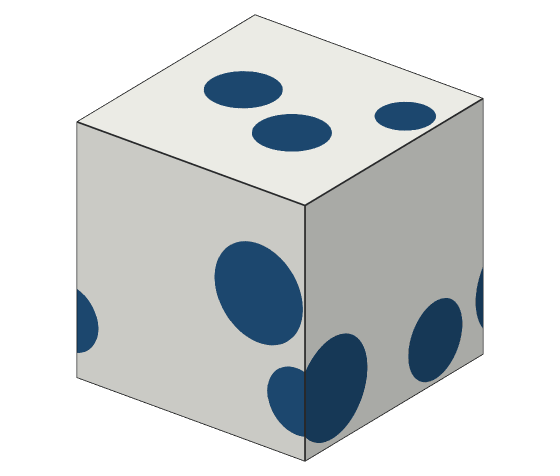
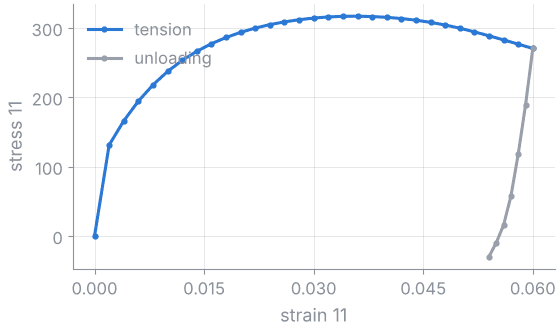
homogenization_ductile_damage — SiC particles in an aluminium matrix whose plasticity is coupled to Lemaitre’s damage: the composite reaches its strength, softens as the matrix is damaged and unloads along its damaged modulus (the nonlinear FFT solver, a delayed damage).
morphogen template homogenization_ductile_damage -o homogenization_ductile_damage.yaml
morphogen run homogenization_ductile_damage.yaml
Configuration
# The ductile damage of a particle-reinforced alloy: elastic SiC particles (20 %) in an
# aluminium matrix whose plasticity (isotropic and kinematic hardenings) is coupled to
# Lemaitre's damage, dD = (Y / S)^s dp beyond a plastic strain of 1 %: the stress of the
# matrix is (1 - D) times its effective stress, Y the energy release rate of the
# effective stress, which grows with the triaxiality between the particles. Pulled to
# 6 %, the composite reaches its strength near 3.6 % and softens as the matrix is
# damaged, then unloads along its damaged modulus. A local damage law that softens has
# no width of its own: the time of the delayed damage (viscosity) keeps the steps well
# posed. The variable p_0 of the curve (spheres_0000_tension_periodic.csv) is the mean
# damage of the matrix; about a minute and a half (FFT, 16 voxels per edge).
model:
  type: hardcore_spheres
  radius: 1.0
  volume_fraction: 0.2
domain:
  size: 5.0
  periodic: true
seed: 7
voxels:
  shape: 16
homogenization:
  method: fft
  materials:
    0:                                   # aluminium alloy (MPa)
      young: 70000
      poisson: 0.33
      plasticity:
        yield: 100                       # R0
        isotropic: [{Q: 80, b: 20}]      # R(p) = Q (1 - exp(-b p))
        kinematic: [{C: 10000, D: 100}]  # Armstrong-Frederick backstress
      damage:
        law: lemaitre                    # also kachanov (creep), with plasticity.norton
        S: 0.35                          # the strength of the damage (MPa)
        s: 1.0
        threshold: 0.01                  # plastic strain at which the damage starts
        closure: 0.2                     # compressions count for a fifth in Y
        viscosity: 0.05                  # the time of the delayed damage
    1: {young: 400000, poisson: 0.2}     # SiC particles, elastic
  properties: []
  paths:
    tension:                             # free components: zero stress
      times: [0, 1, 2]
      increments: [30, 6]
      strain: {"11": [0, 0.06, 0.054]}
outputs:
  directory: out/homogenization_ductile_damage
  name: spheres
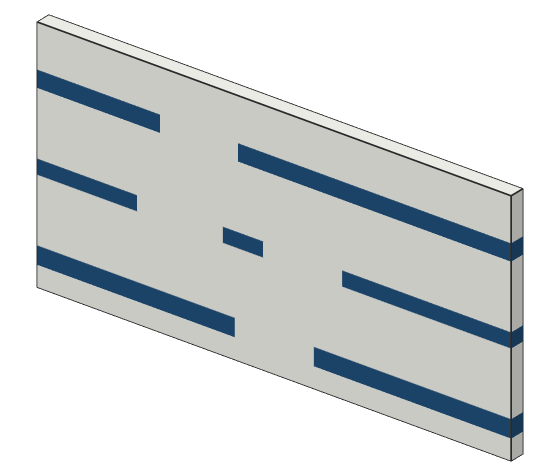
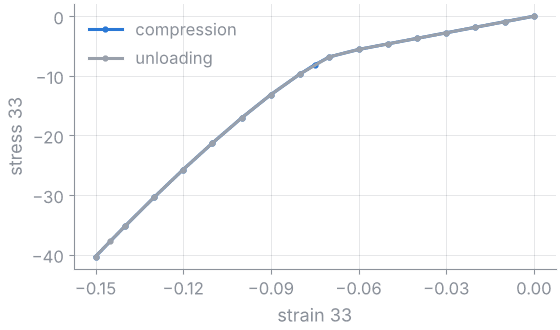
homogenization_contact — Plates parted by gaps and held by pillars, compressed until the gaps close: the walls of the pores press on each other (self-contact with Coulomb’s friction, in finite strains) and the cell stiffens fivefold.
Needs the mesher MMG (extra mesh).
morphogen template homogenization_contact -o homogenization_contact.yaml
morphogen run homogenization_contact.yaml
Configuration
# Plates parted by thin gaps and held apart by pillars (a laminate whose void layers have
# holes: the pillars), compressed across the plates in finite strains. The plates first
# bend between the pillars and the cell is soft; then the gaps close one after another:
# the plates come to rest on each other (the self-contact of the walls of the pores, with
# Coulomb's friction, also through the faces of the periodic cell) and the cell becomes
# five times stiffer. Unloaded, it comes back along nearly the same curve: the walls
# press more than they rub. The curve (gaps_0000_compression_periodic.csv) has at each
# step the area in contact, the largest pressure and the energy that friction dissipated;
# about two minutes.
model:
  type: random_laminate
  thickness: {type: uniform, low: 0.05, high: 0.11}   # the gaps (phase 1)
  spacing: 0.3                                        # the plates (phase 0)
  axis: 2
  hole_fraction: 0.5           # the pillars: holes through the layers of phase 1
  hole_radius: 0.2
domain:
  size: [2.4, 0.08, 1.2]       # a slice: the pillars are walls across it
  periodic: true
seed: 8                        # a pillar or two across each of the three gaps
mesh:
  size: 0.08
  background: 0.04             # the sampling of the level set: the gaps
  min_size: 0.04
  hausdorff: 0.008
  order: 1                     # 4-node tetrahedra, eight across a plate
homogenization:
  method: fe
  materials:
    0: {young: 1000.0, poisson: 0.3}     # the plates and the pillars
    1: void                              # the gaps: the mesh is that of the solid
  properties: []
  paths:
    compression:               # free components: zero stress
      times: [0, 1, 2]
      increments: [15, 15]
      strain: {"33": [0, -0.15, 0], "23": 0.0, "13": 0.0, "12": 0.0}
  nonlinear:
    contact: {friction: 0.3}   # the walls of the pores touch; finite strains by default
outputs:
  directory: out/homogenization_contact
  name: gaps
  conforming_mesh: [vtu]
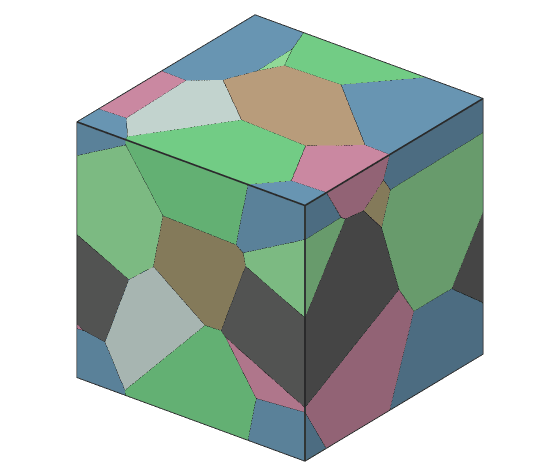
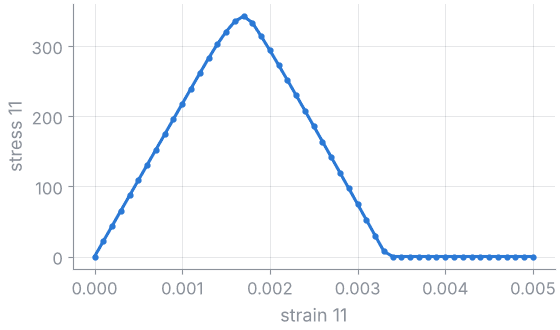
homogenization_intergranular — A polycrystal that breaks along its grain boundaries: cohesive interfaces between the grains of a Voronoi tessellation of cubic crystals. The stress passes a peak and falls to zero as a crack crosses the cell from boundary to boundary; the work that broke it is the fracture energy times the area of the crack.
Needs the mesher MMG (extra mesh).
morphogen template homogenization_intergranular -o homogenization_intergranular.yaml
morphogen run homogenization_intergranular.yaml
Configuration
# A polycrystal that breaks along its grain boundaries. The boundaries of the grains of a
# periodic Voronoi tessellation are cohesive (a strength and a fracture energy); each
# grain is a cubic crystal with its orientation, elastic. Pulled, the polycrystal is
# first as stiff as with perfect boundaries; the boundaries most loaded are damaged, the
# stress passes a peak above the strength of the boundaries (they are not across the
# load) and falls to zero as a crack crosses the cell from boundary to boundary. The
# crack is not flat: its area is 1.2 times the section of the cell, and the work that
# broke the cell is the fracture energy times that area. The curve
# (grains_0000_tension_periodic.csv) has at each step the debonded area, the mean damage
# and the largest opening of the boundaries; the fields (.vtu, with fields: true) the
# damage and the opening of the boundaries of each element. Some ten seconds.
model:
  type: voronoi
  n_cells: 8
  crystal_orientations: true
domain:
  size: 1.0
  periodic: true
seed: 2
mesh:
  size: 0.2
  order: 1                     # 4-node tetrahedra, interface elements of three nodes a side
homogenization:
  method: fe
  materials:
    1: {cubic: [250000.0, 160000.0, 120000.0]}   # a nickel alloy (MPa)
  properties: []
  fields: true
  paths:
    tension:                   # free components: zero stress
      times: [0, 1]
      increments: 50
      strain: {"11": [0, 0.005]}
  nonlinear:
    interfaces:
      faces: grains            # every boundary between two grains
      normal_strength: 300.0   # MPa
      mode_I: 0.5              # the fracture energy (N/mm): tough enough for the boundaries
                               # to soften without a snap-back (no viscosity needed)
outputs:
  directory: out/homogenization_intergranular
  name: grains
  conforming_mesh: [vtu]
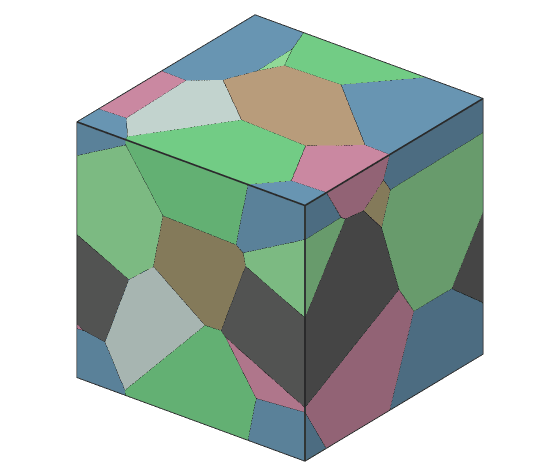
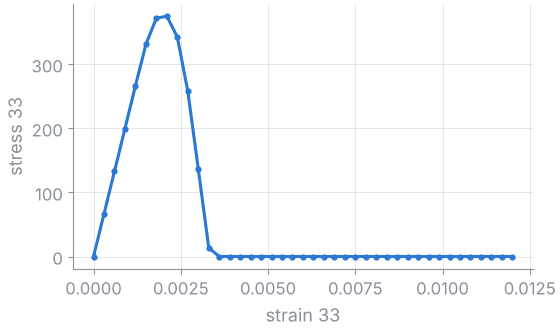
homogenization_grain_fracture — Cracks between the grains and through them: a polycrystal in crystal plasticity whose grain boundaries are cohesive and whose {100} planes cleave. With boundaries weaker than the planes the crack follows them (intergranular fracture); with strong ones it cuts through the grains along their cleavage planes (transgranular).
Needs the mesher MMG (extra mesh).
morphogen template homogenization_grain_fracture -o homogenization_grain_fracture.yaml
morphogen run homogenization_grain_fracture.yaml
Configuration
# Cracks between the grains and through them. A polycrystal meshed grain by grain: the
# boundaries of the grains are cohesive (a strength and a fracture energy), and each
# grain is a cubic crystal that slips ({110}<111>) and whose {100} planes cleave (the
# crack band: the fracture energy of the planes dissipated in one element). Which gives
# way depends on the two strengths: with boundaries weaker than the planes (here), the
# crack follows the boundaries and the grains stay whole (intergranular fracture: the
# work that breaks the cell is the fracture energy of the boundaries times the area of
# the crack); with strong boundaries (normal_strength: 3000) it cuts through the grains
# along their cleavage planes (transgranular fracture: no boundary debonds). The curve
# (grains_0000_tension_periodic.csv) has the debonded area of the boundaries and the
# damage of the cleavage planes at each step; the fields (.vtu) those of each element.
# Half a minute; a minute for the transgranular crack.
model:
  type: voronoi
  n_cells: 8
  crystal_orientations: true
domain:
  size: 1.0
  periodic: true
seed: 2
mesh:
  size: 0.2
  order: 1                     # 4-node tetrahedra, interface elements of three nodes a side
homogenization:
  method: fe
  materials:
    1:
      cubic: [230000.0, 135000.0, 117000.0]   # c11, c12, c44 (MPa)
      crystal_plasticity:
        K: 10.0
        n: 10.0
        families:
          bcc110: {tau0: 300.0, Q: 100.0, b: 20.0}
        cleavage:
          planes: cube         # {100}
          strength: 500.0      # the normal stress that opens a plane (MPa)
          energy: 1.0          # the fracture energy of the planes (N/mm)
          length: 0.2          # the size of the elements that dissipate it
          K: 20.0              # a viscosity of the opening (the crack crosses the cell at once)
          n: 1.0
  properties: []
  fields: true
  paths:
    tension:                   # the other components: zero stress
      times: [0, 1]
      increments: 40
      strain: {"33": [0, 0.012]}
  nonlinear:
    interfaces:
      faces: grains            # every boundary between two grains
      normal_strength: 300.0   # MPa: weaker than the cleavage planes (3000: stronger)
      mode_I: 0.5              # the fracture energy of the boundaries (N/mm)
outputs:
  directory: out/homogenization_grain_fracture
  name: grains
  conforming_mesh: [vtu]
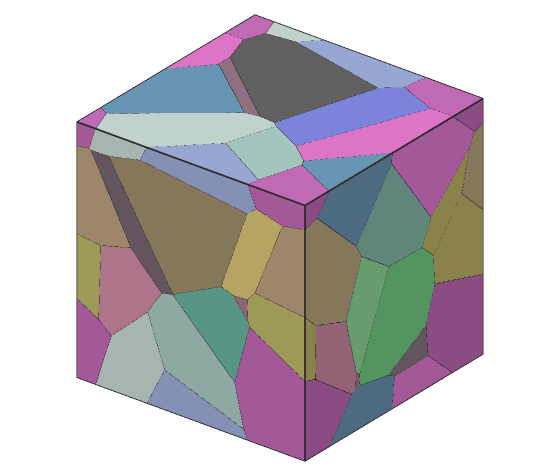
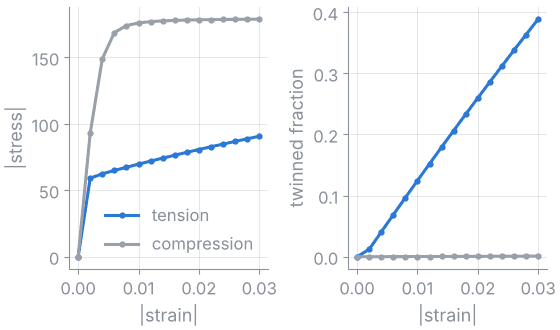
homogenization_twinning — The twins of a textured magnesium: a polycrystal whose axes c are near the load. A twin shears in one sense only: pulled, the grains twin and flow at a low stress; compressed, they do not twin and are twice as hard (crystal plasticity with twins, the nonlinear FFT solver).
morphogen template homogenization_twinning -o homogenization_twinning.yaml
morphogen run homogenization_twinning.yaml
Configuration
# The twins of a textured magnesium. A polycrystal of 20 grains on voxels whose axes c
# are near the axis 3 (a fibre texture: the law of von Mises-Fisher), each grain a
# hexagonal crystal that slips on its basal, prismatic and pyramidal <c + a> systems and
# twins on {10-12}. A twin shears in one sense only, the one that lengthens the axis c
# (c / a < sqrt 3): pulled along 3, the grains twin and the polycrystal flows at a low
# stress, the twinned fraction growing with the strain (the twins give 6.4 % at most);
# compressed along 3, it does not twin and must slip on its hard pyramidal systems: it
# is twice as hard, the asymmetry of textured magnesium. The curves
# (magnesium_0000_tension_periodic.csv, ..._compression_periodic.csv) have the twinned
# fraction at each step; the fields (.vti) that of each voxel. A minute.
model:
  type: voronoi
  n_cells: 20
  crystal_orientations: true
  texture:                     # of the axes c of the grains; the grains turned about them
    type: von_mises_fisher
    kappa: 30.0                # the mean of 1 - cos of their angle to the axis: 1 / kappa
    axis: [0, 0, 1]
domain:
  size: 1.0
  periodic: true
seed: 5
voxels:
  shape: 16
homogenization:
  method: fft
  materials:
    1:
      hexagonal: [59400.0, 25600.0, 21400.0, 61600.0, 16400.0]   # c11, c12, c13, c33, c44 (MPa)
      crystal_plasticity:
        c_over_a: 1.624
        K: 5.0                 # dgamma/dt = <(tau - r) / K>^n
        n: 10.0
        families:              # critical resolved shear stresses (MPa)
          basal: {tau0: 10.0}
          prismatic: {tau0: 60.0}
          pyramidal2_ca: {tau0: 100.0}
        twins:                 # {10-12}<10-1-1>: a shear of 0.129, in one sense
          twin1012: {tau0: 25.0, Q: 15.0, b: 20.0}
        twin_saturation: 1.0   # the fraction of a grain that may twin
  properties: []
  fields: true
  paths:
    tension:                   # the other components: zero stress
      times: [0, 1]
      increments: 15
      strain: {"33": [0, 0.03]}
    compression:
      times: [0, 1]
      increments: 15
      strain: {"33": [0, -0.03]}
outputs:
  directory: out/homogenization_twinning
  name: magnesium
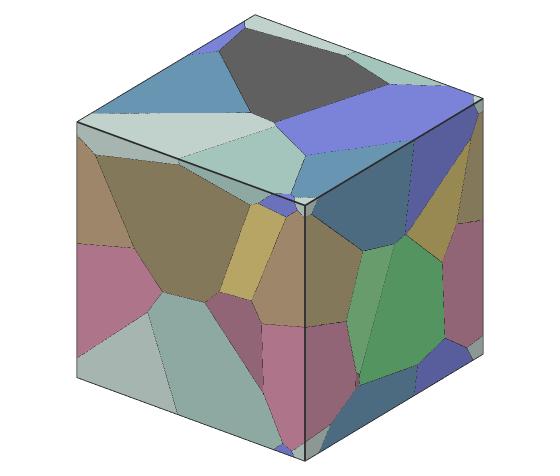
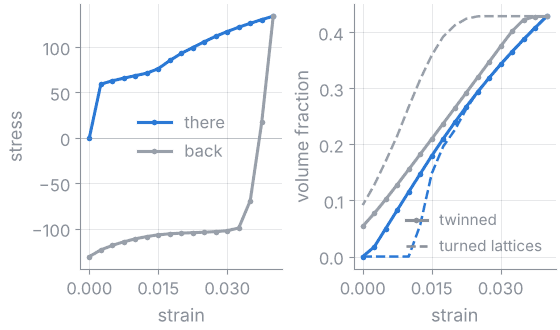
homogenization_detwinning — The twins of a textured magnesium, there and back: pulled along the axes c of its grains, the polycrystal twins, and the lattices of its points become those of their predominant twins, grain by grain (86 degrees off: the polycrystal hardens), the turned volume of each grain following its twinned volume; brought back, the twins shear back at about the stress of the tension (detwinning), and the lattices turn back to those of their grains.
morphogen template homogenization_detwinning -o homogenization_detwinning.yaml
morphogen run homogenization_detwinning.yaml
Configuration
# The twins of a textured magnesium, there and back. The polycrystal of the template
# homogenization_twinning (the axes c of its grains near the axis 3), pulled by 4 % along
# 3 and brought back. The twins that the tension made shear back when the stress is
# reversed (detwinning), at about the stress of the tension: a crystal that kept its twins
# would have to slip on its hard pyramidal systems, at nearly twice that stress
# (twin_detwinning: false; a number: the share of their resistance at which they shear
# back). And the lattices of the points become those of their predominant twins
# (twin_reorientation), 86 degrees off those of their grains, grain by grain: the most
# twinned points first, so that the turned volume of a grain is its twinned volume. A
# turned point slips and twins as the twin does - its axis c lies across the tension, the
# polycrystal hardens - and twins back to the lattice of its grain when the load is
# reversed. The curve (magnesium_0000_cycle_periodic.csv) has the twinned fraction, the
# turned volume and the mean disorientation of the points at each step; the fields (.vti)
# those of each voxel. Half a minute.
model:
  type: voronoi
  n_cells: 12
  crystal_orientations: true
  texture:                     # of the axes c of the grains; the grains turned about them
    type: von_mises_fisher
    kappa: 30.0
    axis: [0, 0, 1]
domain:
  size: 1.0
  periodic: true
seed: 5
voxels:
  shape: 12
homogenization:
  method: fft
  materials:
    1:
      hexagonal: [59400.0, 25600.0, 21400.0, 61600.0, 16400.0]   # c11, c12, c13, c33, c44 (MPa)
      crystal_plasticity:
        c_over_a: 1.624
        K: 5.0
        n: 10.0
        families:              # critical resolved shear stresses (MPa)
          basal: {tau0: 10.0}
          prismatic: {tau0: 60.0}
          pyramidal2_ca: {tau0: 100.0}
        twins:                 # {10-12}<10-1-1>: a shear of 0.129
          twin1012: {tau0: 25.0, Q: 15.0, b: 20.0}
        twin_reorientation:    # the lattices become those of the predominant twins (none
          threshold: 0.2       # by default): grain by grain, past this twinned fraction
          growth: 0.0          # (plus this times turned volume / twinned volume); a
                               # number alone: point by point, at that twinned fraction
        twin_detwinning: true  # the twins shear back when the stress is reversed (default)
  properties: []
  fields: true
  paths:
    cycle:                     # the other components: zero stress
      times: [0, 1, 2]
      increments: 16
      strain: {"33": [0, 0.04, 0.0]}
outputs:
  directory: out/homogenization_detwinning
  name: magnesium
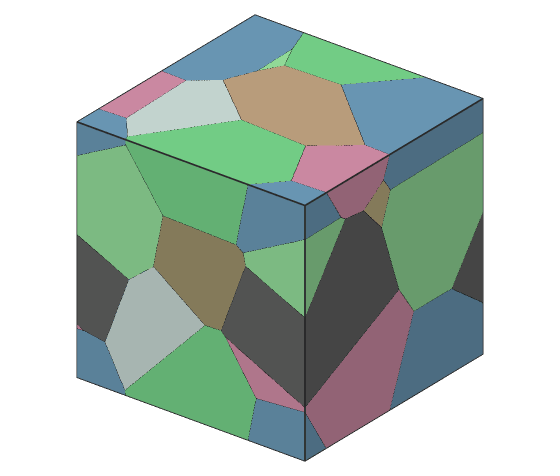
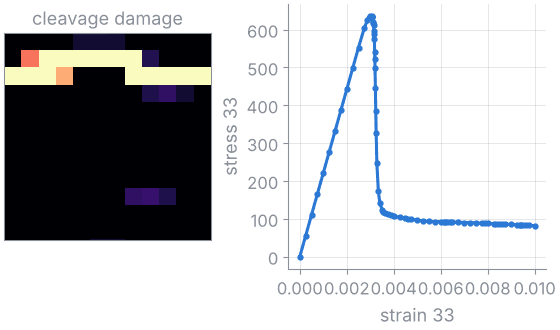
homogenization_cleavage — The cleavage of a polycrystal of iron at a low temperature: the {100} planes of its grains open at their strength and soften (a crack band of one voxel), and a crack crosses the grains from plane to plane. With a softer slip the grains flow first: slip shields cleavage.
morphogen template homogenization_cleavage -o homogenization_cleavage.yaml
morphogen run homogenization_cleavage.yaml
Configuration
# The cleavage of a polycrystal. A polycrystal of iron at a low temperature on voxels:
# each grain a cubic crystal that slips on its {110}<111> systems, hard, and whose {100}
# planes cleave: a plane opens when its normal stress is its strength, and its strength
# then falls with its opening, the fracture energy of the planes being dissipated in a
# band of one voxel (the crack band: energy and length). Pulled, the polycrystal is
# elastic up to the strength of its best oriented planes, then a crack crosses its
# grains from plane to plane: the stress falls, and the work that broke the cell is a
# few times the fracture energy times its section (the planes of the grains are
# inclined: steps, bridges). With a softer slip (tau0: 150), the grains flow before
# their planes open: slip shields cleavage, the ductile-to-brittle transition. The
# curve (iron_0000_tension_periodic.csv) has the opening and the damage of the planes;
# the fields (.vti) those of each voxel. Half a minute.
model:
  type: voronoi
  n_cells: 8
  crystal_orientations: true
domain:
  size: 0.1                    # mm: grains of some 50 micrometres
  periodic: true
seed: 2
voxels:
  shape: 12
homogenization:
  method: fft
  materials:
    1:
      cubic: [230000.0, 135000.0, 117000.0]   # c11, c12, c44 (MPa)
      crystal_plasticity:
        K: 10.0
        n: 10.0
        families:
          bcc110: {tau0: 300.0, Q: 100.0, b: 20.0}   # hard: a low temperature
        cleavage:
          planes: cube         # {100}; also dodecahedral {110}, octahedral {111}
          strength: 500.0      # the normal stress that opens a plane (MPa)
          energy: 0.05         # the fracture energy of the planes (N/mm)
          length: 0.00833      # the size of the voxels that dissipate it (size / shape)
          K: 50.0              # a viscosity of the opening: the crack crosses the cell at
          n: 1.0               # once (a snap-back), the steps pass with it
          # coupling: 5.0      # the strength falls as exp(-coupling x cumulated slip): the
                               # slip nucleates the cleavage (a softer slip, stronger planes)
  properties: []
  fields: true
  paths:
    tension:                   # the other components: zero stress
      times: [0, 1]
      increments: 40
      strain: {"33": [0, 0.01]}
outputs:
  directory: out/homogenization_cleavage
  name: iron
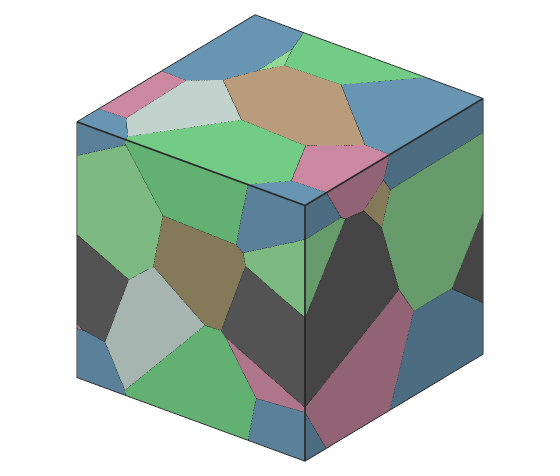
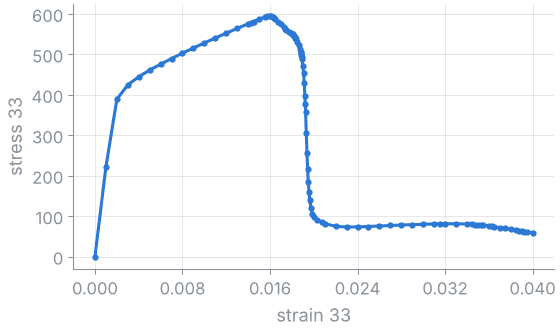
homogenization_slip_cleavage — Cleavage that the slip nucleates: a polycrystal of iron whose grains slip far below the strength of their {100} planes. The slip of a crystal lowers that strength, and the damage of the planes eases the slip in return: the polycrystal yields, hardens, and breaks across a section once its grains have slipped enough, under a lower stress and at a smaller strain than with planes of a constant strength.
morphogen template homogenization_slip_cleavage -o homogenization_slip_cleavage.yaml
morphogen run homogenization_slip_cleavage.yaml
Configuration
# Cleavage that the slip nucleates. A polycrystal of iron on voxels whose grains slip on
# their {110}<111> systems well below the strength of their {100} cleavage planes: with
# a constant strength it would yield, harden and never cleave until the stress of a
# grain came to that strength - slip shields cleavage. Here the slip of a crystal lowers
# the strength of its planes, as exp(-coupling x cumulated slip) (the coupling of
# plasticity and damage of Aslan et al. 2011), and their damage eases its slip in return:
# the polycrystal yields at some 430 MPa, hardens, and breaks across a section once its
# grains have slipped enough: at 594 MPa and 1.6 %, for 682 MPa and 2.4 % without the
# coupling (coupling: 0), where it breaks when the stress of a grain comes to the
# strength of its planes. The curve (iron_0000_tension_periodic.csv) has the plastic
# strain, the opening and the damage of the planes; the fields (.vti) those of each
# voxel. A minute.
model:
  type: voronoi
  n_cells: 8
  crystal_orientations: true
domain:
  size: 0.1                    # mm: grains of some 50 micrometres
  periodic: true
seed: 2
voxels:
  shape: 10
homogenization:
  method: fft
  materials:
    1:
      cubic: [230000.0, 135000.0, 117000.0]   # C11, C12, C44 of iron (MPa)
      crystal_plasticity:
        K: 10.0
        n: 10.0
        families:
          bcc110: {tau0: 150.0, Q: 100.0, b: 20.0}   # a slip far below the cleavage
        cleavage:
          planes: cube         # {100}
          strength: 800.0      # the normal stress that opens a plane that has not slipped (MPa)
          coupling: 5.0        # the strength falls as exp(-coupling x cumulated slip)
          energy: 0.08         # the fracture energy of the planes (N/mm)
          length: 0.01         # the size of the voxels that dissipate it (size / shape)
          K: 50.0              # a viscosity of the opening: the crack crosses the cell at
          n: 1.0               # once (a snap-back), the steps pass with it
  properties: []
  fields: true
  paths:
    tension:                   # the other components: zero stress
      times: [0, 1]
      increments: 40
      strain: {"33": [0, 0.04]}
outputs:
  directory: out/homogenization_slip_cleavage
  name: iron
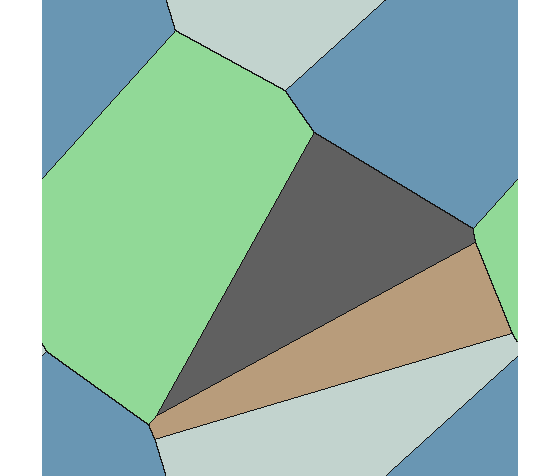
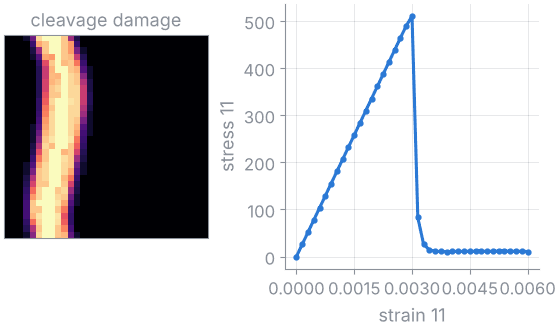
homogenization_cleavage_band — Cleavage across a band of a given width: the {100} planes of a columnar polycrystal of iron regularized by their microdamage, a field that follows their damage over a length. A plane breaks across a band five voxels wide, whatever the grid, where the fracture energy of the planes is dissipated; the crack crosses the grains in a band that winds a little from one to the next, and the planes of its middle are broken through.
morphogen template homogenization_cleavage_band -o homogenization_cleavage_band.yaml
morphogen run homogenization_cleavage_band.yaml
Configuration
# Cleavage across a band of a given width. The polycrystal of iron of
# homogenization_cleavage, here columnar on a finer grid, whose {100} planes are
# regularized by their microdamage (Aslan & Forest 2009): the strength of a plane falls
# with the damage of its point and with a field that follows it over a length, the
# microdamage, so that a plane breaks across a band of a width of its own - five voxels
# here, whatever the grid - and not across one voxel. The fracture energy of the planes
# is dissipated in this band: no length of elements to give, and the same crack on a
# finer grid. Pulled, the polycrystal is elastic up to the strength of its best oriented
# planes (510 MPa at 0.30 %), then a crack crosses its grains within a step, in a band
# that winds a little from grain to grain: the planes of its middle are broken through,
# and the work that broke the cell is 1.7 times the fracture energy times its section
# (the planes of the grains are inclined to the band: they open and slide). The curve
# (iron_0000_tension_periodic.csv) has the opening, the damage and the microdamage of
# the planes; the fields (.vti) those of each voxel: the damage is the share of its
# strength that a plane has lost, 1 where it is broken through. Half a minute.
model:
  type: voronoi
  n_cells: 5
  crystal_orientations: true
domain:
  size: [0.1, 0.1, 0.003125]   # mm: a slice one voxel thick, columnar grains
  periodic: true
seed: 3
voxels:
  shape: [32, 32, 1]
homogenization:
  method: fft
  materials:
    1:
      cubic: [230000.0, 135000.0, 117000.0]   # c11, c12, c44 (MPa)
      crystal_plasticity:
        K: 10.0
        n: 10.0
        families:
          bcc110: {tau0: 300.0, Q: 100.0, b: 20.0}   # hard: a low temperature
        cleavage:
          planes: cube         # {100}
          strength: 500.0      # the normal stress that opens a plane (MPa)
          energy: 0.05         # the fracture energy of the planes (N/mm)
          regularization:
            width: 0.015625    # the width of the damage band (mm): five voxels, some
                               # seven lengths of the microdamage; or {modulus, length}
                               # with the linear softening of the planes
          K: 50.0              # a viscosity of the opening
          n: 1.0
  properties: []
  fields: true
  paths:
    tension:                   # the other components: zero stress
      times: [0, 1]
      increments: 40
      strain: {"11": [0, 0.006]}
outputs:
  directory: out/homogenization_cleavage_band
  name: iron
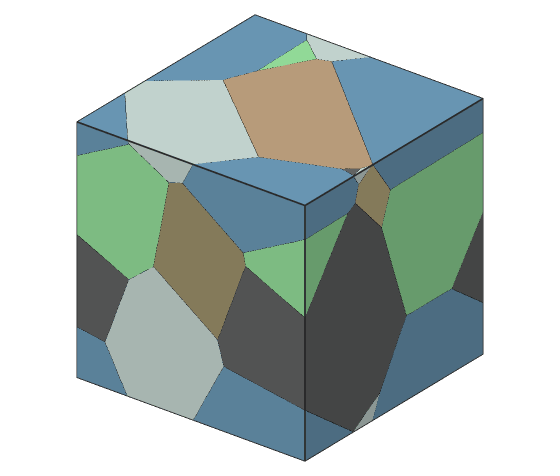
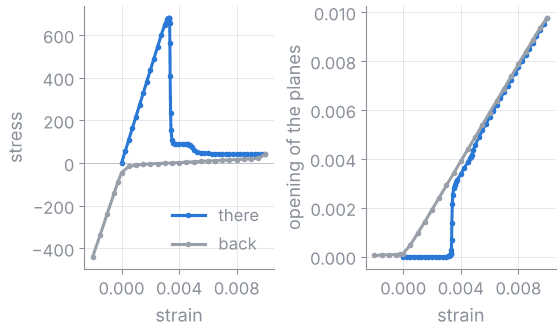
homogenization_crack_closure — A cleavage crack that closes: a polycrystal of iron pulled until a crack has crossed its grains, then pushed. The opening of the cleavage planes goes back under a low pressure, and once the crack is closed the polycrystal carries the pressure as the sound one, its lips rubbing on each other (the unilateral condition of the planes, Coulomb’s friction).
morphogen template homogenization_crack_closure -o homogenization_crack_closure.yaml
morphogen run homogenization_crack_closure.yaml
Configuration
# A cleavage crack that closes. A polycrystal of iron at a low temperature on voxels (the
# crystals of the template homogenization_cleavage: hard slip, {100} planes that cleave),
# pulled until a crack has crossed its grains, then pushed. The opening of a cleavage
# plane goes back under pressure (closure: true, the default): the crack closes at a low
# stress, and once closed the polycrystal carries the pressure nearly as the sound one,
# its lips rubbing on each other (friction). Without the closure (closure: false) the
# planes keep their opening: the lattice alone is pressed as soon as the strain goes
# down, yields, and the planes break further in shear. The curve
# (iron_0000_cycle_periodic.csv) has the opening and the damage of the planes at each
# step; the fields (.vti) those of each voxel. A minute.
model:
  type: voronoi
  n_cells: 6
  crystal_orientations: true
domain:
  size: 0.1                    # mm
  periodic: true
seed: 2
voxels:
  shape: 8
homogenization:
  method: fft
  materials:
    1:
      cubic: [230000.0, 135000.0, 117000.0]   # c11, c12, c44 (MPa)
      crystal_plasticity:
        K: 10.0
        n: 10.0
        families:
          bcc110: {tau0: 300.0, Q: 100.0, b: 20.0}
        cleavage:
          planes: cube         # {100}
          strength: 500.0      # the normal stress that opens a plane (MPa)
          energy: 0.05         # the fracture energy of the planes (N/mm)
          length: 0.0125       # the size of the voxels that dissipate it (size / shape)
          K: 50.0
          n: 1.0
          closure: true        # the planes close under pressure (the default)
          friction: 0.3        # Coulomb's, of the lips of a plane under pressure (default 0)
  properties: []
  fields: true
  paths:
    cycle:                     # the other components: zero stress
      times: [0, 1, 2]
      increments: [40, 24]
      strain: {"33": [0, 0.01, -0.002]}
outputs:
  directory: out/homogenization_crack_closure
  name: iron
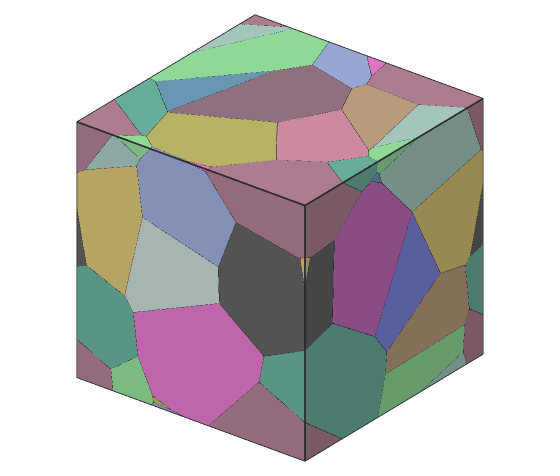
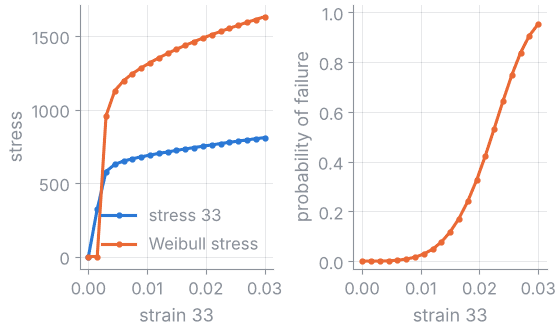
homogenization_beremin — The probability of cleavage of a ferritic steel (the local approach of Beremin): the Weibull stress of the voxels of a polycrystal that have yielded, each driven by the normal stress of the {100} planes of its grain, gives the probability that the weakest link of a tensile bar has failed, from nothing at the yield stress to a certainty as the steel hardens.
morphogen template homogenization_beremin -o homogenization_beremin.yaml
morphogen run homogenization_beremin.yaml
Configuration
# The probability of cleavage of a ferritic steel, by the local approach of Beremin. A
# polycrystal of 20 grains on voxels, each a cubic crystal that slips on its {110}<111>
# and {112}<111> systems, pulled to 3 % at a low temperature. Cleavage starts at
# microcracks that the plastic strain nucleates: every voxel that has yielded is a link
# of a chain, driven by the largest normal stress of the {100} planes of its grain, and
# the Weibull stress of the cell, (sum of sigma^m V / V0)^(1/m), gives the probability
# that the weakest link has failed, 1 - exp(-(sigma_w / sigma_u)^m). The cell stands
# for a point of the gauge of a tensile bar of 10^6 such cells, 1 cm^3: the reference
# volume V0 = (50 micrometres)^3 is divided by their number. The probability rises
# with the hardening, from nothing at the yield stress to a half near 2 %: the scatter
# of the strain to failure of a brittle steel. The curve
# (steel_0000_tension_periodic.csv) has the Weibull stress and the probability at each
# step; the field (..._beremin.vti) the stress that drives each voxel. Half a minute.
model:
  type: voronoi
  n_cells: 20
  crystal_orientations: true
domain:
  size: 0.1                    # mm: grains of some 40 micrometres
  periodic: true
seed: 7
voxels:
  shape: 12
homogenization:
  method: fft
  materials:
    1:
      cubic: [230000.0, 135000.0, 117000.0]   # c11, c12, c44 (MPa)
      crystal_plasticity:
        families: [bcc110, bcc112]
        tau0: 250.0            # a low temperature
        Q: 80.0
        b: 15.0
        K: 10.0
        n: 10.0
  properties: []
  paths:
    tension:                   # the other components: zero stress
      times: [0, 1]
      increments: 20
      strain: {"33": [0, 0.03]}
  beremin:
    modulus: 22.0              # m of Weibull
    scale: 1550.0              # sigma_u (MPa)
    volume: 1.25e-10           # V0 = (0.05 mm)^3 over the 10^6 cells of the gauge (mm^3)
    planes: cube               # the normal stress of {100}; left out: the principal stress
    plastic: 1.0e-4            # the plastic zone: the points beyond this plastic strain
outputs:
  directory: out/homogenization_beremin
  name: steel
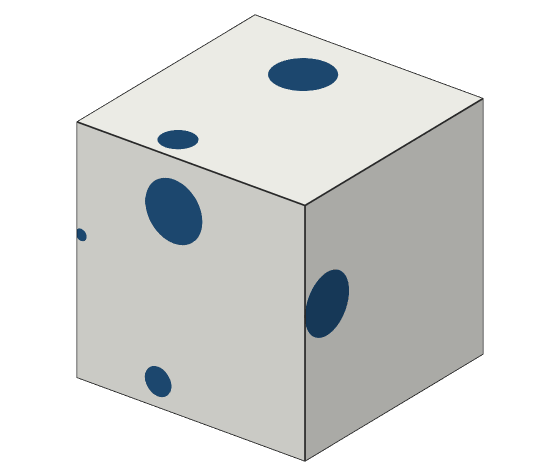
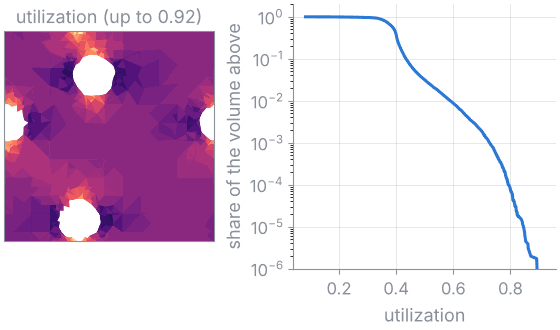
homogenization_fatigue — Pores in a cast alloy under a tension that alternates: Dang Van’s criterion of multiaxial fatigue on the stresses of a cycle maps the utilization of each point, the largest at the equators of the pores, and gives the factor of safety of the cell.
Needs the mesher MMG (extra mesh).
morphogen template homogenization_fatigue -o homogenization_fatigue.yaml
morphogen run homogenization_fatigue.yaml
Configuration
# Pores in a cast alloy under a tension that alternates: where will fatigue start, and
# how far is the alloy from its limit? The cell stays elastic (high-cycle fatigue): the
# stresses of its points along one cycle are judged by Dang Van's criterion, calibrated
# on the fatigue limits of the alloy in alternating bending and torsion. A pore doubles
# the stress at its equator: there the utilization (the equivalent stress over the
# limit) is the largest, and its inverse is the factor by which the loading may grow
# before a point reaches its limit. The file pores_0000_cycle_periodic_fatigue.vtu maps
# the utilization, the amplitude of the shear and the largest pressure; the results
# have the largest utilization, the factor of safety and the share of the alloy beyond
# its limit. About a minute.
model:
  type: hardcore_spheres       # the pores (phase 1)
  radius: 0.5
  volume_fraction: 0.04
domain:
  size: 4.0
  periodic: true
seed: 5
mesh:
  size: 0.35                   # 10-node tetrahedra of the alloy alone, curved on the pores
homogenization:
  method: fe
  materials:
    0: {young: 72000.0, poisson: 0.33}   # the alloy (MPa)
    1: void
  properties: []
  paths:
    cycle:                     # a stress of 40 that alternates; free components: zero stress
      times: [0, 1, 2, 3]
      increments: [1, 2, 2]
      stress: {"11": [0, 40, -40, 40]}
  fatigue:
    criterion: dang_van        # crossland | sines | dang_van | findley | matake
    bending: 110.0             # the fatigue limits of the alloy, alternating bending
    torsion: 80.0              # and torsion (or the coefficients: alpha, beta)
    cycle: [1, 3]              # from the first peak on: the rise from zero is left out
outputs:
  directory: out/homogenization_fatigue
  name: pores
  conforming_mesh: [vtu]
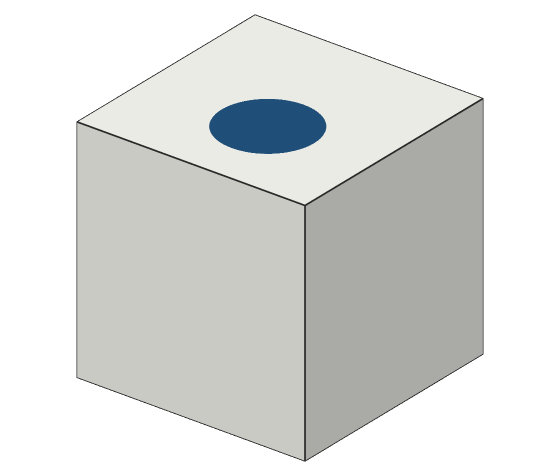
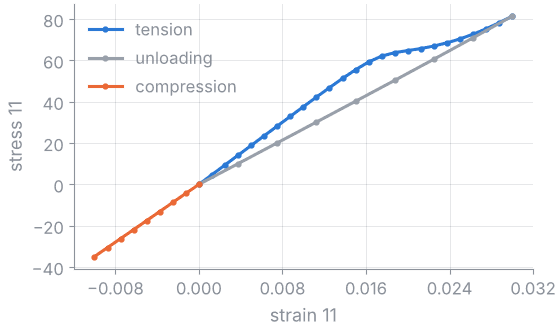
homogenization_debonding — Glass beads that debond from their matrix: cohesive interfaces between the phases (a strength, a fracture energy, Coulomb’s friction once broken). The composite softens to a matrix with holes in tension and finds most of its stiffness again in compression.
Needs the mesher MMG (extra mesh).
morphogen template homogenization_debonding -o homogenization_debonding.yaml
morphogen run homogenization_debonding.yaml
Configuration
# Glass beads that debond from their matrix. The interfaces of the two phases are
# cohesive: a bilinear traction-separation law (a strength and a fracture energy) whose
# broken points touch again in compression and rub (Coulomb's friction). Pulled, the
# composite is first as stiff as with bonded beads; between one and two percent of strain
# the beads debond, from their poles, and its tangent modulus falls to that of a matrix
# with holes. Unloaded, it comes back to the origin along the softer modulus; pushed, the
# poles of the beads close and carry the load again: nearly the modulus of the bonded
# composite, in compression only. The curve (beads_0000_tension_periodic.csv) has at
# each step the debonded area, the mean damage and the largest opening of the interfaces
# and the energy that friction dissipated; about a minute.
model:
  type: hardcore_spheres
  radius: 0.45
  number: 2
domain:
  size: 2.0
  periodic: true
seed: 3
mesh:
  size: 0.45
  hausdorff: 0.04              # the distance of the faces to the spheres
  order: 1                     # 4-node tetrahedra, interface elements of three nodes a side
homogenization:
  method: fe
  materials:
    0: {young: 3000.0, poisson: 0.35}    # the matrix (an epoxy, MPa)
    1: {young: 70000.0, poisson: 0.22}   # the beads (glass)
  properties: []
  paths:
    tension:                   # free components: zero stress
      times: [0, 1, 2, 3]
      increments: [24, 8, 8]
      strain: {"11": [0, 0.03, 0, -0.01]}
  nonlinear:
    interfaces:
      normal_strength: 30.0    # MPa: the shear strength is the same unless given
      mode_I: 0.05             # the fracture energy (N/mm)
      friction: 0.3            # of the broken interfaces
      viscosity: 0.02          # a bead debonds at once: the damage is slowed (time of the path)
outputs:
  directory: out/homogenization_debonding
  name: beads
  conforming_mesh: [vtu]
Fracture¶
Cells that break along a loading path, by the phase-field method: cracks start, run and merge in the phases without being meshed or tracked; a planar section of the volume (voxels.section) makes them quick.
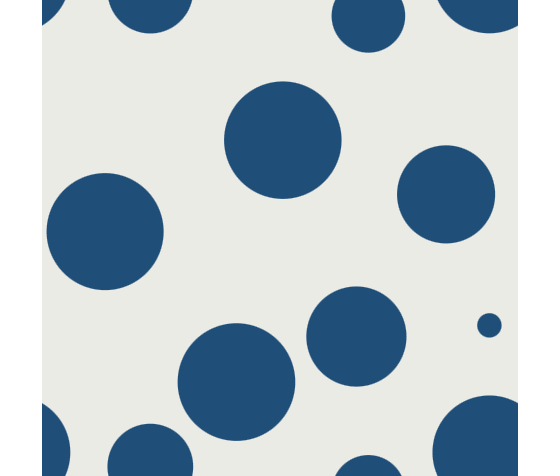
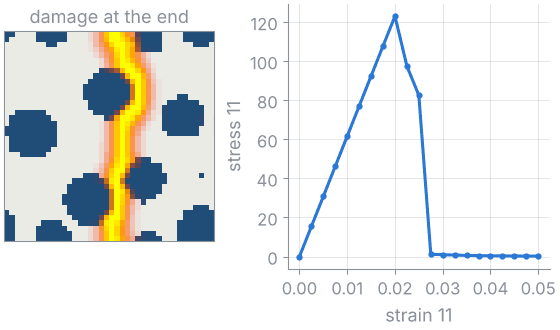
fracture_composite — Glass beads in a brittle epoxy pulled until a crack crosses the cell: the strength and the work of fracture of the composite.
morphogen template fracture_composite -o fracture_composite.yaml
morphogen run fracture_composite.yaml
Configuration
# A composite that breaks, by the phase-field method: glass beads in a brittle epoxy,
# pulled until a crack crosses the cell. The damage field regularizes the cracks over
# the length (two voxels at least); the toughness G_c is the energy of their unit area
# (lengths in micrometres, stresses in MPa: G_c in J/m2); the beads have none and do not
# break. Cracks start at the poles of the beads, where the matrix is stretched most,
# and join across the cell: the strength, near 120 MPa at a strain of 2 %, hardly depends
# on the voxels (122 to 124 MPa on 32, 40 and 48 voxels per edge). voxels.section
# studies one layer of voxels through the middle of the volume (a plane strain): 40 x 40
# voxels instead of 40^3; about a minute.
# Curve: section_0000_pull_periodic.csv (stress, damage, crack surface); fields: .vti.
model:
  type: hardcore_spheres
  radius: 10.0
  volume_fraction: 0.25
domain:
  size: 80.0
  periodic: true
  unit: um
seed: 4
voxels:
  shape: 40
  section: z                   # the layer normal to z through the middle of the volume
homogenization:
  method: fft
  materials:
    0: {young: 3000.0, poisson: 0.38}    # epoxy
    1: {young: 70000.0, poisson: 0.22}   # glass
  properties: []
  paths:
    pull:
      times: [0, 1]
      increments: 20
      strain: {"11": [0, 0.05]}          # the other stresses are free
  fracture:
    toughness: {0: 100.0}                # of the phases that break (phase: G_c)
    length: 4.0                          # of the regularization: the strength goes as sqrt(E G_c / length)
    model: AT1                           # elastic up to a strength; AT2: damage from the first load
    split: spectral                      # the tensile energy breaks; also volumetric, none
  fields: true
outputs:
  directory: out/fracture_composite
  name: section
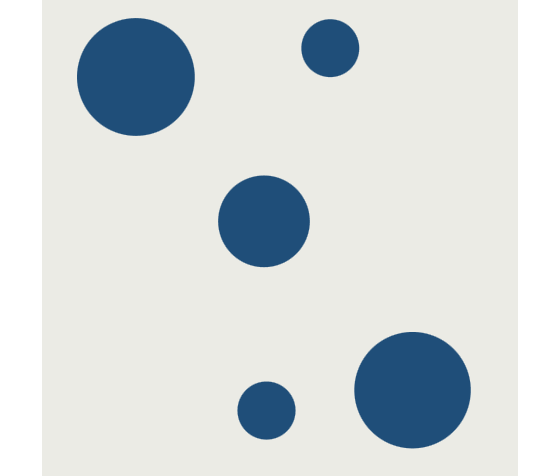
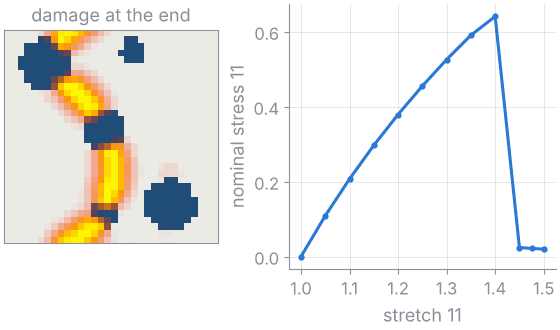
fracture_rubber — A perforated rubber sheet that tears at a stretch of 1.45, in finite strains: the ligaments between the holes break one after another.
morphogen template fracture_rubber -o fracture_rubber.yaml
morphogen run fracture_rubber.yaml
Configuration
# A perforated rubber sheet that tears, by the phase-field method in finite strains: a
# neo-Hookean rubber with holes (20 %), stretched across with its width held and its
# thickness free (the pure shear test of rubbers). The energy of the cell is that of the
# deformation gradient over the reference configuration; the isochoric energy and the
# expansion drive the damage (split: volumetric). The ligaments between the holes
# stretch to 1.4, then a crack runs through them across the sheet. Lengths in mm,
# stresses in MPa (G_c in kJ/m2). voxels.section: one layer of voxels through the middle
# of the volume. About four minutes, most of them in the step where the crack runs.
# Curve: sheet_0000_stretch_periodic.csv (nominal and true measures, damage).
model:
  type: hardcore_spheres       # the holes
  radius: 1.0
  volume_fraction: 0.2
domain:
  size: 8.0
  periodic: true
  unit: mm
seed: 6
voxels:
  shape: 32
  section: z
homogenization:
  method: fft
  materials:
    0:                                   # the rubber
      young: 3.0
      poisson: 0.45
      hyperelasticity: {model: neo_hookean}
    1: void                              # the holes
  properties: []
  paths:
    stretch:
      times: [0, 1]
      increments: 10
      strain: {"11": [0, 0.5], "22": [0, 0]}   # nominal; the thickness (33) is free
  nonlinear:
    kinematics: finite                   # the phase field in finite strains
  fracture:
    toughness: {0: 1.0}
    length: 0.5
    model: AT1
    split: volumetric                    # a rubber: volumetric or none
    residual: 1.0e-3                     # stiffness left in the broken voxels
  fields: true
outputs:
  directory: out/fracture_rubber
  name: sheet
Multiphysics: transport, couplings, harmonic regimes, flow and sound¶
The other physics of the homogenization module on the same microstructures: transport of a scalar potential, weak and strong couplings, harmonic regimes, the flow of a fluid through the pores and the acoustics of porous media, and the extended finite elements that cut a regular grid by the interfaces (guide to the physics).
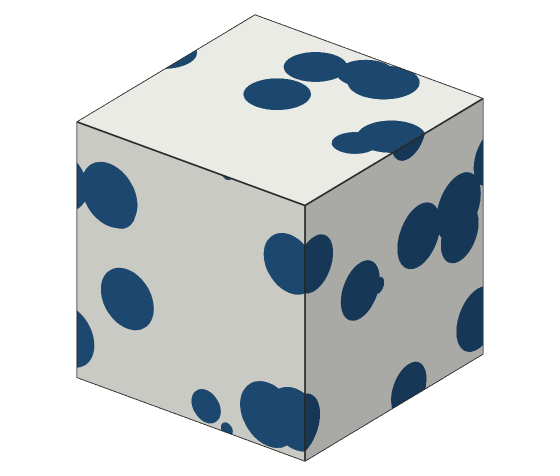
homogenization_transport — Thermal and electrical conductivities, permittivity and diffusivity of conducting, impermeable spheres in a polymer (FFT), with their bounds.
morphogen template homogenization_transport -o homogenization_transport.yaml
morphogen run homogenization_transport.yaml
Configuration
# Four transport phenomena of a scalar potential on the same voxels (FFT solver): the
# thermal and electrical conductivities, the permittivity and the diffusivity of
# conducting, impermeable spheres in a polymer, each with its bounds (Wiener,
# Hashin-Shtrikman). Below their percolation threshold the spheres leave the composite an
# electrical insulator; its diffusivity is that of the matrix divided by its tortuosity.
model:
  type: boolean_spheres
  radius: 1.0
  volume_fraction: 0.2
domain:
  size: 8.0
  periodic: true
seed: 7
realizations: 2
voxels:
  shape: 32
homogenization:
  method: fft
  materials:                # SI units; a zero coefficient: a phase inert for that physics
    0: {conductivity: 0.2, electrical_conductivity: 1.0e-12, permittivity: 3.0,
        diffusivity: 1.0e-12}
    1: {conductivity: 30.0, electrical_conductivity: 1.0e+4, permittivity: 10.0,
        diffusivity: 0.0}
  properties: [conductivity, electrical_conductivity, permittivity, diffusivity,
               conductivity_tensor]
outputs:
  directory: out/homogenization_transport
  name: composite
  image: [vti]
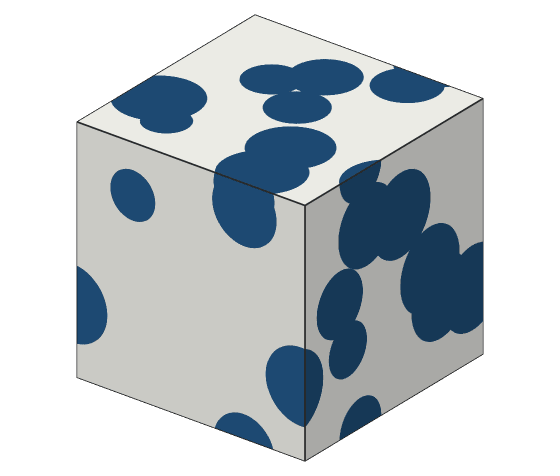
homogenization_piezoelectric — A piezoelectric composite of barium titanate particles in a polymer: the displacement and the electric potential solved together, the constants of the effective law.
morphogen template homogenization_piezoelectric -o homogenization_piezoelectric.yaml
morphogen run homogenization_piezoelectric.yaml
Configuration
# A piezoelectric composite: barium titanate particles poled along x3 in a polymer (SI
# units). The displacement and the electric potential are solved together on the voxels
# (a strong coupling: MINRES preconditioned in Fourier space); the results are the
# tensors of the effective law (stiffness, piezoelectric matrix e, permittivity) and its
# constants: d33, g33, the hydrostatic coefficients d_h and g_h, the coupling factors.
model:
  type: boolean_spheres
  radius: 1.0
  volume_fraction: 0.3
domain:
  size: 6.0
  periodic: true
seed: 11
voxels:
  shape: 16
homogenization:
  method: fft
  materials:
    0: {young: 4.0e+9, poisson: 0.35, permittivity: 3.7e-11}        # polymer
    1:                                                               # BaTiO3 (Li & Dunn 1998)
      hexagonal: [166.0e+9, 77.0e+9, 78.0e+9, 162.0e+9, 43.0e+9]
      permittivity: [11.2e-9, 11.2e-9, 12.6e-9]
      coupling: {piezoelectric: {e31: -4.4, e33: 18.6, e15: 11.6}}   # C/m^2
  properties: [piezoelectric]
outputs:
  directory: out/homogenization_piezoelectric
  name: composite
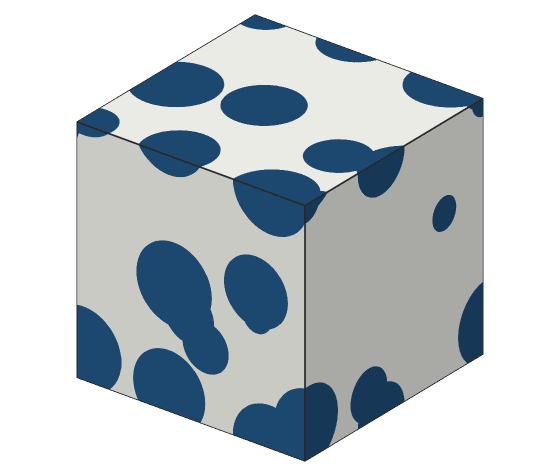
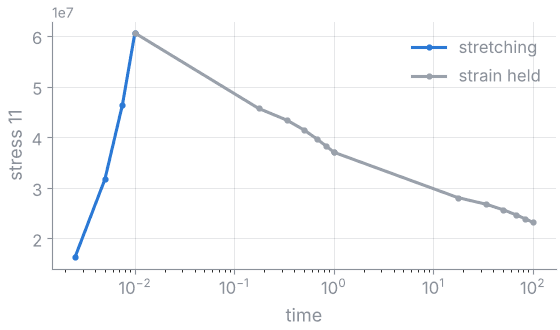
homogenization_viscoelastic — Glass beads in a viscoelastic resin: storage and loss moduli over five decades of frequency, and the relaxation in time.
morphogen template homogenization_viscoelastic -o homogenization_viscoelastic.yaml
morphogen run homogenization_viscoelastic.yaml
Configuration
# Glass beads in a viscoelastic resin (a Prony series of its shear and bulk moduli): the
# storage and loss moduli of the composite over five decades of frequency (the
# correspondence principle, complex laws on the voxels) and, in time, its relaxation
# after a fast stretch (the same law integrated exactly along a loading path).
model:
  type: boolean_spheres
  radius: 1.0
  volume_fraction: 0.25
domain:
  size: 6.0
  periodic: true
seed: 5
voxels:
  shape: 20
homogenization:
  method: fft
  materials:
    0:                       # resin: instantaneous moduli, then (relative modulus, time)
      young: 3.0e+9
      poisson: 0.35
      viscoelasticity:
        shear: [[0.4, 0.01], [0.3, 1.0], [0.15, 100.0]]
        bulk: [[0.2, 1.0]]
    1: {young: 70.0e+9, poisson: 0.22}                               # glass
  properties: [dynamic_stiffness]
  frequencies: [0.001, 0.01, 0.1, 1.0, 10.0, 100.0]                  # rad/s
  paths:
    relaxation:              # stretch in 0.01 s, then hold; the other stresses are free
      times: [0, 0.01, 1, 100]
      increments: [4, 6, 6]
      strain: {"11": [0, 0.01, 0.01, 0.01]}
outputs:
  directory: out/homogenization_viscoelastic
  name: composite
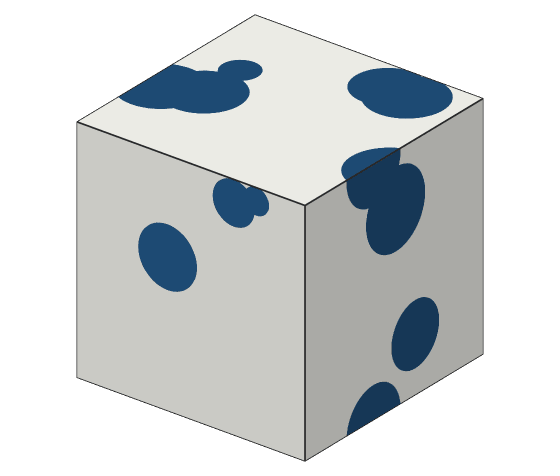
homogenization_poroelastic — The poroelastic law of a porous solid: drained stiffness, tensor and modulus of Biot, undrained response with water in the pores.
morphogen template homogenization_poroelastic -o homogenization_poroelastic.yaml
morphogen run homogenization_poroelastic.yaml
Configuration
# The poroelastic law of a porous solid (Biot): its drained stiffness, the tensor and the
# modulus of Biot (Sigma = C_d : E - b p; change of porosity b : E + p / N) and, with
# water in the pores, the undrained stiffness and the coefficient of Skempton (Gassmann).
# The pressure of the pores is one more loading of the elastic solver: the eigenstrain
# -p S_s : 1 of the solid.
model:
  type: boolean_spheres     # the pores: overlapping spheres, connected above 29 %
  radius: 1.0
  volume_fraction: 0.2
domain:
  size: 6.0
  periodic: true
seed: 3
realizations: 2
voxels:
  shape: 24
homogenization:
  method: fft
  materials:
    0: {young: 60.0e+9, poisson: 0.15}     # quartz-like solid
    1: void
  properties: [stiffness, poroelastic]
  fluid_bulk_modulus: 2.2e+9               # water
outputs:
  directory: out/homogenization_poroelastic
  name: rock
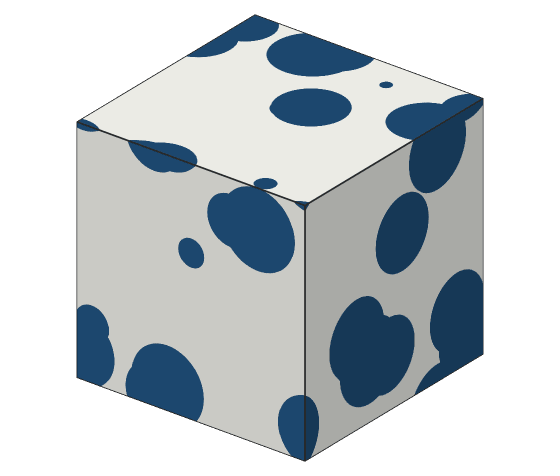
homogenization_xfem — Extended finite elements: a regular grid cut by the level set of the spheres, elastic and thermal properties without a mesher.
morphogen template homogenization_xfem -o homogenization_xfem.yaml
morphogen run homogenization_xfem.yaml
Configuration
# Extended finite elements: the level set of the spheres cuts a regular grid of 16^3
# cells (six tetrahedra each), whose cut elements are enriched (Moes et al. 2003) instead
# of drawing the interfaces as stairs of voxels or meshing them. Elastic and thermal
# properties under periodic conditions; compare with method: fft at the same shape.
model:
  type: boolean_spheres
  radius: 1.0
  volume_fraction: 0.25
domain:
  size: 6.0
  periodic: true
seed: 2
voxels:
  shape: 16                 # the grid cut by the interfaces
homogenization:
  method: xfem
  materials:
    0: {young: 1.0, poisson: 0.3, conductivity: 1.0}
    1: {young: 10.0, poisson: 0.3, conductivity: 10.0}
  properties: [bulk_modulus, shear_modulus, conductivity, stiffness]
outputs:
  directory: out/homogenization_xfem
  name: spheres
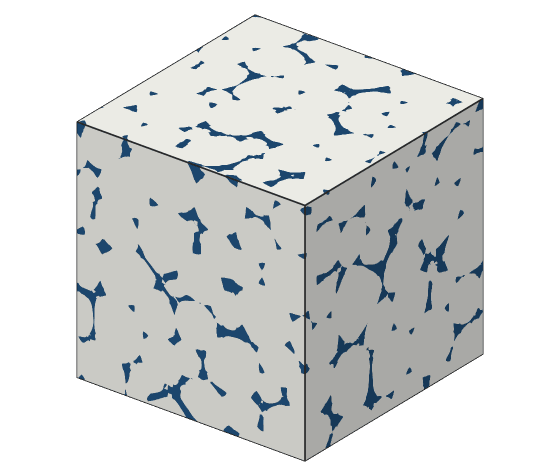
homogenization_acoustic_foam — The flow and the sound in an open-cell foam: Darcy’s permeability by a Stokes flow through the pores, and the parameters of its equivalent fluid (tortuosity, characteristic lengths).
morphogen template homogenization_acoustic_foam -o homogenization_acoustic_foam.yaml
morphogen run homogenization_acoustic_foam.yaml
Configuration
# The flow and the sound in an open-cell foam: the permeability of Darcy's law (a Stokes
# flow through the pores, by the lattice Boltzmann method) and the parameters of the
# equivalent fluid of the rigid frame (Johnson-Champoux-Allard-Lafarge): porosity,
# tortuosity, viscous and thermal characteristic lengths, thermal permeability. Lengths
# in mm here: the permeabilities come out in mm^2 (1e-6 m^2). In Python,
# morphogen.homogenization.absorption gives the absorption of a layer from them.
# The foam is a level set of distance fields (as the template level_set_foam): cells of
# about 0.3 mm, 8 % of solid in struts that thicken towards their nodes. Raise
# domain.size for the statistics (an rve section) and lower voxels.voxel_size until the
# parameters settle (the struts are two voxels thick here).
model:
  type: level_set_foam
  seed_radius: {type: uniform, low: 0.12, high: 0.18}
  packing: dense
  packing_fraction: 0.6
  volume_fraction: 0.08
  curvature: -0.7
  c1: 50.0
  c2: 1.0
domain:
  size: 1.5
  periodic: true
seed: 3
voxels:
  voxel_size: 0.025
homogenization:
  method: fft
  materials:
    0: void                                  # the pores: the fluid flows through them
    1: {young: 2500.0, poisson: 0.35}        # polymer (MPa); the frame is rigid for the flow
  properties: [hydraulic_permeability, acoustic]
  tolerance: 1.0e-4
outputs:
  directory: out/homogenization_acoustic_foam
  name: foam
  image: [vti]
RVE studies¶
The size of the representative volume element by the ensemble and window methods.
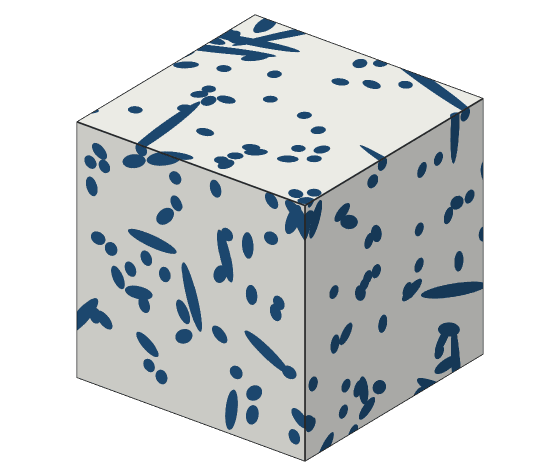
rve_poisson_fibers — The variance of the volume fraction and specific surface of Poisson fibres at five sizes (ensemble method).
morphogen template rve_poisson_fibers -o rve_poisson_fibers.yaml
morphogen run rve_poisson_fibers.yaml
Configuration
# RVE study by the ensemble method (Kanit et al. 2003; Dirrenberger et al. 2014):
# realizations at several sizes, variance of the volume fraction and specific surface,
# fit D^2(V) = K V^-gamma (gamma = 2/3 in theory for Poisson fibres), RVE sizes.
model:
  type: poisson_fibers
  radius: 1.0
  volume_fraction: 0.16
domain:
  periodic: false
seed: 2014
voxels:
  voxel_size: 0.5
rve:
  method: ensemble
  sizes: [10, 15, 20, 30, 40]        # cube edges
  realizations: [64, 48, 32, 16, 8]  # per size (or a single number)
  properties: [volume_fraction, specific_surface]
  relative_errors: [0.01, 0.05]
  n_realizations: [1, 10]
outputs:
  directory: out/rve_poisson_fibers
  name: fibres
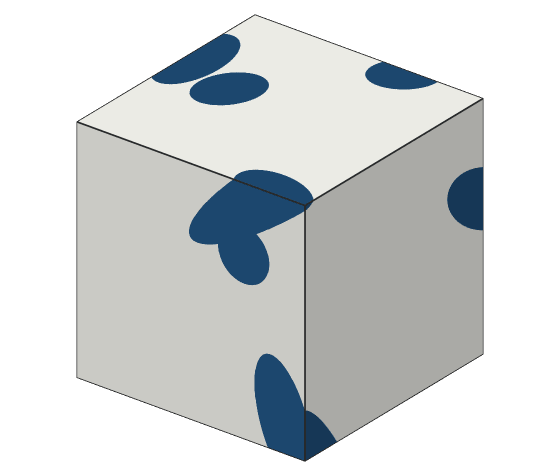
rve_poisson_fibers_fe — The RVE sizes of the elastic and thermal properties of Poisson fibres, KUBC and MBC (finite elements).
Needs the mesher MMG (extra mesh).
morphogen template rve_poisson_fibers_fe -o rve_poisson_fibers_fe.yaml
morphogen run rve_poisson_fibers_fe.yaml
Configuration
# RVE study of the apparent elastic and thermal properties of Poisson fibres, after
# Dirrenberger, Forest & Jeulin (2014): steel fibres (16 %) in a porous matrix, kinematic
# (KUBC) and mixed (MBC) boundary conditions, gamma = 2/3 imposed for the RVE sizes.
# Each realization is meshed conformingly (only the fibres: the pores carry no stress
# nor flux) and solved by finite elements (10-node elements whose nodes lie on the
# fibres). This is a laptop-sized version (about four
# minutes): increase the sizes and realizations, and split the study across cluster
# jobs (--task-id, --n-tasks), for real studies.
model:
  type: poisson_fibers
  radius: 1.0
  volume_fraction: 0.16
domain:
  periodic: false
seed: 2014
mesh:
  size: 1.0                   # the fibre radius; the interface is refined
homogenization:
  materials:
    0: void                   # pores
    1: {young: 210000.0, poisson: 0.3, conductivity: 100.0}   # steel, MPa and W/(m K)
  boundary_conditions: [kubc, mixed]
  properties: [bulk_modulus, shear_modulus, conductivity]
rve:
  method: ensemble
  sizes: [5, 7, 9]
  realizations: [12, 8, 5]
  gamma: 0.6666667            # theoretical exponent of Poisson fibres (Jeulin 2011)
  relative_errors: [0.01, 0.05]
  n_realizations: [1, 10]
outputs:
  directory: out/rve_poisson_fibers_fe
  name: fibres
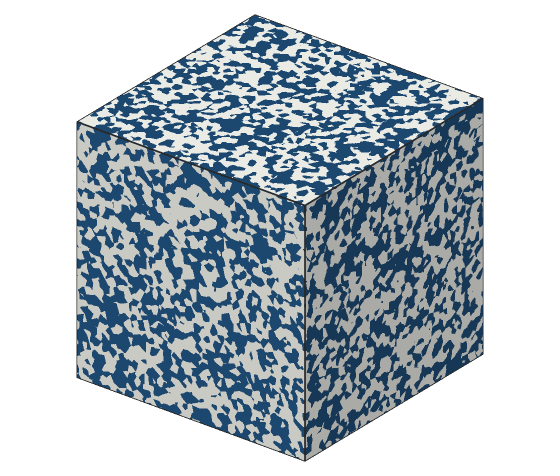
rve_voronoi_windows — The window method on one large two-phase Voronoi mosaic.
morphogen template rve_voronoi_windows -o rve_voronoi_windows.yaml
morphogen run rve_voronoi_windows.yaml
Configuration
# RVE study by the window method: variance of the volume fraction over non-overlapping
# sub-volumes of one large two-phase Voronoi mosaic (integral range 1.179 / theta).
model:
  type: voronoi
  intensity: 1.0
  phase_fractions: [0.5, 0.5]
domain:
  periodic: true
seed: 2003
voxels:
  voxel_size: 0.2
rve:
  method: windows
  size: 40.0
  window_sizes: [4, 5, 8, 10]  # window edges; keep at least ~30 windows per size
  gamma: 1.0                   # impose gamma = 1 (finite integral range)
  min_volume: 100              # fit only windows much larger than the integral range
outputs:
  directory: out/rve_voronoi_windows
  name: mosaic
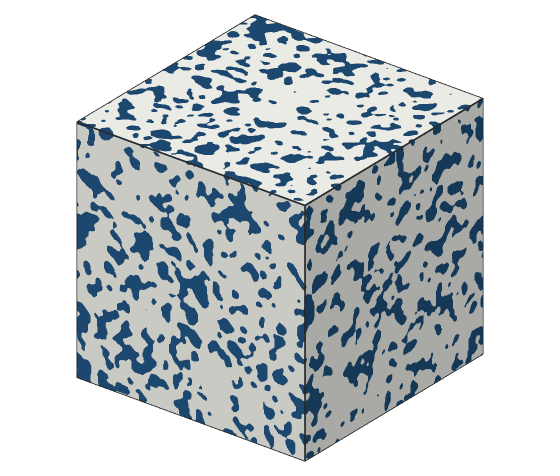
rve_cellular_automaton — The window method on a structure grown by a cellular automaton.
morphogen template rve_cellular_automaton -o rve_cellular_automaton.yaml
morphogen run rve_cellular_automaton.yaml
Configuration
# RVE study by the window method of a structure grown by a cellular automaton: the
# variance of the volume fraction over sub-volumes of one large realization gives its
# integral range and the RVE sizes for given precisions (Kanit et al. 2003). Automata
# generate any size in a few seconds: the lattice of the cube of edge 64 has 256^3 cells.
model:
  type: cellular_automaton
  rule: conserved              # coarsening at constant volume fraction
  volume_fraction: 0.3
  steps: 30
  cell_size: 0.25
domain:
  periodic: true
seed: 2003
voxels:
  voxel_size: 0.25             # one voxel per cell
rve:
  method: windows
  size: 64.0
  window_sizes: [4, 8, 16]
  relative_errors: [0.01, 0.05]
outputs:
  directory: out/rve_cellular_automaton
  name: automaton
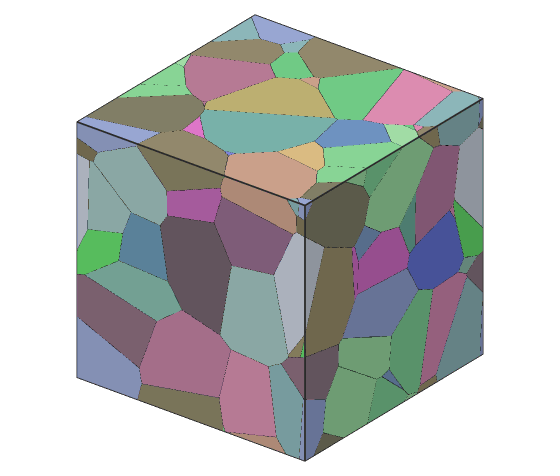
rve_crystal_plasticity_fft — The RVE sizes of the elastic and viscoplastic responses of a polycrystal (Yang et al. 2019; FFT).
morphogen template rve_crystal_plasticity_fft -o rve_crystal_plasticity_fft.yaml
morphogen run rve_crystal_plasticity_fft.yaml
Configuration
# RVE study of the elastic and viscoplastic responses of a polycrystal, after Yang,
# Dirrenberger, Monteiro & Ranc (2019): Poisson-Voronoi grains (one per unit volume,
# random orientations) of a nickel alloy with crystal plasticity (Meric and Cailletaud),
# pulled to 1 % at 1e-3 /s with free lateral faces, on voxels (the nonlinear FFT solver,
# periodic conditions). The apparent bulk and shear moduli and the stress of the tension
# at 0.1, 0.3 and 1 % (the end of the elastic regime, the elastic-plastic transition and
# the plastic flow) are analysed at three volumes: variance scaling, RVE sizes and their
# numbers of grains (rve_report.md). A laptop-sized study (about 90 s; wide confidence
# intervals): increase the sizes and the realizations, and split the study across
# cluster jobs (--task-id, --n-tasks), for real studies.
model:
  type: voronoi
  intensity: 1.0                      # grains per unit volume
  crystal_orientations: true
domain:
  periodic: true
seed: 2019
voxels:
  voxel_size: 0.2                     # about 125 voxels per grain
homogenization:
  method: fft
  materials:
    1:
      cubic: [250000, 160000, 120000]  # MPa
      crystal_plasticity:
        families: [octahedral]
        tau0: 80                        # MPa
        Q: 20
        b: 10
        C: 20000
        D: 300
        K: 25
        n: 10
        interaction: [1.0, 1.0, 0.6, 12.3, 1.6, 1.3]
  properties: [bulk_modulus, shear_modulus]
  paths:
    tension:                            # strain rate 1e-3 /s, lateral stresses free
      times: [0, 1, 3, 10]
      increments: [2, 4, 7]
      strain: {"11": [0, 0.001, 0.003, 0.01]}
rve:
  method: ensemble
  sizes: [2, 3, 4]                      # 8, 27 and 64 grains on average
  realizations: [16, 8, 4]
  # quantities of the curves: S11 of the path tension at the times 1 and 3, and at its end
  properties: [bulk_modulus, shear_modulus, tension.S11@1, tension.S11@3, tension.S11]
  relative_errors: [0.01, 0.05]
  n_realizations: [1, 10]
outputs:
  directory: out/rve_crystal_plasticity_fft
  name: polycrystal
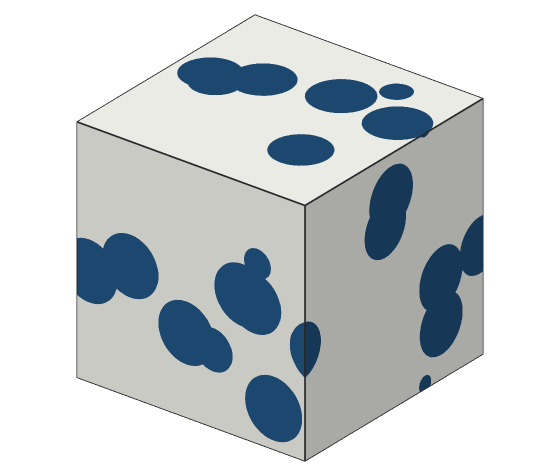
rve_multiphysics — The RVE sizes of several physics at once: bulk modulus, conductivity, swelling, loss modulus and the stress of a loading path of the same realizations (FFT).
morphogen template rve_multiphysics -o rve_multiphysics.yaml
morphogen run rve_multiphysics.yaml
Configuration
# The size of the representative volume element for several physics at once: the bulk
# modulus, the thermal conductivity, the swelling by moisture and the loss modulus at
# 10 rad/s of glass beads in a viscoelastic resin, and the stress of a loading path, on
# the same realizations (ensemble method, FFT solver). Every result can be named in
# rve.properties: scalars, <property>.<result> of tensors, couplings and harmonic
# properties, <path>.<quantity> of loading paths (a column, the strength, the work).
model:
  type: boolean_spheres
  radius: 1.0
  volume_fraction: 0.2
domain:
  periodic: true
seed: 1
voxels:
  voxel_size: 0.5
homogenization:
  method: fft
  materials:
    0:
      young: 3.0e+9
      poisson: 0.35
      conductivity: 0.2
      swelling: 0.4                        # strain per unit moisture content
      viscoelasticity: {shear: [[0.5, 0.01], [0.3, 1.0]]}
    1: {young: 70.0e+9, poisson: 0.22, conductivity: 1.0}
  properties: [bulk_modulus, conductivity, swelling, dynamic_stiffness]
  frequencies: [10.0]
  paths:
    pull: {times: [0, 1], increments: 4, strain: {"11": [0, 0.01]}}
rve:
  sizes: [4.0, 6.0, 8.0]
  realizations: [16, 8, 4]
  properties:
    - volume_fraction
    - bulk_modulus
    - conductivity
    - swelling.mean
    - dynamic_stiffness.shear_loss_1
    - pull.S11
    - pull.work
outputs:
  directory: out/rve_multiphysics
  name: spheres
Topology optimization¶
Periodic cells optimized for their homogenized properties; the images show their designs.
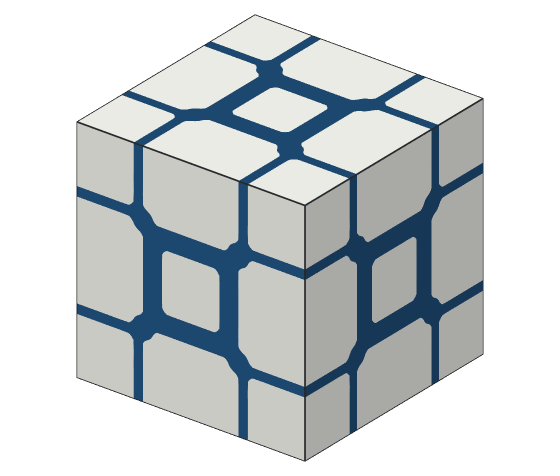
optimize_bulk — A 3D cell of maximal bulk modulus at 30 % of solid (method of moving asymptotes).
morphogen template optimize_bulk -o optimize_bulk.yaml
morphogen optimize optimize_bulk.yaml
Configuration
# Periodic cell of maximal bulk modulus at a volume fraction of 30 % (Sigmund 2000):
# 3D, cubic symmetry, method of moving asymptotes. The thresholded design reaches about
# 97 % of the Hashin-Shtrikman upper bound (0.117 E for a solid of Poisson's ratio 0.3)
# on its grid, 93 % on a grid twice as fine (optimization.json: properties and check),
# in about a minute. Other methods: oc (optimality criteria), beso (solid/void voxels)
# and hca (hybrid cellular automaton).
optimization:
  objective: bulk_modulus
  volume_fraction: 0.3
  grid: 24
  cell_size: 1.0
  material: {young: 1.0, poisson: 0.3}
  method: mma
  filter_radius: 1.5
  projection: 8.0
  symmetry: cubic
  iterations: 200
seed: 2000
outputs:
  directory: out/optimize_bulk
  name: bulk
  image: [vti]
  geometry: [json]

optimize_auxetic — A planar cell of negative Poisson’s ratio, near -0.87 (method of moving asymptotes).
morphogen template optimize_auxetic -o optimize_auxetic.yaml
morphogen optimize optimize_auxetic.yaml
Configuration
# Topology optimization of a periodic cell with a negative Poisson's ratio (auxetic),
# by inverse homogenization (Sigmund 1994) with the FFT solver: minimize C_12 / C_11 at
# a volume fraction of 35 %, the mean normal stiffness staying above 5 % of the
# Young's modulus of the solid, with the method of moving asymptotes. The cell is planar
# (one voxel through the thickness: a prismatic microstructure, in-plane properties in
# plane strain), with square symmetry. Expect a re-entrant cell with a Poisson's ratio
# near -0.87, the same on a grid twice as fine, after about a minute (optimization.json).
# Smaller filter radii or sharper projections give mechanisms whose members touch at
# corners (hinges, reported): check them on the finer grid. The json geometry can be
# meshed and homogenized like any microstructure (morphogen homogenize auxetic.json
# --size ...), and morphogen view auxetic.json --tile 3 shows the periodic pattern.
optimization:
  objective: poisson_ratio
  volume_fraction: 0.35
  grid: [64, 64, 1]
  cell_size: 1.0
  material: {young: 1.0, poisson: 0.3}
  method: mma
  filter_radius: 3.0         # voxels: minimal length scale (members of a few voxels)
  projection: 8.0            # Heaviside projection, doubled from 1 up to 8
  symmetry: cubic            # square symmetry in 2D
  iterations: 300
seed: 1994
outputs:
  directory: out/optimize_auxetic
  name: auxetic
  image: [vti]
  density: [vti]
  geometry: [json]
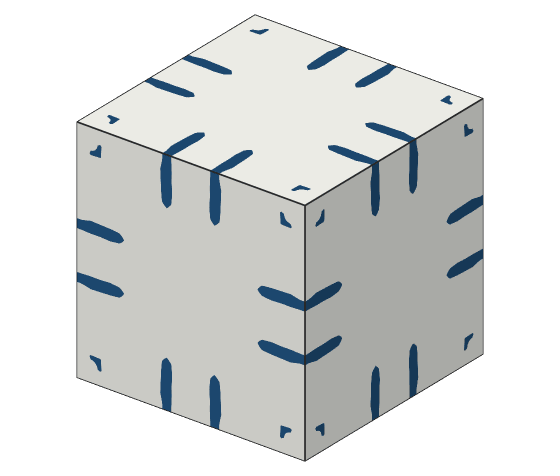
optimize_auxetic_3d — A 3D cell of negative Poisson’s ratio along its three axes, near -0.14 on 24^3 voxels (method of moving asymptotes).
morphogen template optimize_auxetic_3d -o optimize_auxetic_3d.yaml
morphogen optimize optimize_auxetic_3d.yaml
Configuration
# Topology optimization of a periodic cell with a negative Poisson's ratio in three
# dimensions (auxetic along its three axes), by inverse homogenization with the FFT
# solver: minimize C_12 / C_11 at a volume fraction of 30 %, with cubic symmetry and the
# method of moving asymptotes, on 24^3 voxels. Expect a Poisson's ratio near -0.14 (-0.2
# on a grid twice as fine: optimization.json, properties and check) after 250 iterations,
# three to eight minutes. The planar cell of optimize_auxetic reaches -0.87 in a minute:
# in space the members that fold inwards are bars, not walls, and a finer grid and more
# iterations go further. The json geometry can be meshed and homogenized like any
# microstructure, and morphogen view auxetic3d.json --tile 2 shows its three sections.
optimization:
  objective: poisson_ratio
  volume_fraction: 0.3
  grid: 24
  cell_size: 1.0
  material: {young: 1.0, poisson: 0.3}
  method: mma
  filter_radius: 2.0         # voxels: minimal length scale
  projection: 8.0            # Heaviside projection, doubled from 1 up to 8
  symmetry: cubic
  iterations: 250
seed: 1994
outputs:
  directory: out/optimize_auxetic_3d
  name: auxetic3d
  image: [vti]
  density: [vti]
  geometry: [json]
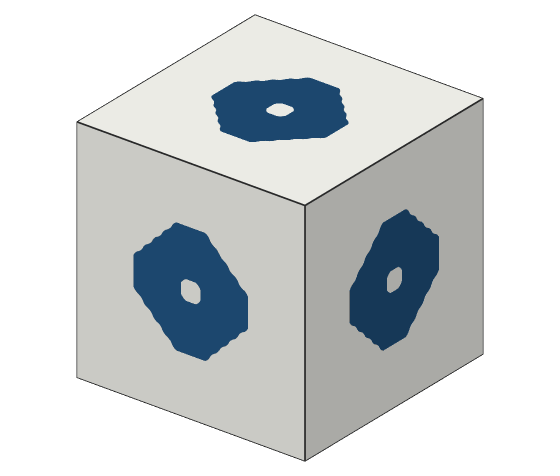
optimize_conductivity — A 3D cell of maximal conductivity at 30 % of solid (hybrid cellular automaton).
morphogen template optimize_conductivity -o optimize_conductivity.yaml
morphogen optimize optimize_conductivity.yaml
Configuration
# Periodic cell of maximal thermal conductivity at a volume fraction of 30 % by a hybrid
# cellular automaton (Tovar et al. 2006): every voxel adjusts its density to bring the
# mean stimulus (dissipation density) of its Moore neighbourhood to a common set point
# that keeps the volume. The design reaches about 88 % of the Hashin-Shtrikman upper
# bound 2 f / (3 - f) = 0.222 k on this coarse grid (87 % on a grid twice as fine), in
# about 20 seconds.
optimization:
  objective: conductivity
  volume_fraction: 0.3
  grid: 24
  material: {young: 1.0, poisson: 0.3, conductivity: 1.0}
  method: hca
  symmetry: cubic
  iterations: 150
seed: 2006
outputs:
  directory: out/optimize_conductivity
  name: conductor
  image: [vti]
  geometry: [json]
Laser-architectured sheets¶
Steel sheets architectured by localized laser treatment, their tensile test and the optimization of the laser path (morphogen laser); the images show the hardness of the parallel part of the specimen through its thickness (the mean, the upper and the lower layers) and the axes of the tracks.
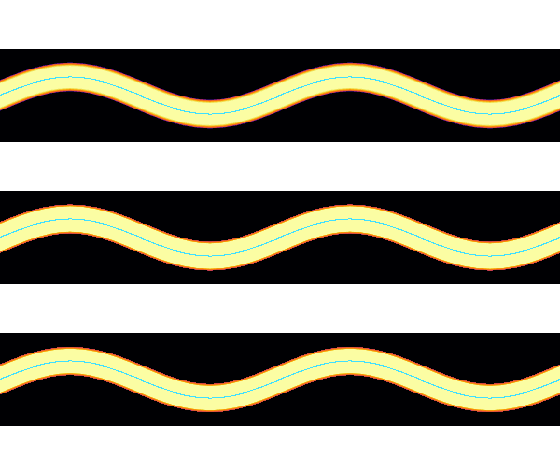
laser_corrugated — Corrugated tracks of martensite in an annealed 0.23 C steel by a double-sided laser (Wang 2022), and their amplitude and period optimized for the strength-ductility balance (Bayesian optimization).
morphogen template laser_corrugated -o laser_corrugated.yaml
morphogen laser laser_corrugated.yaml
Configuration
# Architectured sheet by localized laser treatment (morphogen laser): corrugated tracks of
# martensite in an annealed 0.23 C steel (Wang 2022, thesis ch. 5; Wang et al. 2023,
# steel res. int. 94, 2200695), their tensile test, and the optimization of their
# amplitude and period for the strength-ductility balance at a minimum yield strength.
laser_sheet:
  material: annealed_ms1500        # aisi430, dp1180, or {preset: ..., strength: [...]}
  treatment: hardening             # carburizing, nitriding, alloying (melt pool)
  configuration: symmetric         # a beam on each face (single: the upper face only)
  layers: 4                        # through the thickness
  laser:
    beam: {power: 150, speed: 10, radius: 0.5, absorptivity: 0.55}       # fibre, Gaussian
    bottom: {power: 100, speed: 10, radius: 0.6, absorptivity: 0.55, profile: tophat}  # diode
    pause: 30                      # s between tracks
  specimen: {kind: dogbone, length: 30, width: 5, thickness: 1.0}
  element: 0.5                     # mm (0.25 for a converged check)
  pattern: {kind: corrugated, count: 1, amplitude: 1.0, period: 15}
  compare:
    base: {kind: none}
    straight: {kind: straight, count: 1}
optimization:
  method: bayesian                 # grid, nelder_mead, differential_evolution, genetic
  evaluations: 24
  objective: strength_ductility    # energy, uniform_elongation, tensile_strength, yield_strength
  parameters:
    pattern.amplitude: [0.0, 2.5]  # mm
    pattern.period: [6.0, 30.0]    # mm
  constraints:
    yield_strength: [400, null]    # MPa
    min_radius: [1.5, null]        # mm: tracks curved gently (quasi-steady cycles)
  check_element: 0.25
seed: 1
outputs:
  directory: laser_corrugated
  figures: true
  fields: [vti]
  gcode: true
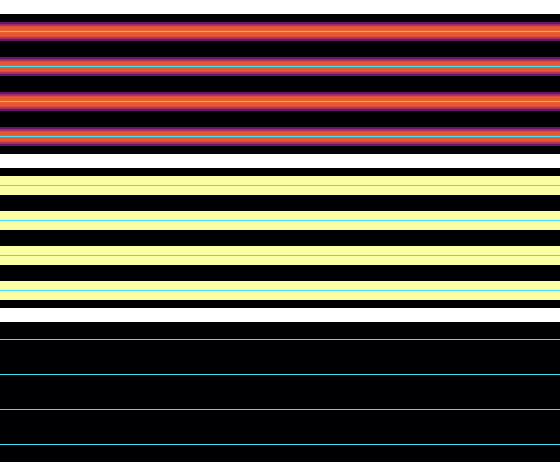
laser_bending — A strip hardened on one face by longitudinal tracks in three-point bending: the number of tracks and the power optimized for the load at a deflection of 1 mm within a budget of laser energy.
morphogen template laser_bending -o laser_bending.yaml
morphogen laser laser_bending.yaml
Configuration
# Three-point bending of a strip of annealed 0.23 C steel hardened by longitudinal laser
# tracks on its upper face only (morphogen laser): the number of tracks and the power of
# the beam optimized for the load at a deflection of 1 mm, within a budget of laser
# energy; the stiffness does not change (the hardened steel keeps its Young's modulus),
# the strength in bending does.
laser_sheet:
  material: annealed_ms1500
  treatment: hardening
  configuration: single            # the face that the load puts in compression
  layers: 6                        # the hardened depth matters in bending
  laser:
    beam: {power: 200, speed: 10, radius: 0.5, absorptivity: 0.55}
    pause: 30
  specimen: {kind: strip, length: 40, width: 10, thickness: 1.0}
  element: 0.5
  loading: {kind: bending, span: 30, deflection: 1.0}
  pattern: {kind: straight, count: 4}
  compare:
    base: {kind: none}
optimization:
  method: bayesian
  evaluations: 20
  objective: bending_load_at_deflection
  parameters:
    pattern.count: [1, 8, true]
    beam.power: [100.0, 300.0]     # W
  constraints:
    laser_energy: [null, 6000]     # J (the tracks are 50 mm long at 10 mm/s)
    melted_fraction: [null, 0.05]
seed: 1
outputs:
  directory: laser_bending
  figures: true
  fields: [vti]
  gcode: true
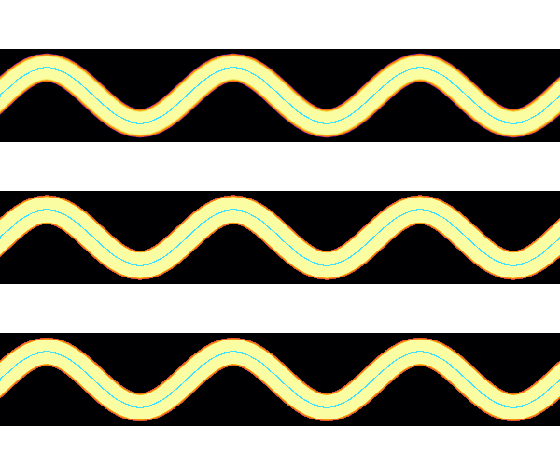
laser_cells — The corrugated track of Wang et al. (2023) drawn by a 1 mm spot on cells of 0.5 mm and changed by a cellular automaton (neighbour exchanges tested by finite elements) for the failure strain at a tensile strength of 700 MPa, the martensite brittle; its tracks treated by the laser.
morphogen template laser_cells -o laser_cells.yaml
morphogen laser laser_cells.yaml
Configuration
# Cellular design of a laser-architectured sheet (morphogen laser; docs/laser.md, §6): the
# corrugated track of martensite of Wang et al. (2023, steel res. int. 94, 2200695) drawn
# by a 1 mm spot on cells of 0.5 mm, then changed by a cellular automaton (neighbour
# exchanges tested by finite elements, periodic and symmetric, treatable by the spot) for
# the failure strain at a tensile strength of at least 700 MPa; the phases of the paper
# with the fracture of the martensite; the tracks of the result treated by the laser.
laser_sheet:
  material: annealed_ms1500        # the process model of the tracks of the result
  configuration: symmetric         # a fibre beam above, a diode below
  layers: 4
  laser:
    beam: {power: 150, speed: 10, radius: 0.5, absorptivity: 0.55}
    bottom: {power: 100, speed: 10, radius: 0.6, absorptivity: 0.55, profile: tophat}
  specimen: {kind: dogbone, length: 30, width: 5, thickness: 1.0}
  element: 0.5                     # mm
  pattern: {kind: corrugated, count: 1, amplitude: 1.5, period: 10}
  compare:
    straight: {kind: straight, count: 1}
cellular:
  phases: wang                     # ferrite and martensite (Hollomon laws), brittle martensite
  size: 0.5                        # mm, the cells
  objective: ductility             # the failure strain (fracture of the martensite or necking)
  constraints:
    tensile_strength: [700, null]  # MPa
  start: {amplitude: 1.5, period: 10}  # the track of the pattern above, drawn by the spot
  method: exchange                 # swap (BESO rule), hca, topology
  symmetry: [point]
  period: 10                       # mm: the cells change by periods of the pattern
  min_width: 2                     # cells: the 1 mm spot
  candidates: 6                    # moves tested by finite elements per iteration
  iterations: 30
  realize: true                    # the tracks of the result treated by the laser
seed: 1
outputs:
  directory: laser_cells
  figures: true
  fields: [vti]
  gcode: true
Couplings and the whole chain¶
Transient diffusion in a microstructure, and every step from the model to the figures and videos.
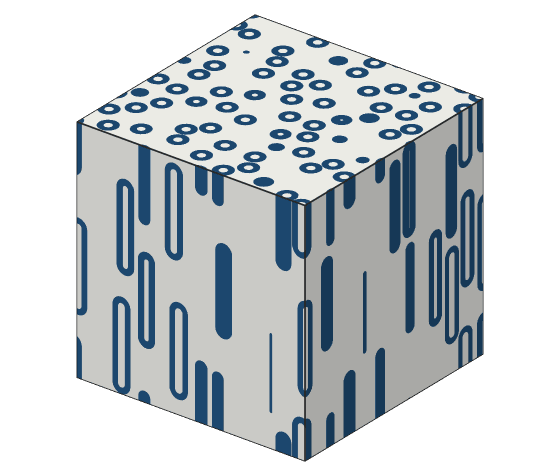
diffusion — Moisture uptake of a composite of hollow flax-like fibres exposed on two faces.
morphogen template diffusion -o diffusion.yaml
morphogen run diffusion.yaml
Configuration
# Moisture uptake of a fibre composite: flax-like hollow fibres (lumens in phase 0, here
# the matrix) aligned along z in a polymer, the plate exposed on its faces x- and x+ to a
# humidity raised from 0 to 1 in an hour, then held. Each phase has its diffusivity and
# its solubility (the concentration at equilibrium with the outside activity 1); the
# activity is continuous across the interfaces. Outputs: the uptake curve
# (fibres_0000_diffusion.csv: mean concentration, its ratio to saturation, the mean of
# each phase) and the concentration fields at the times (.vti). Units: mm and s.
model:
  type: hardcore_fibers
  radius: 0.04
  length: 0.3                      # shorter than half the periodic box
  orientation: {type: aligned, direction: [0, 0, 1]}
  volume_fraction: 0.3
  lumen: 0.4
domain:
  size: 1.0
  periodic: true
seed: 5
voxels:
  shape: 48
diffusion:
  phases:
    0: {diffusivity: 1.0e-6, solubility: 0.02}   # polymer matrix
    1: {diffusivity: 5.0e-6, solubility: 0.15}   # fibre walls, more hygroscopic
  exposed: [x-, x+]                # the other faces: periodic (impermeable if not periodic)
  activity: {times: [0, 3600], values: [0, 1]}
  times: [600, 3600, 36000, 360000]
  steps: 30
  fields: true
outputs:
  directory: out/diffusion
  name: fibres
analysis: [volume_fraction]
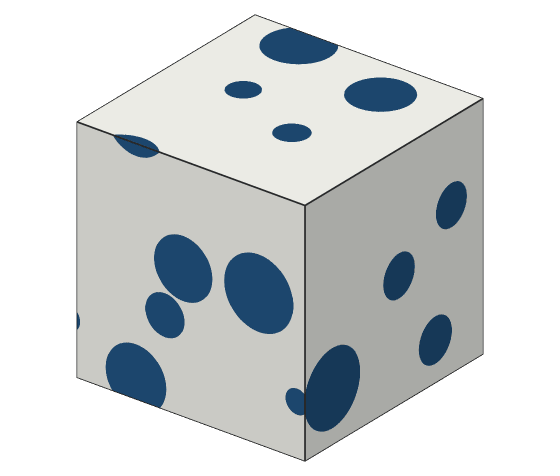
workflow — The whole chain: model, voxels, conforming mesh, homogenization, a loading path, tables, figures and videos.
Needs the mesher MMG (extra mesh), VTK and ffmpeg (extra video).
morphogen template workflow -o workflow.yaml
morphogen run workflow.yaml
Configuration
# The whole chain on one example: a morphological model (stiff SiC spheres in an
# elasto-plastic aluminium alloy), its voxel image and conforming mesh, the apparent shear
# modulus and a tension path computed by finite elements on the mesh, and the exports:
# tables (csv, txt, xlsx), figures (png, svg, pdf, TikZ) and videos (mp4) of the image,
# the mesh and the fields (von Mises stress on the deformed mesh, cumulated plastic
# strain). The 3D views need VTK and the mp4 videos ffmpeg: pip install 'morphogen[video]'.
model:
  type: hardcore_spheres
  radius: 0.8
  volume_fraction: 0.2
domain:
  size: 5.0
  periodic: true
seed: 7
voxels:
  shape: 48
mesh:
  size: 0.8
homogenization:
  materials:
    0:                                   # aluminium alloy (MPa)
      young: 70000
      poisson: 0.33
      plasticity: {yield: 100, isotropic: [{Q: 80, b: 20}]}
    1: {young: 400000, poisson: 0.2}     # SiC particles
  boundary_conditions: [periodic]
  properties: [shear_modulus]            # its fields: a unit shear
  paths:
    tension:                             # 1 % in 10 steps, the lateral stresses free
      times: [0, 1]
      increments: [10]
      strain: {"11": [0, 0.01]}
outputs:
  directory: out/workflow
  name: composite
  geometry: [json]
  image: [vti]
  conforming_mesh: [vtu]
  tables: [txt, xlsx]                    # results, homogenization, curves (besides .csv)
analysis: [volume_fraction, specific_surface]
visualization:
  realizations: 1                        # figures and videos of the first realization
  cmap: viridis
  size: [800, 600]                       # pixels of the 3D views and videos
  figures:
    - {of: image, formats: [png, svg, tex]}                 # three sections (TikZ: LaTeX)
    - {of: mesh}                                            # 3D view coloured by phase
    - {of: shear_modulus.periodic, color: von_mises, section: {axis: 2, fraction: 0.5}}
    - {of: tension.periodic, formats: [pdf, tex]}           # its curves
    - {of: tension.periodic, kind: field, color: p}         # plastic strain at the end
  videos:
    - {of: image, kind: orthoslices, mode: bounce}          # as the orthoslices of Avizo
    - {of: mesh, kind: turntable}
    - {of: mesh, kind: sweep, axis: 0}                      # a cross-section sweeping
    - {of: shear_modulus.periodic, wave: sine, mode: loop, repeat: 3, part: fluctuation}
    - {of: tension.periodic, color: von_mises, frames: 60, section: {axis: 1, fraction: 0.5}}