morphoGen
Virtual microstructures for the mechanics and physics of materials.
morphoGen generates random and architected media from models of stochastic geometry, describes them exactly, measures them against theory, computes their properties up to their fracture, and tells how large a volume must be to represent them. A Python package, a command line and a graphical interface in the web browser; free software (GNU GPL v3 or later).
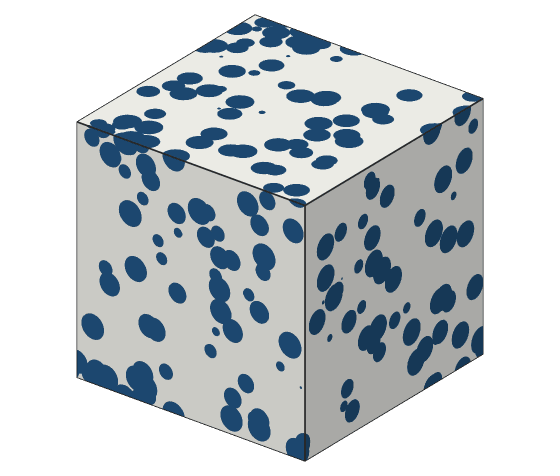
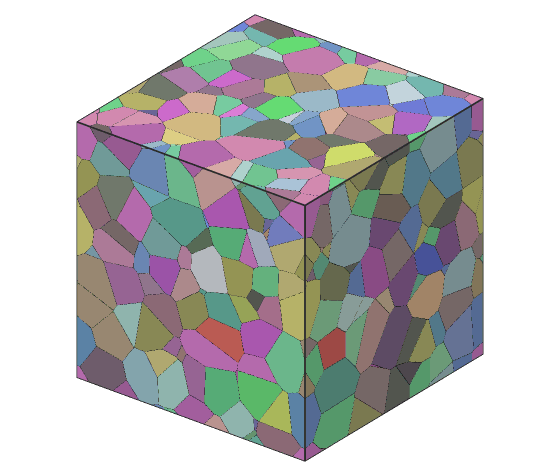
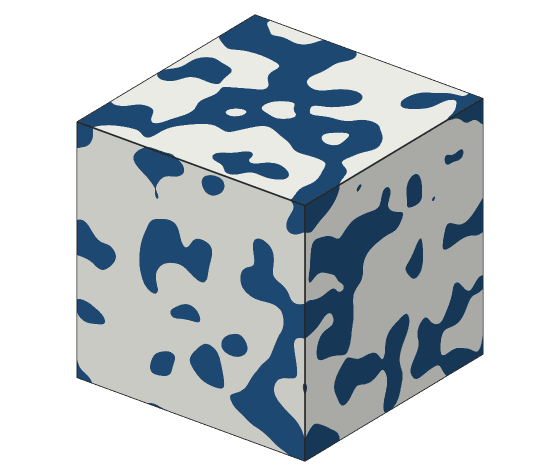
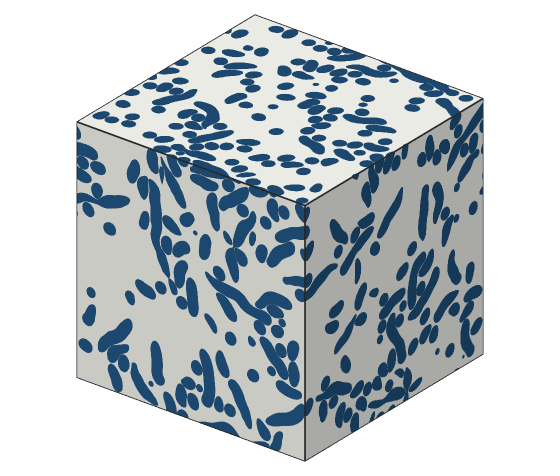
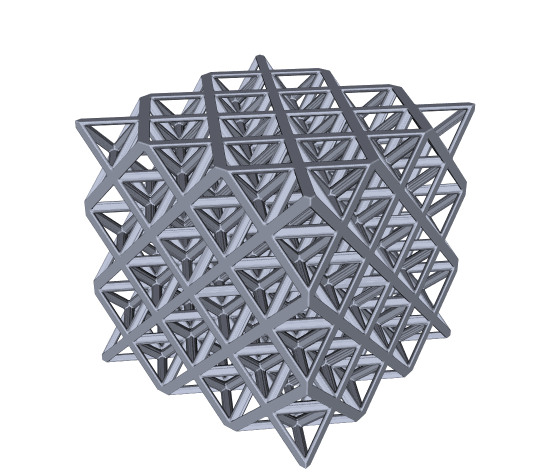
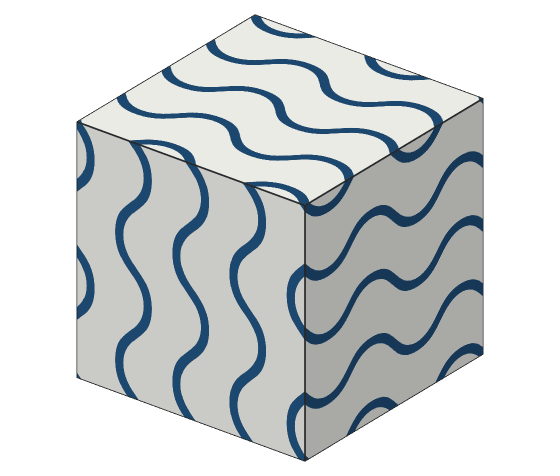
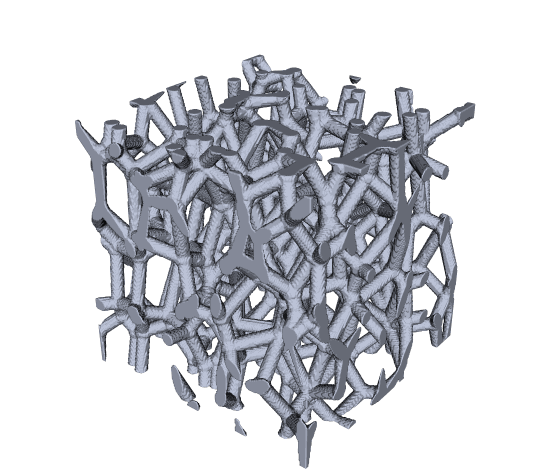
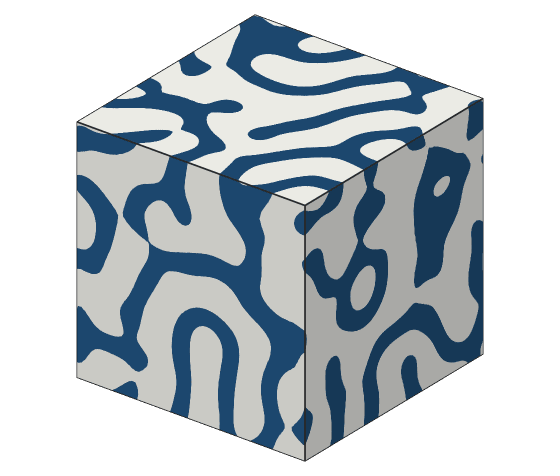
The steps of a study
40 models of random and architected media: Boolean models, packings, fibres, tessellations, Gaussian fields, dead leaves, automata and growths, lattices, foams, triply periodic surfaces, bio-inspired structures; periodic or not, combined, nested.
A realization is a description (centres, axes, cells) with an implicit function for each phase: sections, surfaces and conforming meshes are cut from it at any resolution, not from voxels.
Fractions, specific surface, covariance, chords, tortuosity, percolation thresholds, stereology, textures…, each beside the closed form of its model when there is one.
Elastic, thermal, electrical, dielectric, magnetic and diffusive properties, their weak and strong couplings, harmonic regimes, waves, flow and sound: an FFT solver on voxels (CPU or GPU), finite elements on conforming meshes, extended finite elements.
Plasticity, crystal plasticity, viscoelasticity, hyperelasticity, damage and MFront laws along loading paths, in small or finite strains; macroscopic laws identified, reduced or learned from the responses.
The phase field of fracture on voxel images, cohesive zones, cracks of any surface and front, ductile growth; contact, self-contact and friction; high-cycle fatigue.
Size the representative volume
The statistics of Kanit et al. (2003) for every property: the variance against the volume, the integral range, the volume and the number of realizations for a precision.
Periodic cells optimized for their homogenized properties, compatible assemblies of building blocks, lattices with defects and their rigidity, holes shaped on their exact geometry, patterns after buckling.
Applications and tools
Localized laser treatments: the thermal cycles of the tracks, the phases they leave, the tensile test of the specimen, the path optimized for strength and ductility.
Explicit dynamics with OpenRadioss: the crushing, tension, shear and impact of a morphology at the rates of crashes, shocks and drops.
Python functions, configuration files run from the command line (in parallel, on clusters), or the forms of the graphical interface: the same computations, the same files.
Meshes, images, behaviours and results for Abaqus and CalculiX, AMITEX_FFTP, MFront, Z-set, Gmsh, Neper, DAMASK, FEniCSx and ParaView.
A first study
A model, a realization, its voxels, a measure against theory and three apparent properties, in a second:
import morphogen as mg
from morphogen.homogenization import Material, homogenize

model = mg.models.BooleanSpheres(radius=1.0, volume_fraction=0.3)
micro = model.generate(mg.Domain.cube(8.0, periodic=True), seed=1)  # centres and radii
image = micro.voxelize(shape=32)  # 32³ voxels: phase 0 (matrix), phase 1 (spheres)
theory = model.theory()
print(mg.analysis.volume_fraction(image), theory["volume_fraction"])  # 0.29 for 0.3

phases = {
    0: Material(young=3.0, poisson=0.35, conductivity=0.2),  # a polymer: GPa, W/(m K)
    1: Material(young=70.0, poisson=0.22, conductivity=1.0),  # glass
}
properties = ["bulk_modulus", "shear_modulus", "conductivity"]
out = homogenize(image, phases, properties=properties)
print({name: result.value for name, result in out.items()})  # 5.89, 2.59 (GPa), 0.33
The same from a configuration file, or from forms:
morphogen template homogenization_spheres -o study.yaml  # an example to start from
morphogen run study.yaml                                 # realizations and properties
morphogen gui                                            # the interface, in the browser
Where to go next
To… |
read |
|---|---|
install morphoGen |
|
learn it by a study |
the tutorials: a whole study, the size of the representative volume, a rubber, exact geometry, isogeometric analysis, contact and damage, fracture, textures, the interface |
go through the steps of a study |
the user guide, a page for each step |
get a quick answer |
the recipes and the questions and troubles |
know what is computed, and by which solver |
|
start from an example |
the gallery: a card per template, with its image and its configuration |
find a key of a configuration or a command |
|
look up a function or a class |
the API reference |
read the formulas and how they are checked |
the theory notes |
check what a word means here |
the glossary |
see what changed |
the change log |